ICSE-X-HistCivics
Previous Year Paper year:2019
- #7-a
- #7-a-iIdentify’ the Memorial built for those who were killed in this incident. [3]
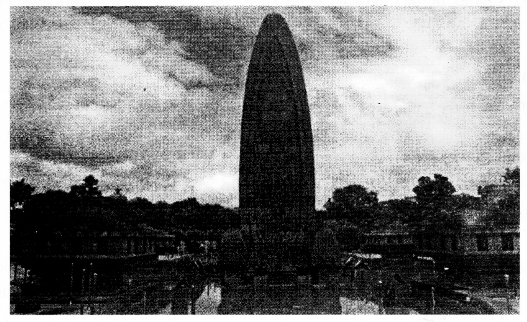
Ans : Jallianwalabagh.
- #7-a-iiWhere did this incident take place ?Ans : Amritsar.
- #7-a-iiiName the movement launched by Gandhi in 1920 as a consequence.Ans : Non-cooperation movement.
- #7-bExplain briefly the reason for the suspension of this particular movement by Gandhi in 1922. [3]Ans : (1) Violent Incident : The Movement was suspended by Gandhiji due to the ugly incident which took place in Chauri Chaura village of Uttar Pradesh in which 22 policemen were burnt alive by a mob. Gandhiji took a serious view of this incident. He felt that the nationalist workers had not yet properly understood the philosophy of non-violence. Non-violence was creed to Gandhiji who could hardly tolerate that his followers should indulge in violence. So he took the step of suspending the movement.
(2) In 1922, there was a revolution in Turkey. Turkey became a republic, so after the revolution the movement lost its importance.
- #7-cState any four impacts of the movement. [4]Ans : (i) Establishment of New Educational Institutions : The Non-Cooperation Movement gave a boost to the Indian Education System. A new programme of national education was started. Institutions such as the Jama Millia and the Kashi Vidyapeeth were established.
(ii) Mass Movement : The Movement gave rise to the sentiments of nationalism on a wider scale. When thousands and thousands of people walked together shoulder to shoulder and resisted the British for months, the National Movement naturally became quite wider in its scope. It was no longer limited to only few educated urban people.
(iii) Unity : This was the first major Movement in which the Hindus and the Muslims participated as one, and scenes of ffatemality (friendly relations) were witnessed all over the country.
(iv) Change in the Character of the Congress : The Movement had a great impact on the working of the Congress. The Congress decided to use the weapons of Satyagraha and Non-Cooperation on wider scale.
- #8-aState any three features of the Programme of the Civil Disobedience Movement launched in 1930. [3]Ans : (i) Mahatma Gandhi found in salt a powerful symbol that could unite the nation. Salt was something consumed by the rich and the poor alike, and it was one of the most essential items of food.
(ii) The Civil Disobedience Movement caused a tide of patriotic fervor in the country. People became fully aware of their responsibilities and the Movement succeeded in creating political awakening among the masses.
(iii) The Movement had a healthy impact upon the social conditions. The ‘Harijan Sevak Sangh’ was established which helped the untouchables to obtain the basic rights. The depressed classes were given entry into churches, temples.
- #8-bWhat was the significance of the Second Round Table Conference held in 1931 ? [3]Ans : The Second Round Table Conference was held in London in September, 1931. Gandhiji was chosen as the sole representative of the Congress. All sections of the Indian society were represented at the Conference.
Gandhiji demanded a responsible Government and Independence for India and immediate Dominion Status for India.
Cause of the Failure : The representatives of other groups like Muslims, Sikhs, Christians, etc. were more concerned about safeguarding their own rights and their narrow interests. The Conference could not arrive at any agreement regarding communal representation and ended inconclusively.
- #8-cState any four clauses of the Cabinet Mission Plan of 1946. [4]Ans : (i) Division of the Country : The country would be divided into two Dominions i. e., India and, Pakistan.
(ii) The Constituent Assembly : The existing Constituent Assembly would continue to work, but the Constitution framed by it would not be applied to Pakistan. A separate Constituent Assembly would be constituted for those parts which decided in favour of partition.
(iii) The Princely States : The Princely States would be free to choose their own option, and treaties signed with them would soon come to an end.
(iv) A Boundary Commission: A Boundary Commission would be set up to decide about the boundary disputes.
- #9-aSate any three reasons for the Rise of Fascism in Italy. [3]Ans : 1. First World War: The war had caused a great economic strain on Italy’s economy
- Thousands of soldiers, discharged from army, were unemployed after the war.
- There was a steep price rise and inflation in the country.
- There were frequent strikes as the workers were dissatisfied which led to reduction in production.
2. Political instability : In 1919, a Parliamentary Government, based on male adult franchise, was introduced in Italy for the first time. But the electorates failed to give a clear majority to any political party. There came series of short-lived coalition governments in Italy, with neither consistency nor continuity in the policies. These governments were unable to deal effectively with the frequent strikes and riots in the country.
3. Mistreatment after the War : Italy had joined the First World War on the side of Britain and France in 1915. She hoped to get large territories such as Trentino, Trieste, Istria, Fiume, Coastal regions of Dalmatia, Albania and some parts of Germany and Turkey after their victory. But the Paris Peace Treaties gave her nothing from the defeated German and Turkish empires. So among the Italians a feeling developed that they “had won the war, but lost the peace”. Italians felt badly cheated by their War-time Allies.
- #9-bExplain any three consequences of World War II. [3]Ans : (i) Though England and France were victors, their status and economic position was lowered. The large scale production, minimum loss during the war and possession of atom bomb made the USA as one of the Super Powers of the world. Another Super Power was the Soviet Union.
(ii) The USA
: By using the atom bomb to crush Japan, she emerged as a super military and economic power.
(iii) The Soviet Union : The Russian empire was greatly expanded. It included half of Poland, Ethunia, Latavia, Lithuania, Finland and many parts of Germany. It also emerged as a dominant power in world politics and occupied position of a leader of the Communist Bloc. Two Power Blocs emerged after the Second World War. They were:
- The American Bloc
- The Soviet Bloc
(iv) The horrors of the two World Wars and failure of the League of Nations forced the Allied powers to create another body by the name of the United Nations Organisation. The United Nations was established on October 24, 1945 with its headquarters at the New York, the USA to save the coming generation from the scourge of another War.
- #9-cName the two rival blocs that fought against each other during World War II and state its signatory countries. [4]Ans : American bloc and Soviet bloc
Countries :
- American Bloc: USA, British, France
- Soviet Bloc: Poland, Hungary, Bulgaria and Romania
- Qstn #10The necessity to maintain International peace led to the establishment of the United Nations Organisation. With reference to the statement, answer the following: