ICSE-X-Biology
Previous Year Paper year:2012
- #3: (a) Given below is the diagram of a cell as seen under the microscope after having been placed in a solution:
 (a) What is the technical term used for the state icondition of the cell given above ? (a) Give the technical term for the solution in which the ceil was placed. (a) Name, the parts numbered 1 to 4. (a) Is the cell given above a. plant cell or an animal cell ? Give two reasons in support of your answer as evident from the diagram. (a) What would you do to bring this cell back to it original condition ? (b) Differentiate between the following pairs on the basis of what is mentioned in brackets: (b) Natality and Mortality (definition) (b) Stoma and Stroma (describe its structure.) (b) Acromegaly and Cretinism (symptoms) (b) Transpiration and Guttation (structures involved) (b) Diabetes mellitus and Diabetes insipidus (reason) cause). (a) Given below is the diagram of a cell as seen under the microscope after having been placed in a solution:
(a) What is the technical term used for the state icondition of the cell given above ? (a) Give the technical term for the solution in which the ceil was placed. (a) Name, the parts numbered 1 to 4. (a) Is the cell given above a. plant cell or an animal cell ? Give two reasons in support of your answer as evident from the diagram. (a) What would you do to bring this cell back to it original condition ? (b) Differentiate between the following pairs on the basis of what is mentioned in brackets: (b) Natality and Mortality (definition) (b) Stoma and Stroma (describe its structure.) (b) Acromegaly and Cretinism (symptoms) (b) Transpiration and Guttation (structures involved) (b) Diabetes mellitus and Diabetes insipidus (reason) cause).Ans : (a) (a) Plasmolysed (a) Hypertonic solution (a) (1) Nucleus (2) Chloroplast (3) Vacuole (4) Hypertonic solution (a) Plant cell. Because
(1.) Clear distinct cell wall is seen
(2.) Chloroplast clearly seen in. the cytoplasm.
(3.) Centrosome not seen. (a) Place it on a hypotonic medium or plain water for some time. (b) (b) Natality - Number of live births per 1000 per year.
Mortality - Number of deaths per 1000 per year. (b) Stoma - The opening in the stomata through which transpired water and respiratory gases pass.
Stroma - It is the part/region in the chloroplast where dark reaction of photosynthesis takes place. (b) Acromegaly - Overgrowth of certain parts of body like cheek bones etc. due to oversecretion of growth hormone in adults.
Cretinism - Dwarfism and mental retardation due to undersecretion of thyroxine in children. (b) Transpiration - Stomata/cuticle/lenticels.
Guttation - Hydathodes. (b) Diabetes mellitus - Undersecretion of insulin due to which level of glucose increases in blood.
Diabetes insipidus - Undersecretion of Antidiuretic hormone due to which reabsorption of water from kidney tubules becomes less. (a) (a) Plasmolysed (a) Hypertonic solution (a) (1) Nucleus (2) Chloroplast (3) Vacuole (4) Hypertonic solution (a) Plant cell. Because
(1.) Clear distinct cell wall is seen
(2.) Chloroplast clearly seen in. the cytoplasm.
(3.) Centrosome not seen. (a) Place it on a hypotonic medium or plain water for some time. (b) (b) Natality - Number of live births per 1000 per year.
Mortality - Number of deaths per 1000 per year. (b) Stoma - The opening in the stomata through which transpired water and respiratory gases pass.
Stroma - It is the part/region in the chloroplast where dark reaction of photosynthesis takes place. (b) Acromegaly - Overgrowth of certain parts of body like cheek bones etc. due to oversecretion of growth hormone in adults.
Cretinism - Dwarfism and mental retardation due to undersecretion of thyroxine in children. (b) Transpiration - Stomata/cuticle/lenticels.
Guttation - Hydathodes. (b) Diabetes mellitus - Undersecretion of insulin due to which level of glucose increases in blood.
Diabetes insipidus - Undersecretion of Antidiuretic hormone due to which reabsorption of water from kidney tubules becomes less.
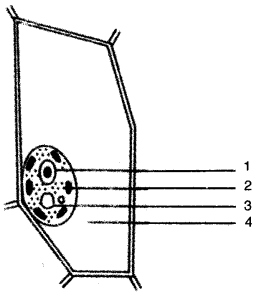
- #3-a [5]Given below is the diagram of a cell as seen under the microscope after having been placed in a solution:
- #3-a-iWhat is the technical term used for the state icondition of the cell given above ?Ans : Plasmolysed
- #3-a-iiGive the technical term for the solution in which the ceil was placed.Ans : Hypertonic solution
- #3-a-iiiName, the parts numbered 1 to 4.Ans : (1) Nucleus (2) Chloroplast (3) Vacuole (4) Hypertonic solution
- #3-a-ivIs the cell given above a. plant cell or an animal cell ? Give two reasons in support of your answer as evident from the diagram.Ans : Plant cell. Because
(1.) Clear distinct cell wall is seen
(2.) Chloroplast clearly seen in. the cytoplasm.
(3.) Centrosome not seen.
- #3-a-vWhat would you do to bring this cell back to it original condition ?Ans : Place it on a hypotonic medium or plain water for some time.
- #3-b [5]Differentiate between the following pairs on the basis of what is mentioned in brackets:
- #3-b-iNatality and Mortality (definition)Ans : Natality - Number of live births per 1000 per year.
Mortality - Number of deaths per 1000 per year.
- #3-b-iiStoma and Stroma (describe its structure.)Ans : Stoma - The opening in the stomata through which transpired water and respiratory gases pass.
Stroma - It is the part/region in the chloroplast where dark reaction of photosynthesis takes place.
- #3-b-iiiAcromegaly and Cretinism (symptoms)Ans : Acromegaly - Overgrowth of certain parts of body like cheek bones etc. due to oversecretion of growth hormone in adults.
Cretinism - Dwarfism and mental retardation due to undersecretion of thyroxine in children.
- #3-b-ivTranspiration and Guttation (structures involved)Ans : Transpiration - Stomata/cuticle/lenticels.
Guttation - Hydathodes.
- #3-b-vDiabetes mellitus and Diabetes insipidus (reason) cause).Ans : Diabetes mellitus - Undersecretion of insulin due to which level of glucose increases in blood.
Diabetes insipidus - Undersecretion of Antidiuretic hormone due to which reabsorption of water from kidney tubules becomes less.