ICSE-X-Biology
Previous Year Paper year:2016
- #4-b-iiiThe vein which drains the blood from the intestine to the liver.Ans : Hepatic portal vein
- #4-b-ivThe canal through which the testes descend into the scrotum just before
the birth of a male baby.Ans : Inguinal canal
- #4-b-ixThe process of uptake of mineral ions against the concentration gradient
using energy from the cell.Ans : Active absorption
- #4-b-vThe process causing an undesirable change in the environment.Ans : Pollution
- #4-b-viiThe repeating components of each DNA strand lengthwise.Ans : Nucleotide
- #4-b-viiiAn alteration in the genetic material that can be inherited.Ans : Mutation
- #4-b-xBlood vessels carrying blood to the left atrium.Ans : Plumonary veins
- #5
- #5-a [5]The given diagram shows a stage during mitotic division in an animal cell :

- #5-a-iIdentify the stage. Give a reason to support your answer.Ans : Prophase
Reason : Chromosomes clearly visible as paired chromatids connected by centromere. Centrosome split into centrioles and are moving to opposite poles. Nuclear membrane and nucleolus disappearing. Chromosomes not arranged in any pattern.
- #5-a-iiDraw a neat labelled diagram of the cell as it would appear in the next
stage. Name the stage.Ans :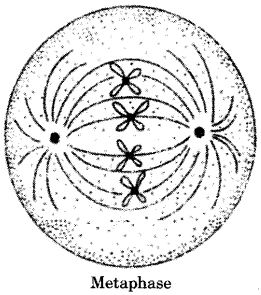
- #5-a-iiiIn what two ways is mitotic division in an animal cell different from the
mitotic division in a plant cell?Ans :Mitotic in Plant cell Mitotic in Animal cell 1. Centrosome and centrioles absent. 1. Centrosome and centriole present 2. Cell plate developing from centre and glowing towards periphery during cytokinesis. 2. Cell furrow developing from periphery grows towards centre during cytokinesis.
- #5-a-ivName the type of cell division that occurs during :
A. Growth of a shoot
B. Formation of pollen grains.Ans : A - Mitosis.
B - Meiosis.
- #5-b [5]Give scientific reasons for the following statements :