ICSE-X-Biology
Previous Year Paper year:2011
- #2-a-iiiName the stages involved in the formation of urine.Ans : Ultrafiltration Selective reabsorption Tubular secretion
- #2-a-ivWhat is the technical term given to the process occurring in 2 and 3?
Briefly describe the process.Ans : Ultrafiltration.
Blood rich in nitrogenous waste and excess water enters Bowmans Capsule through a wider afferent arteriole then splits into fine capillaries called glomerulus due to which a hydrostatic pressure is created. This pressure leads to filtration of water with nitrogenous wastes.
- #2-bGive reasons for the following:
- #2-b-iPeople living in hilly regions usually suffer from simple goitre.Ans : Photosynthesis process leads to release of oxygen which is essential for all life on earth. It also produces food for all heterotrophs.
- #2-b-iiUrine is slightly thicker in summer than in winter.Ans : Lack of nucleus helps in having more surface area for absorption and transport of oxygen.
Lack of mitochondria helps in the way that RBC would not consume any oxygen that it is transporting.
- #2-b-iiiPotato cubes when placed in water become firm and increase in size.Ans : Water is a hypotonic medium, so endosmosis occurs due to which water enters into potato cells making them firm and larger in size i.e., making them turgid.
- #2-b-ivA matured mammalian erythrocyte lacks nucleus and mitochondria.Ans : In summer, body loses large amount of water by perspiration or direct evaporation. So blood is order to maintain its osmotic concentration reabsorbs large amount of water from the tubules of Nephron due to which there is less water left to be released as urine. So urine becomes thicker whereas in winter, there is less reabsorption. So thin urine is passed.
- #2-b-vPhotosynthesis is considered as a process supporting all life on Earth.Ans : In hilly areas there is scarcity of iodine in the soil and in their diet. Deficiency of iodine leads to simple goitre.
- #3 [10]
- #3-aStudy the diagram given below and answer the following questions:
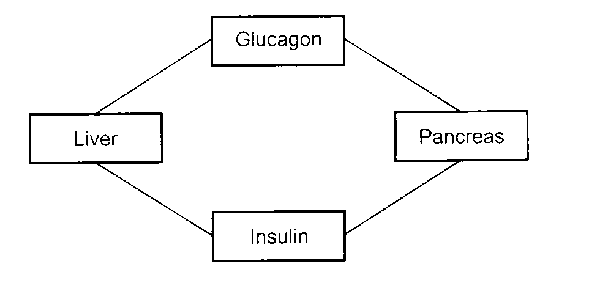
- #3-a-iName the pancreatic cells which produce (1) glucagon and (2) insulin.Ans : (1.) Glucagon-Produced in alpha cells of pancreas.
(2.) Insulin-Produced in beta cells of pancreas.
- #3-a-iiState the main function of (1) glucagon and (2) insulin.Ans : (1.) Glucagon-It helps to convert glycogen to glucose when blood glucose level falls.
(2) Insulin-It helps to convert excess glucose to glycogen when there is higher level of glucose in blood.
- #3-a-iiiWhy is the pancreas referred to as an exo-endocrine gland?Ans : It is both exocrine as well as endocrine gland. As exocrine, it secretes pancreatic juice containing digestive enzymes and pour them into duodenum part of intestine through pancreatic duet. As endocrine, it secretes hormones like insulin, glucagon and somatostatin and pour them directly into blood.
- #3-a-ivWhy is insulin not given orally but is injected into the body?Ans : Insulin is a protein by composition so if it is given orally it will get digested in the stomach and will not be able to perform its function.
- #3-a-vWhat is the technical term for the cells of the pancreas which produce endocrine
hormones?Ans : Islets of Langerhans.