ICSE-X-Biology
Previous Year Paper year:2019
- #6-a-ivState Mendel’s Law of Dominance.Ans : In a heterozygous condition, out of the two contrasting alleles, one expresses itself morphologically and other remains unexpressed. The factor which expresses itself phenotypically is called dominant and the other which remains unexpressed is called recessive.
- #6-a-vWhat is a Dihybrid Cross?Ans : A cross between two individuals having two pairs of contrasting traits producing a generation in which all individuals are heterozygous for both the characters.
- #6-bGiven below is a diagram representing a stage during the mitotic cell division. Study the diagram and answer the following questions :
[5]
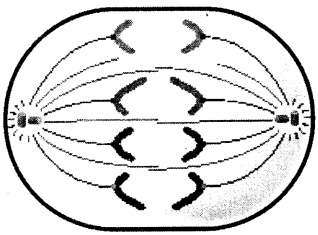
- #6-b-iIdentify the stage by giving a suitable reason.Ans : Anaphase: Two sister chromatids move towards opposite poles.
- #6-b-iiIs it a plant or an animal cell ? Give a reason to support your answer.Ans : Animal cell: No cell wall; presence of centrioles at opposite poles.
- #6-b-iiiDraw a neat, labelled diagram of the stage which follows the one shown in the diagram.Ans :
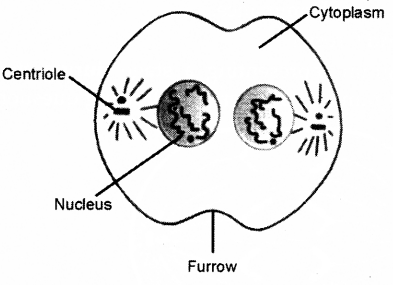
- #6-b-ivHow many chromosomes will each daughter cell have after the completion of the above division ?Ans : Four
- #6-b-vName the four nitrogenous bases.Ans : Adenine, Guanine, Cytosine, Thymine
- #7
- #7-aAnswer the following questions briefly :
[5]
- #7-a-iHow are the cytons and axons placed in the brain and the spinal cord ?Ans : In brain, outer portion contains cyton which gives a grayish colour hence called as gray matter, while axon is inside.
In spinal cord, cyton’is inside forming gray matter and axon is outside forming white matter.
- #7-a-iiWhich part of the human ear gives ‘Dynamic balance’ and ‘Static balance’ to the body ?Ans : Dynamic balance - semicircular canal
Static balance - utriculus and sacculus (vestibule)
- #7-a-iiiExplain how the human eye adapts itself to bright light and dim light.Ans : When a person moves from dark lighted area to brightly lighted area, visual purple of rods is bleached reducing their sensitivity and pupil constricts to reduce the amount of light entering eyes. This is light adaptation.
When a person moves from brightly lighted area to dark area, visual purple of rods which were earlier broken due to bright light regenerates and pupil dilates to allow more light to enter. This is dark adaptation.
- #7-a-ivWhat is Parthenocarpy ? Give one example.Ans : Development of fruit without fertilization, e.g., Apple, banana, tomato.
- #7-a-vMention any two objectives of ‘Swachh Bharat Abhiyan’.Ans :
- Eliminate open defecation by constructing community toilets.
- Neat and Clean India