ICSE-X-Biology
Previous Year Paper year:2019
- #1-i-ivState one measure to control this pollution.Ans : We should treat the poisonous substances and discharge materials and toxic substances coming out of the homes and factories before discharging them into the rivers and ponds. We should not mix petroleum substances in the water. Dead bodies should not be thrown in the river. We should set more and more sewage treatment plants that play a crucial role in the reclaimed polluted water. Effective steps should be taken to outlaw dumping of wastes into a river or other water sources.
- #1-i-vWhat is a ‘Pollutant’? Explain the term.Ans : Agents causing pollution are called pollutants.
Example, Gaseous pollutants are so2, co2 and co.
Chemical pollutants like fertilizers, pesticide and insecticide.
- #Section : II(40 Marks)
Attempt any four questions from this Section.
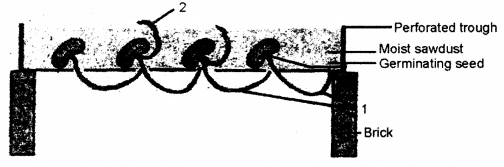
- Qstn #2Given below is an experimental setup to demonstrate a particular tropic movement in germinating seeds. Study the diagram and answer the questions that follow :
[5]
- #2-a
- #2-a-iLabel the parts 1 and 2.Ans : 1 - Radicle 2 - Plumule
- #2-a-iiName the tropic movement shown by part 1.Ans : Hydrotropism
- #2-a-iiiPart 1 is affected by two stimuli. Name them. Which one of the two is stronger?Ans : Gravity and Water - Water is stronger.
- #2-a-ivWhat is Thigmotropism ? Give one example.Ans : Growth movement of plants in response to touch stimulus, e.g., Sweet Pea
- #2-a-vWhat is meant by ‘Positive’ and ‘Negative’ tropic movements in plants?Ans : Movement of parts of plant towards source of stimulus is positive and away from source of stimulus is negative.
- #2-bMention the exact location of the following :
[5]
- #2-b-iTestisAns : Inside Scrotum
- #2-b-iiIncusAns : Between malleus and stapes.
- #2-b-iiiThylakoidsAns : In the stroma (matrix) of chloroplast
- #2-b-ivAmniotic fluidAns : Cavity between amnion and embryo