ICSE-X-Geography
06: Water Resources Class 10 Geography
Note: Please signup/signin free to get personalized experience.
Note: Please signup/signin free to get personalized experience.
10 minutes can boost your percentage by 10%
Note: Please signup/signin free to get personalized experience.
- Qstn #1What are the favourable conditions in India for the development of irrigation?Ans :
- Perennial Rivers: There are a number of rivers which flow throughout the year because they are fed by the melting of snows.
- Suitable spots for the construction of dams: Along the Indian streams there are many places suitable for construction of dams or embankments across the streams for impounding the water.
- Inexhaustible store of underground water: A large proportion of the rain water finds its way underneath the surface by percolation and remains stored in the aquifer rock layer. This underground water can be tapped for irrigation when required.
- Arable land is level: Arable lands in India are confined to the northern plains and also parts of deltaic India which are level and suitable for the construction of canals.
- Abundance of natural depressions in Southern India: Peninsular India is mostly a plateau region with rolling uplands. There are a number of natural depressions. Only an earthen embankment is required to check the outflow.
- Qstn #2What are the reasons that necessitate artificial irrigation?
Or
What is the importance of irrigation?Ans : Artificial irrigation has to be resorted to for the following reasons:
- Indian rainfall is periodic. Most of the rainfalls is in four months from June to September. The remaining eight months are dry.
- Rainfall is not well distributed during the rainy season. During the four months of the monsoon, there are spells of dry weather. There are regions where the rainfall is scanty, e.g., Rajasthan, Punjab, Haryana, the interior parts of Peninsular Plateau get much less rain than is required.
- Agricultural crops are varied. The requirements of water varies for different crops. Rice requires heavy rain. Sugarcane, tobacco, vegetables also require regular and abundant supply of water.
- Ample supply of water is required during the period of growth.
- India is a hot country. Evaporation is rapid.
- Drought conditions. In India droughts commonly occur. This becomes a problem not only for agriculture but also the economy of the entire country.
- #3-iName two states in which well irrigation is widely used.Ans : Uttar Pradesh, Punjab, Haryana.
- #3-iiName two types of well used for irrigation in these states.Ans : Ordinary wells and tube-wells.
- #3-iiiDescribe two methods of drawing water from the wells.Ans : The prevailing methods are the Persian Wheel, Mhote and the Picotin. The Persian wheel: It is also known as ‘Rehat’ and is worked by bullocks, buffaloes or camels.
Mhote: It is also worked by bullocks moving up a sloping ramp to pull up a big leather bucket.
Picotin: In this device a vertical pole is employed for balancing the bucket and the equivalent load fixed on either ends. It is also known as ‘Dhenkuli’.
- #3-ivGive two advantages and two disadvantages of wells.Ans : Advantages of wells:
- easy to dig and construct,
- cheap
Disadvantages of wells:
- wells can irrigate a very small area about half an hectare of land.
- In times of drought they run dry.
- Besides there is strain on the animals.
- Qstn #4What are the several methods applied for lifting water from wells?Ans : Several methods are used for lifting the water. The prevailing methods are the Persian Wheel, Mhote and the Picotin.
- The Persian Wheel: It is also known as ‘Rehat’ and is worked by bullocks, buffaloes or camels.
- Mhote: It is also worked by bullocks, moving up a sloping ramp to pull up a big leather bucket.
- Picotin: In this device a vertical pole is employed for balancing the bucket and the equivalent load fixed on either ends. It is also known as ‘Dhenkuli’.
dlt23107266451927901371">
- Qstn #5Give (i) two advantages of tube-wells as a method of irrigation,
(ii) What are the conditions necessary for tube-wells.Ans : (i) Two advantages of tube wells as a method of irrigation:
- Tube-wells can irrigate a larger area about 400 hectares
- They are definitely better in times of drought when surface wells dry up.
- The process of irrigation is quicker and more convenient.
(ii) The conditions necessary for tube wells are:
- Sufficient ground water.
- Cheap electric power must be made available.
- Qstn #6What are the demerits of canals? How to overcome these defects?Ans :
- Salt effervescence: The cultivators misuse canal water by overflooding the fields. It leads to salt-effervescence which makes the soil infertile. The farmers have to be educated in the careful utilization of canal water.
- Water-logging: It is a serious problem which has rendered extensive area unfit for farming. The canals are generally unlined. Hence water seepage towards the adjoining areas goes on, turning them into swamps. For solving this problem:• Canals should be lined with brick and mortar along the embankments.• Wells may be dug in water-logged areas so that the water may soak down into these wells. • Swamps may be dried up, by draining out the water with the aid of power-driven pumps. • Gypsum can be used which makes the soil fertile again.
- Qstn #7Why should we save rain water?Ans :
- Approximately, 40% of water used in summer is used outdoors, for the garden and trees. This is the period when water shortages occur and cities have to resort to restricting water supply.
- The more rain water is used, the less will go into the sewers it gets mixed with oil and other toxic residues from the cities.
- Saving water saves money and helps the environment. The more rain water is used, the less the need to use chlorinated water or chemically treated tap water.
- There is saving on water bill to the extent of 30% to 50% for domestic users and 80% for commercial users of the treated drinking water from the mains. Having metered water is the best way of appreciating this difference.
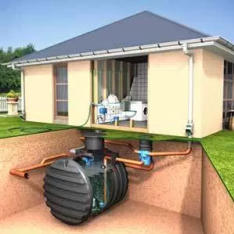
- Qstn #8What is a rain water harvester? How does it work?Ans : It is a storage tank usually fitted underground to your down pipes coming from the roof. Rainwater enters the tank through a filter which removes the leaves and other debris. The system contains a pump which pushes or sucks the rain water back into the house where it is delivered to the toilets or clothes washing machine. The tank is placed in the dark and kept oxygenated to prevent the growth of algae. This filtered untreated water should not be used for drinking.
Rain water harvesters can be installed in houses, bungalows, large sheds or any building with a roof on it to capture the rain water. Commercial premises are very suitable as they
often have a larger roof space and higher percentage of water use that can be replaced by rain water.
- Qstn #9What is the importance of rain water harvesting?Ans :
- The demand for water is increasing. The urban population of India has increased five times in the last five decades from 62.4 million in 1951 to 286 million in 2001. The demand for water has concomitantly grown to almost double the amount of water a citizen ordinarily requires.
- Till not very many years back our cities were self-sufficient for water. Today, water bodies are disappearing and ground water is being extracted. The rivers are getting polluted.
- The management of water is in the hands of the states. This has led to communities and households ho longer being the agents of water management.
- The earlier use of rain water and flood water has declined. In its place, an ever growing reliance on river water and ground water has arisen. This has led to such large scale extraction of ground water both by the government and private bodies that our river basins are getting polluted.
- Large dams are constructed to store water and canals constructed to distribute the water. The former have caused large scale displacement of communities and ecological havoc, while the latter has brought large scale degradation of land due to soil salination. Water availability both in terms of quality and quantity has declined to such an extent that many parts of India face a drought like situation.
- #10
- #10-iName two methods of water harvesting in India.Ans : Two methods of water harvesting in India are:
- Collecting of rain water on the roof top and directing to any tanks.
- Watershed is defined as a geographic area through which water flows across the land and drains into common body of water such as stream, river, lake, ocean, etc.