ICSE-X-Geography
03: Climate of India Class 10 Geography
Note: Please signup/signin free to get personalized experience.
Note: Please signup/signin free to get personalized experience.
10 minutes can boost your percentage by 10%
Note: Please signup/signin free to get personalized experience.
- Qstn #6State two important characteristic features of the monsoon rainfall in India.Ans :
- Reversal of wind system.
- Uneven distribution of rainfall over the year.
- Qstn #7How are the sources of rainfall in the North-west part of India different from the rainfall experienced on the coastal areas of Eastern India in winter?Ans : North-west India—Summer: South-west Monsoons (Bay of Bengal stream), Winter: Winter cyclones from Mediterranean Sea.
Coastal regions of Eastern India—Winter or North-east Monsoon or Retreating Monsoons.
- Qstn #8Name an area which receives rain in winter. What causes rainfall in this region and how does it benefit agriculture?Ans : (i) Indo-Gangetic Plain receives rain in winter. Due to the temperate cyclones coming from the Mediterranean Sea these cyclonic rains are beneficial to crops of wheat and barley.
(ii) Chennai Coast and parts of Tamil Nadu from the winter monsoon. It helps in rice cultivation.
- Qstn #9What is ‘October Heat’?Ans : The retreating of monsoon winds results in clearing the sky. Consequently, the temperature increases. The land is still moist in these months. Owing to the high temperature, the humidity becomes very oppressive. This state of weather is known as October Heat.
- #Section : CLong Questions
- Qstn #1Describe the climatic conditions which prevail over India during different Seasons.Ans :
- The Cold Season: The cold Season lasts from December to February.
(a)Temperature: The sun is over head at Tropic of Capricorn. India has winter Season. January is the coldest month. The Southern parts have warm conditions (20°C) while low temperatures (10°C) are found in North-West India.
(b) Pressure and Winds: High pressure is developed over N.W. part while a low pressure exists over Indian Ocean with the result winds blow from land to Sea. The out-blowing winds are Westerly in Northern plain and North Easterly over the rest of the country.
(c) Rainfall: The North-east Monsoons are off-shore wind and are dry but these winds pick up some moisture while crossing Bay of Bengal and give rain to South-east coast of India. Some cyclones from Mediterranean Sea also bring a small amount of rain (10 to 20 cm.) to Northern plains. Night frost is common in the North-west parts. - The Hot Season: The hot Season lasts from March to May.
(a) Temperature: As the sun’s rays fall vertical over Tropic of Cancer, the temperature begins to rise. The average temperature is above 30°C, the maximum temperature rises to 50°C in Barmer (Rajasthan). The daily range of temperature rises in inland areas.
(b) Pressure and Winds: Intense heat results in the development of low pressure over North-West India. A high pressure exists over Indian Ocean. South-West Monsoons begin to blow from Sea to land. ‘Nor-westers’ and ‘Loo’ blow over Northern plains.
(c) Rainfall: Some areas receive convectional rainfall. The west coast also starts receiving rainfall. Most of the country is dry in title pre-Monsoon period. - The Rainy Season: The rainy Season lasts from June to September.
(a) Temperature: The sun shines vertical over Tropic of Cancer. The temperatures are more than 30°C. With the onset of monsoon there is a drop in temperature (5°C to 10°C) with the result, July is not the hottest month.
(b) Pressure and Winds: South-West Monsoons blow from Sea to land with a ‘burst’ on the West Coast. It blows in two currents. (i) The Arabian Sea Current(ii) The Bay of Bengal Current.
(c) Rainfall: Most of the parts of India receive rainfall in this Season. The Arabian Sea branch gives heavy rainfall on the west coast, but Deccan plateau lies in rain shadow of western Ghats. The Bay of Bengal branch gives heavy rainfall in Eastern Himalayas. The rainfall goes on decreasing up the Ganges Valley with the decrease in moisture. Rajasthan is practically a desert.
- The Cold Season: The cold Season lasts from December to February.
- Qstn #2Give two important characteristics of the summer monsoon rainfall in India.Ans : Two important characteristics of the summer monsoon rainfall in India are as follows:
- The monsoon rainfall in India is unevenly spread and sporadic. Thus places like the western Ghats receive heavy rainfall of more than 200 cm whereas the desert regions of Rajasthan receive scanty rainfall of less 50 cm a year.
- Monsoon rainfall in India is orographic in nature. Thus the windward slopes of the Western Ghats receive more rain than the leeward slopes.
- #3
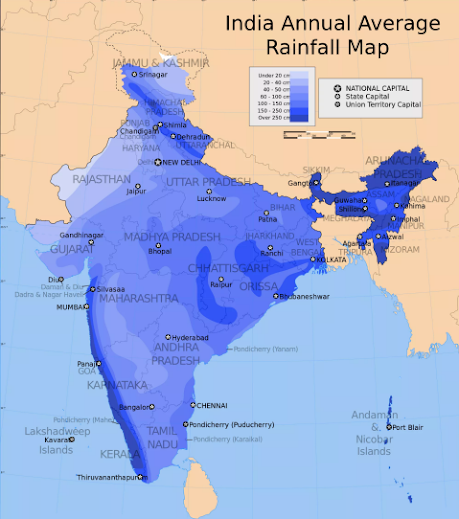
- #3-iGive an account of distribution of annual rainfall in India.Ans : The average annual rainfall of India is 110 cm. Regional variations in the distribution are found due to differences in relief of the country. Rainfall is unevenly distributed throughout the country. India can be divided into the following rainfall regions:
Areas of heavy rainfall: These areas get more than 200 cm, of annual rainfall. These include Western Coast and Western Ghats, Sub-Himalayas, and the North-east parts of India. Areas of moderate rainfall: These areas get annual rainfall of 100-200 cm. These include West: Bengal, Orissa, Bihar, Eastern parts of U.P., and Madhya Pradesh; coastal plains of Tamil Nadu. Areas of very little rain: Jammu-Kashmir, Western Rajasthan (Thar Desert).
- #3-iiExplain how it is related to the relief, with examples.Ans : The Western Ghats: places to the windward side of the Ghats, e.g., Mumbai, Goa, Mangalore, Kerala coast get heavy rain, Places on the leeward side like Pune, the Deccan plateau, Chennai, get less rain.
Garo-Khasi Hills: Cherrapunji which is favourably situated in these hills, gets entrapped in the Bay
of Bengal branch of the S.W. Monsoon and gets very heavy rain, Shillong which lies on the leeward side of these Hills gets less rain.
Aravalli Hills: These hills run parallel to the Arabian Sea branch of the S.W. Monsoon and is not conducive to rain. Besides, the Bay of Bengal winds of the S.W. Monsoon coming from the east is blocked and hence Rajasthan lying on the leeward side of these Hills, gets little rain. This is why Thar is a desert.
The Himalaya Mountains block the Bay of Bengal branch of the S.W. Monsoon from crossing the mountains. The places on the southern slopes of the Mountains get heavy rain.
- Qstn #4State three dominant characteristics of the monsoon.Ans : The dominant characteristics of monsoon are:
- Seasonal reversal of direction in the winds system. The monsoon winds blow from land to Sea in winters and from Sea to land in summers.
- Seasonal heavy rainfall and drought are common features of the monsoon.
- Inspite of local variation in climatic conditions, it unites the whole sub-continent in a single climatic thread of monsoon type of climate.
- #5
- #5-i‘Rainfall decreases as one travels up the Ganges Valley.’ Why?Ans : A branch of Summer Monsoon from Bay of Bengal moves up the Ganges Valley, it moves westwards along the Himalayas. The lower Ganges Valley receives the rainfall first and the upper Ganges Valley later on. Kolkata has an annual rainfall of 160 cm. As the branch of monsoon moves westward, it gets drier and drier. So it gives less rainfall. Varanasi gets 104 cm. of rainfall, Delhi gets 66 cm of rainfall.
- #5-iiWhat is the direction of the summer monsoon on the Indo-Gangetic Plain?Ans : Their direction on the Indo-Gangetic plain is east-west.
- Qstn #6The Coromandel coast has more rainy months but less rainfall than the Konkan Coast. Why?Ans : Konkan Coast faces on-shore S. W. Monsoons during summer. These moist laden winds give heavy rainfall (more than 300 cm.). But these winds do not give much rainfall on the Coromandel Coast as it lies in the rain shadow of Western Ghats. Coromandel Coast also receives winter rainfall from N. E. monsoons, but on Konkan Coast these winds are off. shore and do not give any rainfall. N. E. Monsoon is a dry wind as it blows from the land. Thus, Coromandel Coast gets rainfall in both the Seasons, but the total blows amount is less than that of Konkan Coast.