CBSE-IX-Social-Science
04: Climate
- Qstn #2-viiWhy is the monsoon considered a unifying bond?Ans : Despite variations in temperature conditions across India, a sense of unity is imposed by the monsoon. The seasonal alteration of the wind systems and the associated weather conditions provide a rhythmic cycle of seasons that binds the entire country.
- Qstn #3Why does the rainfall decrease from the east to the west in Northern India?
Ans : The amount of rainfall decreases from east to west in Northern India because of the progressive decrease in the humidity of the winds. As the moisture-bearing winds of the Bay of Bengal branch of the southwest monsoon move further and further inland, they exhaust most of the moisture they carry along with them. This consequently leads to a gradual decrease in the amount of rainfall from east to west.
- Qstn #4-iSeasonal reversal of wind direction takes place over the Indian subcontinent?Ans : The seasonal reversal of wind direction over the Indian subcontinent is the result of the Coriolis force. It is an apparent force caused by the Earth’s rotation. The Coriolois force is responsible for deflecting winds towards the right in the northern hemisphere and towards the left in the southern hemisphere.
- Qstn #4-iiThe bulk of rainfall in India is concentrated over a few months.Ans : The rainfall received by India is largely due to the south-west monsoon winds. The duration of the monsoon is between 100 to 120 days. Hence, the bulk of rainfall received by the country is concentrated over a few months.
- Qstn #4-iiiThe Tamil Nadu coast receives winter rainfall.Ans : During the winter season, north-east trade winds prevail over India. They blow from land to sea and hence, for most part of the country, it is a dry season. However, the Tamil Nadu Coast receives winter rainfall due to these winds. This is because in this region these winds blow from sea to land, thereby carrying moisture along with them.
- Qstn #4-ivThe delta region of the eastern coast is frequently struck by cyclones.Ans : The delta region of the eastern coast of India is frequently struck by cyclones. This is because the cyclonic depressions that originate over the Andaman Sea are brought in by the sub-tropical easterly jet stream blowing over peninsular India during the monsoon as well as during the October to November period.
- Qstn #4-vParts of Rajasthan, Gujarat and the leeward side of the Western Ghats are drought-prone.Ans : Parts of Rajasthan, Gujarat and the leeward side of the Western Ghats are drought-prone because of the scanty rainfall received by these regions during the monsoon rains. The progressive decrease in the humidity of the winds of the Bay of Bengal branch causes the amount of rainfall to decrease from east to west in northern India. As the leeward side is the rain-shadow area, the regions lying in this region receive very little rain from the Arabian Sea branch. It is the windward side of the Ghats that receives the maximum rain.
- Qstn #5Describe the regional variations in the climatic conditions of India with the help of suitable examples.
Ans : Despite the overall unity accorded by the monsoon, there are visible regional variations in climatic conditions within India. Regardless of the moderating influences of the Himalayas in the north and the sea in the south, variations do exist in temperature, humidity and precipitation. For example, in summer, some parts of the Rajasthan desert, in north-western India, record temperatures of 50°C, while it may be around 20°C in Pahalgam in Jammu and Kashmir, in the north of the country. On a winter night, the temperature at Drass in Jammu and Kashmir may be as low as minus 45°C, while Thiruvananthapuram may have a temperature of 22°C. In general, coastal areas experience less contrasts in temperature conditions. Seasonal contrasts are more in the interior of the country.
Another case in point is precipitation. While precipitation is mostly in the form of snowfall in the upper parts of the Himalayas, it rains over the rest of the country. The annual precipitation varies from over 400 cm in Meghalaya to less than 10 cm in Ladakh and western Rajasthan. Most parts of the country receive rainfall from June to September, but some parts like the Tamil Nadu coast get most of their rain during October and November.
- Qstn #6Discuss the mechanism of monsoons.
Ans : During summer, a low-pressure area develops over interior Asia as well as over north and north-western India. At the same time, there is a high-pressure system over the southern Indian Ocean. Winds move from a high-pressure area to a low-pressure area. As a result, the low-pressure system attracts the southeast trade winds of the southern hemisphere. On crossing the equator, these trade winds—due to the Coriolis force—turn right towards the low-pressure areas over the Indian subcontinent. After crossing the equator, these winds start blowing in a south-westerly direction, and enter the Indian peninsula as the southwest monsoon. As these winds blow over warm oceans, they bring abundant moisture to the subcontinent. Arriving at the southern tip of the Indian peninsula, the wind system breaks up into two branches - the Arabian Sea branch and the Bay of Bengal branch. The Arabian Sea branch hits the Western Ghats, while the Bay of Bengal branch flows over the Bay of Bengal and hits the eastern Himalayas. The coastal areas west of the Western Ghats receive much of the rainfall from the Arabian Sea Branch, while the regions lying east of the Western Ghats do not receive much rain from these winds. The north-eastern parts of the country receive much of their rainfall from the Bay of Bengal Branch. As these winds move from east to west, the moisture they carry progressively declines. As a result, rainfall decreases from east to west. The Arabian Sea branch moves towards the north-east from the south-west, and joins the Bay of Bengal branch over the northern part of the country. The duration of the monsoon is between 100 to 120 days. By the end of this period, the low pressure system over north and north-west India gradually weakens, and this leads to the retreat of the monsoon winds.
- Qstn #7Give an account of weather conditions and characteristics of the cold season.
Ans : The Cold Weather Season
Beginning from mid-November, the winter season lasts till February. The weather is usually marked by clear sky, low temperatures and low humidity, and feeble and variable winds. The temperature decreases from the south to the north, with the peninsular region not showing any noticeable seasonal change in temperature pattern due to the moderating influence of the sea. The coldest months are December and January. The days are generally warm and the nights are cold. Frost is common in the north and the higher slopes of the Himalayas experience snowfall.
During this season, the sub-tropical westerly jet streams blowing south of the Himalayas bring in cyclonic disturbances from the Mediterranean region. These cause winter rains over the plains and snowfall in the mountains. The Tamil Nadu coast also receives winter rainfall due to the blowing of the north-east trade winds from sea to land.
- Qstn #8Give the characteristics and effects of the monsoon rainfall in India.
Ans : Characteristics of monsoon rainfall in India:
(i) The duration of the monsoon is between 100 to 120 days from early June to mid-September.
(ii) Around the time of its arrival, the normal rainfall increases suddenly and continues for several days. This is known as the ‘burst’ of the monsoon.
(iii) The monsoon has characteristic wet and dry spells or ‘breaks’ in rainfall. The monsoon rains take place only for a few days at a time. They are interspersed with rainless intervals.
(iv) The moisture is carried by pulsating south westerlies that are affected by different atmospheric conditions, thereby giving monsoon rains an uncertain character. The annual rainfall is highly variable from year to year
(v) The rainfall is unevenly distributed across the Indian landscape. Parts of the western coast and north-eastern India receive the maximum rainfall. Regions such as parts of Rajasthan, Gujarat, Leh and the leeward side of the Western Ghats receive very little rainfall.
Effects of monsoon rainfall in India:
(a) Indian agriculture is largely dependent upon the water from the monsoon rains. Late, low or excessive rains have a negative impact upon crops.
(b) Due to the uneven distribution of rainfall across the country, there are some regions that are drought prone and some that are flood afflicted.
(c) The monsoon provides India with a distinct climatic pattern. Hence, in spite of the presence of great regional variations, it has a unifying influence upon the country and its people.
- #Section : II
- Qstn #1
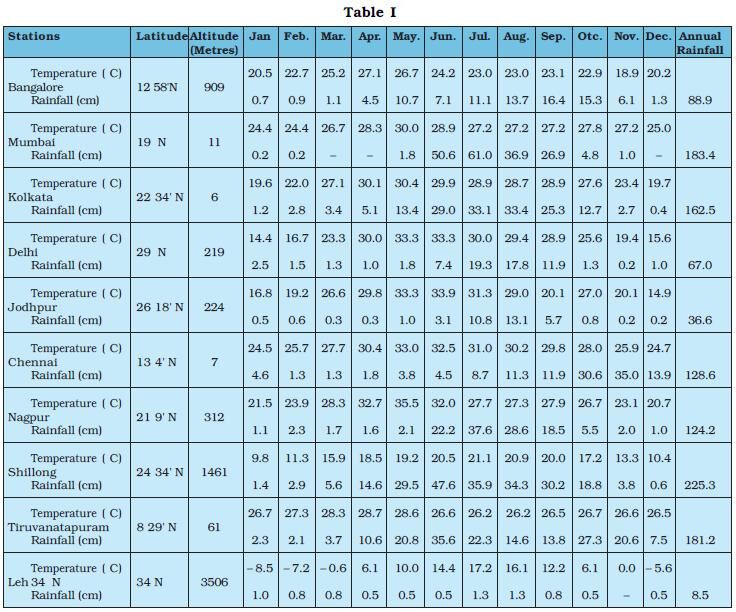
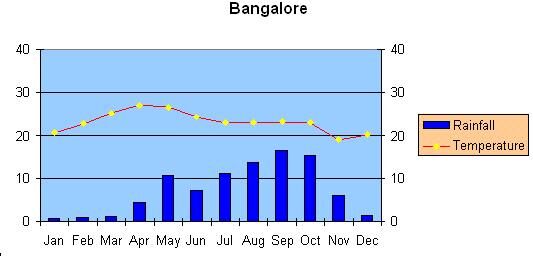
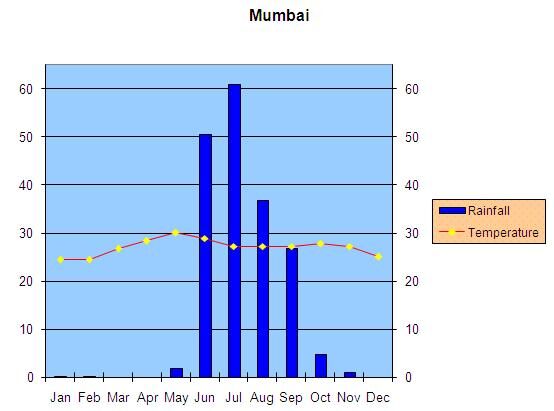
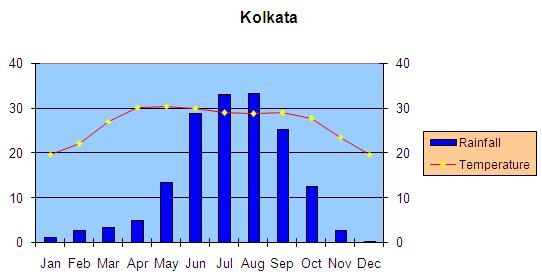
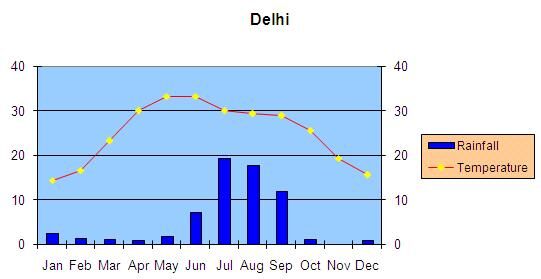
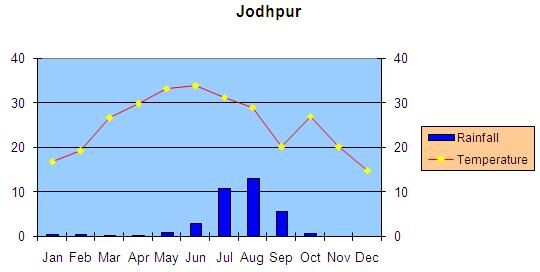
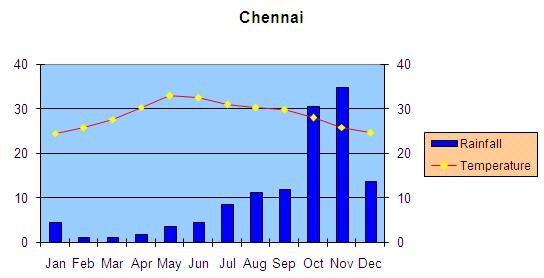
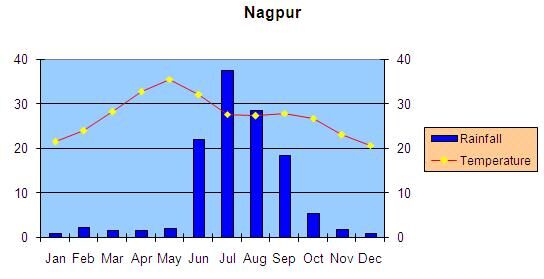
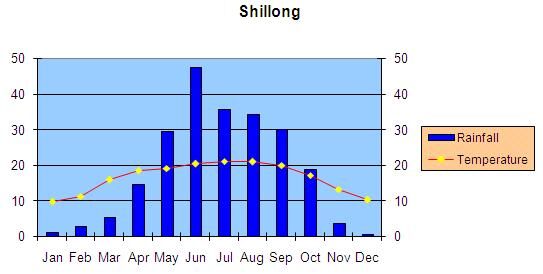
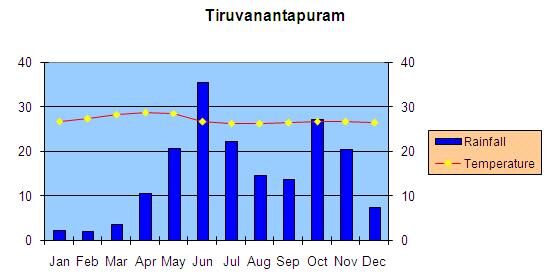
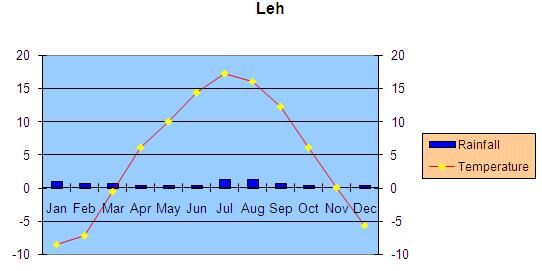
In Table-I the average mean monthly temperatures and amounts of rainfall of ten representative stations have been given. It is for you to study on your own and convert them into ‘temperature and rainfall’ graphs. A glance at these visual representations will help you to grasp instantly the similarities and differences between them. One such graph (Figure 1) is already prepared for you. See if you can arrive at some broad generalisations about our diverse climatic conditions. We hope you are in for a great joy of learning. Do the following activities.
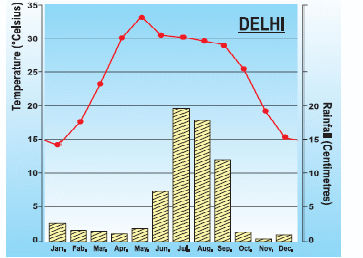
Figure 1: Temperature and Rainfall of Delhi
Ans :