NEET-XII-Physics
14: Some Mechanical Properties of Matter
Note: Please signup/signin free to get personalized experience.
Note: Please signup/signin free to get personalized experience.
10 minutes can boost your percentage by 10%
Note: Please signup/signin free to get personalized experience.
- Qstn #28Consider an ice cube of edge 1.0 cm kept in a gravity-free hall. Find the surface area of the water when the ice melts. Neglect the difference in densities of ice and water.Ans : Given:
Edge of the ice cube
(a) = 1.0 cm
The water that is formed due to the melting of ice acquires a spherical surface.
In the absence of gravity, let the radius of the spherical surface be r.
Volume of ice cube = volume of spherical surface of water
`` \Rightarrow {a}^{3}=\frac{4}{3}\,\mathrm{\,\pi \,}{r}^{3}``
`` \Rightarrow r={\left[\frac{3{\,\mathrm{\,a\,}}^{3}}{4\,\mathrm{\,\pi \,}}\right]}^{1/3}``
Surface area of spherical water surface = 4πr2
`` =4\,\mathrm{\,\pi \,}{\left[\frac{3{a}^{3}}{4\,\mathrm{\,\pi \,}}\right]}^{2/3}``
`` ={\left(36\,\mathrm{\,\pi \,}\right)}^{1/3}{\,\mathrm{\,cm\,}}^{2}``
Page No 301:
- Qstn #29A wire forming a loop is dipped into soap solution and taken out so that a film of soap solution is formed. A loop of 6.28 cm long thread is gently put on the film and the film is pricked with a needle inside the loop. The thread loop takes the shape of a circle. Find the tension the the thread. Surface tension of soap solution = 0.030 N m-1.Ans : Given:
Surface tension of soap solution T = 0.030 N m-1
Let the radius of the thread loop be r.
`` \Rightarrow 2\,\mathrm{\,\pi \,}r=6.28\,\mathrm{\,cm\,}``
`` \Rightarrow r=\frac{6.28}{2\times 3.14}=1\,\mathrm{\,cm\,}``
The excess pressure inside the loop is expressed as follows:
`` ∆P=\frac{4T}{r}``
Tension in the thread:
`` T\text{'}=∆P\times \left(\,\mathrm{\,area\,}\,\mathrm{\,of\,}\,\mathrm{\,loop\,}\right)``
`` \Rightarrow T\text{'}=\frac{4T}{r}\times \,\mathrm{\,\pi \,}{r}^{2}``
`` \Rightarrow T\text{'}=4\,\mathrm{\,\pi \,}Tr``
`` =4\times 0.030\times 3.14\times {10}^{-2}\,\mathrm{\,N\,}``
`` =3.8\times {10}^{-3}\,\mathrm{\,N\,}``
Page No 301:
- Qstn #30A metal sphere of radius 1 mm and mass 50 mg falls vertically in glycerine. FindAns :Given:
Radius of metallic sphere r = 1 mm = 10-3 m
Speed of the sphere v = 10-2 m/s
Coefficient of viscosity η = 8 poise = 0.8 decapoise
Mass m = 50 mg = 50 × 10-3 kg
Density of glycerin σ = 1260 kg/m3
- #30-athe viscous force exerted by the glycerine on the sphere when the speed of the sphere is 1 cm s-1,Ans : Viscous force exerted by glycerine on the sphere F = 6πηrv
⇒ F= 6 × (3.14) × (0.8) × 10-3 × (10-2)
= 1.50 × 10⁻⁴ N
- #30-bthe hydrostatic force exerted by the glycerine on the sphere andAns : Let V be the volume of the sphere.
Hydrostatic force exerted by glycerin on the sphere `` F\text{'}=V\sigma g``
`` \Rightarrow F\text{'}=\frac{4}{3}\pi {r}^{2}\sigma g``
`` =\left(\frac{4}{3}\right)\times \left(3.14\right)\times \left({10}^{-6}\right)\times 1260\times 10``
`` =5.275\times {10}^{-5}\,\mathrm{\,N\,}``
- #30-cthe terminal velocity with which the sphere will move down without acceleration. Density of glycerine = 1260 kg m-3 and its coefficient of viscosity at room temperature = 8.0 poise.Ans : Let the terminal velocity of the sphere be v'.
The forces acting on the drops are
(i) The weight mg acting downwards
(ii) The force of buoyance, i.e., `` \frac{4}{3}\pi {r}^{3}\sigma g`` acting upwards
(iii) The force of viscosity, i.e., 6πηrv' acting upwards
From the free body diagram:
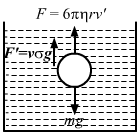
`` 6\pi \eta rv\text{'}+\frac{4}{3}\pi {r}^{3}\sigma g=mg``
`` \Rightarrow v=\frac{mg-{\displaystyle \frac{4}{3}}\pi {r}^{2}\sigma g}{6\pi \eta r}``
`` =\frac{50\times {10}^{-3}-{\displaystyle \frac{4}{3}}\times 3.14\times {10}^{-6}\times 1260\times 10}{6\times 3.14\times 0.8\times {10}^{-3}}``
`` =\frac{500-{\displaystyle \frac{4}{3}}\times 3.14\times {10}^{-3}\times 1260\times 10}{6\times 3.14\times 0.8}``
`` =2.3\,\mathrm{\,cm\,}/s``
Page No 301:
- Qstn #31Estimate the speed of vertically falling raindrops from the following data. Radius of the drops = 0.02 cm, viscosity of air = 1.8 × 10⁻⁴ poise, g= 9.9 × 10 ms-2 and density of water = 1000 kg m-3.Ans : Given:
Radius of the drops r = 0.02 cm = 2 × 10⁻⁴ m
Viscosity of air η = 1.8 × 10⁻⁴ poise = 1.8 × 10⁻⁵ decapoise
Acceleration due to gravity g = 9.9 m/s2
Density of water ρ = 1000 kg/m3
Let v be the terminal velocity of a drop.
The forces acting on the drops are
(i) The weight `` mg`` acting downwards
(ii) The force of buoyance, i.e., `` \left(\frac{4}{3}\right)\pi {r}^{3}\rho g`` acting upwards
(iii) The force of viscosity, i.e., 6πηrv acting upwards
Because the density of air is very small, the force of buoyance can be neglected.
From the free body diagram:

`` 6\pi \eta rv=mg``
`` 6\pi \eta rv=\frac{4}{3}\pi {r}^{3}\rho g``
`` v=2{r}^{2}\frac{\,\mathrm{\,\rho \,}g}{9\eta }``
`` =2\times {\left(0.02\times {10}^{-2}\right)}^{2}\times 1000\times \frac{\left(9.9\right)}{9}\times \left(1.8\times {10}^{-5}\right)``
`` =5\,\mathrm{\,m\,}/\,\mathrm{\,s\,}.``
Hence, the required vertical speed of the falling raindrops is 5 m/s.
Page No 302:
- Qstn #32Water flows at a speed of 6 cm s-1 through a tube of radius 1 cm. Coefficient of viscosity of water at room temperature is 0.01 poise. Calculate the Reynolds number. Is it a steady flow?Ans : Given:
Speed of water, v = 6 cm/s = 6 × 10⁻² m/s
Radius of tube, r = 1 cm = 10-2 m
Diameter of tube, D = 2 × 10⁻² m
Coefficient of viscosity, η = 0.01 poise
Let the Reynolds number be R and the density of water be ρ.
`` \Rightarrow R=\frac{vpD}{\eta }``
`` =\left(6\times {10}^{-3}\right)\times {10}^{3}\times \frac{2\times {10}^{-2}}{{10}^{-2}}``
`` =120``
Here, the Reynolds number is less than 2000. Therefore, it is a steady flow.