NEET-XII-Physics
10: Rotational Mechanics
- #18The density of a rod AB continuously increases from A to B. Is it easier to set it in rotation by clamping it at A and applying a perpendicular force at B or by clamping it at B and applying the force at A?Ans : It will require more force to set the bar into rotation by clamping at A and then clamping at B.
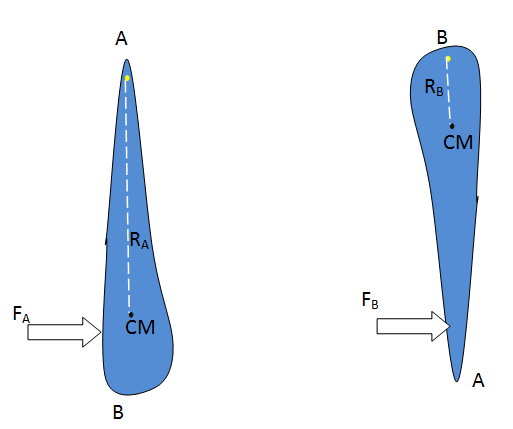
Explanation: Since the rod has mass density increasing towards B, the Center of Mass (CM) of the rod is near B. If the rod is clamped along A, the distance of CM of the rod from the pivot will be greater when the rod is clamped along B. Greater distance of CM from the Center of rotation increases the moment of inertia of the rod and hence more torque will be necessary to rotate the bar about A. Greater torque implies greater force will be necessary to rotate it.
FA = Force required to rotated the rod clamped at A
RA= Distance of CM from pivot A
M = Mass of the rod
FB = Force required to rotate the rod clamped at B
RB= Distance of CM from pivot B
We have RA>RB.
We have to find the torque required to rotate rod clamped at A to produce angular acceleration a.
TA = MRA2a = RAFA
=> FA = MRAa
We have to find torque required to rotate rod clamped at B to produce angular acceleration a.
TB = MRB2a = RBFB
=> FB = MRBa
On comparing, since RA>RB, we get:
FA>FB
Page No 192: