NEET-XII-Physics
32: Electric Current in Conductors
- #28Figure (32-E6) shows a part of a circuit. If a current of 12 mA exists in the 5 kΩ resistor, find the currents in the other three resistors. What is the potential difference between the points A and B?
Figure32-E6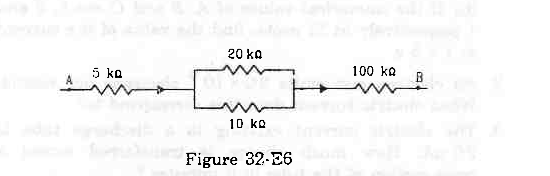 Ans :
Ans :
Let the current flowing through the resistors be marked as shown in the figure.
Given: i = 12 mA
The resistors of 20 kΩ and 10 kΩ are connected in parallel. So, the potential difference across their ends will be same, i.e.
`` 20{i}_{1}=10\left(i-{i}_{1}\right)``
`` \Rightarrow 30{i}_{1}=10i``
`` \Rightarrow {i}_{1}=\frac{i}{3}=\frac{12}{3}=4\,\mathrm{\,mA\,}``
∴ The current flowing through the 20 kΩ resistor = i1 = 4 mA
The current flowing through the 10 kΩ resistor = i - i1 = 8 mA
From the figure,
The current flowing through the 100 kΩ resistor = i = 12 mA
The equivalent resistance between the points A and B,
`` {R}_{\,\mathrm{\,net\,}}=\left(5+\frac{20\times 10}{20+10}+100\right)\,\mathrm{\,k\Omega \,}=111.67\,\mathrm{\,k\Omega \,}``
The potential difference V between the points A and B,
`` V=i{R}_{\,\mathrm{\,net\,}}``
`` \Rightarrow V=12\times {10}^{-3}\times 111.67\times {10}^{3}=1340\,\mathrm{\,V\,}``
Page No 199: