NEET-XII-Chemistry
07: Chemistry in Everyday Life
Note: Please signup/signin free to get personalized experience.
Note: Please signup/signin free to get personalized experience.
10 minutes can boost your percentage by 10%
No item to list.
Note: Please signup/signin free to get personalized experience.
- Qstn #21-iCationic detergentsAns : Cationic detergent
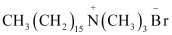
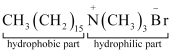
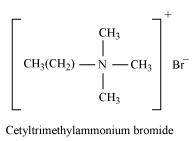
Cationic detergents are quaternary ammonium salts of acetates, chlorides, or bromides. These are called cationic detergents because the cationic part of these detergents contains a long hydrocarbon chain and a positive charge on the N atom.
For example: cetyltrimethylammonium bromide
- Qstn #21-iiAnionic detergents andAns : Anionic detergents
Anionic detergents are of two types:
1.Sodium alkyl sulphates: These detergents are sodium salts of long chain alcohols. They are prepared by first treating these alcohols with concentrated sulphuric acid and then with sodium hydroxide. Examples of these detergents include sodium lauryl sulphate (C11H23CH2OSO3-Na+) and sodium stearyl sulphate (C17H35CH2OSO3-Na+).
2.Sodium alkylbenzenesulphonates: These detergents are sodium salts of long chain alkylbenzenesulphonic acids. They are prepared by Friedel-Crafts alkylation of benzene with long chain alkyl halides or alkenes. The obtained product is first treated with concentrated sulphuric acid and then with sodium hydroxide. Sodium 4-(1-dodecy) benzenesulphonate (SDS) is an example of anionic detergents.
- Qstn #21-iiiNon-ionic detergentsAns : Non-ionic detergents
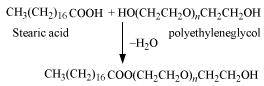
Molecules of these detergents do not contain any ions. These detergents are esters of alcohols having high molecular mass. They are obtained by reacting polyethylene glycol and stearic acid.
- Qstn #22What are biodegradable and non-biodegradable detergents? Give one example of each.
Ans : Detergents that can be degraded by bacteria are called biodegradable detergents. Such detergents have straight hydrocarbon chains. For example: sodium lauryl sulphate
Detergents that cannot be degraded by bacteria are called non-biodegradable detergents. Such detergents have highly-branched hydrocarbon chains. For example: sodium -4- (1, 3, 5, 7- tetra methyl octyl) benzene sulphonate
- Qstn #23Why do soaps not work in hard water?
Ans : Soaps are sodium or potassium salts of long-chain fatty acids. Hard water contains calcium and magnesium ions. When soaps are dissolved in hard water, these ions displace sodium or potassium from their salts and form insoluble calcium or magnesium salts of fatty acids. These insoluble salts separate as scum.
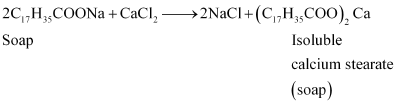
This is the reason why soaps do not work in hard water.
- Qstn #24Can you use soaps and synthetic detergents to check the hardness of water?
Ans : Soaps get precipitated in hard water, but not in soft water. Therefore, soaps can be used for checking the hardness of water.
However, synthetic detergents do not get precipitated either in hard water or in soft water. Therefore, synthetic detergents cannot be used for checking the hardness of water.
- Qstn #25Explain the cleansing action of soaps.
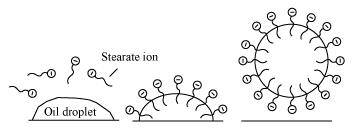
Ans : Soap molecules form micelles around an oil droplet (dirt) in such a way that the hydrophobic parts of the stearate ions attach themselves to the oil droplet and the hydrophilic parts project outside the oil droplet. Due to the polar nature of the hydrophilic parts, the stearate ions (along with the dirt) are pulled into water, thereby removing the dirt from the cloth.
- Qstn #26If water contains dissolved calcium hydrogen carbonate, out of soaps and synthetic detergents which one will you use for cleaning clothes?
Ans : Synthetic detergents are preferred for cleaning clothes. When soaps are dissolved in water containing calcium ions, these ions form insoluble salts that are of no further use.
However, when synthetic detergents are dissolved in water containing calcium ions, these ions form soluble salts that act as cleansing agents.