NEET-XII-Chemistry
05: Biomolecules
Note: Please signup/signin free to get personalized experience.
Note: Please signup/signin free to get personalized experience.
10 minutes can boost your percentage by 10%
No item to list.
Note: Please signup/signin free to get personalized experience.
- Qstn #5What do you understand by the term glycosidic linkage?
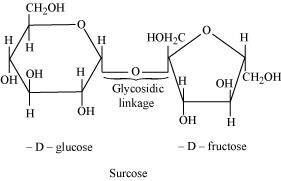
Ans : Glycosidic linkage refers to the linkage formed between two monosaccharide units through an oxygen atom by the loss of a water molecule.
For example, in a sucrose molecule, two monosaccharide units, ∝-glucose and β-fructose, are joined together by a glycosidic linkage.
- Qstn #6What is glycogen? How is it different from starch?
Ans : Glycogen is a carbohydrate (polysaccharide). In animals, carbohydrates are stored as glycogen.
Starch is a carbohydrate consisting of two components - amylose (15 - 20%) and amylopectin (80 - 85%).
However, glycogen consists of only one component whose structure is similar to amylopectin. Also, glycogen is more branched than amylopectin.
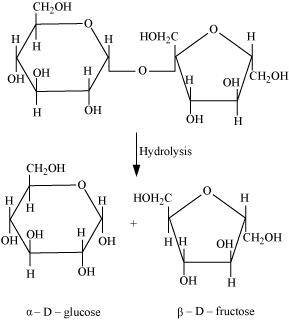
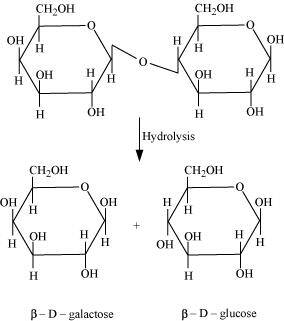
- Qstn #7-isucrose andAns : On hydrolysis, sucrose gives one molecule of ∝-D glucose and one molecule of β- D-fructose.
- Qstn #8What is the basic structural difference between starch and cellulose?
Ans : Starch consists of two components - amylose and amylopectin. Amylose is a long linear chain of ∝-D-(+)-glucose units joined by C1-C4 glycosidic linkage (∝-link).
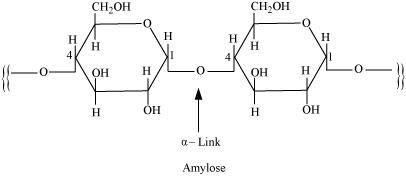
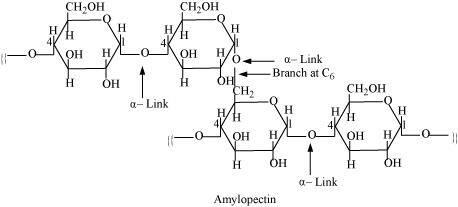
Amylopectin is a branched-chain polymer of ∝-D-glucose units, in which the chain is formed by C1-C4 glycosidic linkage and the branching occurs by C1-C6 glycosidic linkage.
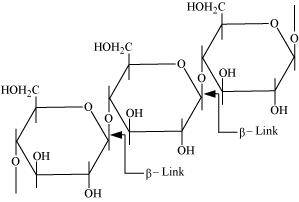
On the other hand, cellulose is a straight-chain polysaccharide of β-D-glucose units joined by C1-C4 glycosidic linkage (β-link).
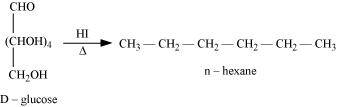
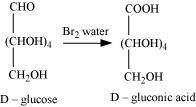
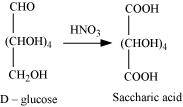
- Qstn #9-iiBromine waterAns : When D-glucose is treated with Br2 water, D- gluconic acid is produced.
- Qstn #10Enumerate the reactions of D-glucose which cannot be explained by its open chain structure.
Ans : (1) Aldehydes give 2, 4-DNP test, Schiff’s test, and react with NaHSO4 to form the hydrogen sulphite addition product. However, glucose does not undergo these reactions.
(2) The pentaacetate of glucose does not react with hydroxylamine. This indicates that a free -CHO group is absent from glucose.
(3) Glucose exists in two crystalline forms - ∝ andβ. The ∝-form (m.p. = 419 K) crystallises from a concentrated solution of glucose at 303 K and the β-form (m.p = 423 K) crystallises from a hot and saturated aqueous solution at 371 K. This behaviour cannot be explained by the open chain structure of glucose.
- Qstn #11What are essential and non-essential amino acids? Give two examples of each type.
Ans : Essential amino acids are required by the human body, but they cannot be synthesised in the body. They must be taken through food. For example: valine and leucine
Non-essential amino acids are also required by the human body, but they can be synthesised in the body. For example: glycine, and alanine
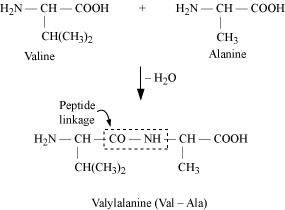
- Qstn #12-iPeptide linkageAns : Peptide linkage:
The amide formed between -COOH group of one molecule of an amino acid and -NH2 group of another molecule of the amino acid by the elimination of a water molecule is called a peptide linkage.
- Qstn #12-iiPrimary structureAns : Primary structure:
The primary structure of protein refers to the specific sequence in which various amino acids are present in it, i.e., the sequence of linkages between amino acids in a polypeptide chain. The sequence in which amino acids are arranged is different in each protein. A change in the sequence creates a different protein.