NEET-XII-Biology
13: Organisms and Populations
Note: Please signup/signin free to get personalized experience.
Note: Please signup/signin free to get personalized experience.
10 minutes can boost your percentage by 10%
No item to list.
Note: Please signup/signin free to get personalized experience.
- #13 - Organisms and Populations
- #Section : IPage No 239:
- Qstn #1How is diapause different from hibernation?
Ans : Diapause is a stage of suspended development to cope with unfavourable conditions. Many species of Zooplankton and insects exhibit diapause to tide over adverse climatic conditions during their development.
Hibernation or winter sleep is a resting stage where in animals escape winters (cold) by hiding themselves in their shelters. They escape the winter season by entering a state of inactivity by slowing their metabolism. The phenomenon of hibernation is exhibited by bats, squirrels, and other rodents.
- Qstn #2If a marine fish is placed in a fresh water aquarium, will the fish be able to survive? Why or why not?
Ans : If a marine fish is placed in a fresh water aquarium, then its chances of survival will diminish. This is because their bodies are adapted to high salt concentrations of the marine environment. In fresh water conditions, they are unable to regulate the water entering their body (through osmosis). Water enters their body due to the hypotonic environment outside. This results in the swelling up of the body, eventually leading to the death of the marine fish.
- Qstn #3Define phenotypic adaptation. Give one example.
Ans : Phenotypic adaptation involves changes in the body of an organism in response to genetic mutation or certain environmental changes. These responsive adjustments occur in an organism in order to cope with environmental conditions present in their natural habitats. For example, desert plants have thick cuticles and sunken stomata on the surface of their leaves to prevent transpiration. Similarly, elephants have long ears that act as thermoregulators.
- Qstn #4Most living organisms cannot survive at temperature above 45°C°. How are some microbes able to live in habitats with temperatures exceeding 100°C?
Ans : Archaebacteria (Thermophiles) are ancient forms of bacteria found in hot water springs and deep sea hydrothermal vents. They are able to survive in high temperatures (which far exceed 100°C) because their bodies have adapted to such environmental conditions. These organisms contain specialized thermo-resistant enzymes, which carry out metabolic functions that do not get destroyed at such high temperatures.
- Qstn #5List the attributes that populations but not individuals possess.
Ans : A population can be defined as a group of individuals of the same species residing in a particular geographical area at a particular time and functioning as a unit. For example, all human beings living at a particular place at a particular time constitute the population of humans.
The main attributes or characteristics of a population residing in a given area are:-
( a) Birth rate (Natality): It is the ratio of live births in an area to the population of an area. It is expressed as the number of individuals added to the population with respect to the members of the population.
(b) Death rate (Mortality): It is the ratio of deaths in an area to the population of an area. It is expressed as the loss of individuals with respect to the members of the population.
(c) Sex ratio: It is the number of males or females per thousand individuals.
(d) Age Distribution: It is the percentage of individuals of different ages in a given population. At any given time, the population is composed of individuals that are present in various age groups. The age distribution pattern is commonly represented through age pyramids.
(e) Population density: It is defined as the number of individuals of a population present per unit area at a given time.
- Qstn #6If a population growing exponentially double in size in 3 years, what is the intrinsic rate of increase (r) of the population?
Ans : A population grows exponentially if sufficient amounts of food resources are available to the individual. Its exponential growth can be calculated by the following integral form of the exponential growth equation:
Nt = No ert
Where,
Nt= Population density after time t
NO= Population density at time zero
r = Intrinsic rate of natural increase
e = Base of natural logarithms (2.71828)
From the above equation, we can calculate the intrinsic rate of increase (r) of a population.
Now, as per the question,
Present population density = x
Then,
Population density after two years = 2x
t = 3 years
Substituting these values in the formula, we get:
⇒ 2x = x e3r
⇒ 2 = e3r
Applying log on both sides:
⇒ log 2 = 3r log e
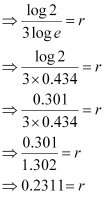
Hence, the intrinsic rate of increase for the above illustrated population is 0.2311.
- Qstn #7Name important defence mechanisms in plants against herbivory.
Ans : Several plants have evolved various mechanisms both morphological and chemical to protect themselves against herbivory.
(1) Morphological defence mechanisms:
(a) Cactus leaves (Opuntia) are modified into sharp spines (thorns) to deter herbivores from feeding on them.
(b) Sharp thorns along with leaves are present in Acacia to deter herbivores.
(c) In some plants, the margins of their leaves are spiny or have sharp edges that prevent herbivores from feeding on them.
(2) Chemical defence mechanisms:
(a) All parts of Calotropis weeds contain toxic cardiac glycosides, which can prove to be fatal if ingested by herbivores.
(b) Chemical substances such as nicotine, caffeine, quinine, and opium are produced in plants as a part of self-defense.
- Qstn #8An orchid plant is growing on the branch of mango tree. How do you describe this interaction between the orchid and the mango tree?
Ans : An orchid growing on the branch of a mango tree is an epiphyte. Epiphytes are plants growing on other plants which however, do not derive nutrition from them. Therefore, the relationship between a mango tree and an orchid is an example of commensalisms, where one species gets benefited while the other remains unaffected. In the above interaction, the orchid is benefited as it gets support while the mango tree remains unaffected.
- Qstn #9What is the ecological principle behind the biological control method of managing with pest insects?
Ans : The basis of various biological control methods is on the concept of predation. Predation is a biological interaction between the predator and the prey, whereby the predator feeds on the prey. Hence, the predators regulate the population of preys in a habitat, thereby helping in the management of pest insects.
- #10-aHibernation and AestivationAns : Hibernation and Aestivation
-
Hibernation
Aestivation
1.
Hibernation is a state of reduced activity in some organisms to escape cold winter conditions.
1.
Aestivation is a state of reduced activity in some organisms to escape desiccation due to heat in summers.
2.
Bears and squirrels inhabiting cold regions are examples of animals that hibernate during winters. 2.
Fishes and snails are examples of organisms aestivating during summers.
-
- #10-bEctotherms and EndothermsAns : Ectotherms and Endotherms
-
Ectotherms
Endotherms
1.
Ectotherms are cold blooded animals. Their temperature varies with their surroundings.
1.
Endotherms are warm blooded animals. They maintain a constant body temperature.
2.
Fishes, amphibians, and reptiles are ectothermal animals.
2
Birds and mammals are endothermal animals.
-