NEET-XI-Physics
14: Oscillations
Note: Please signup/signin free to get personalized experience.
Note: Please signup/signin free to get personalized experience.
10 minutes can boost your percentage by 10%
Note: Please signup/signin free to get personalized experience.
- #
- #1-aA swimmer completing one (return) trip from one bank of a river to the other and back.Ans : It is not a periodic motion. Though the motion of a swimmer is to and fro but will not have a definite period.
- #1-bA freely suspended bar magnet displaced from its’N-S direction and released.Ans : Since a freely suspended magnet if once displaced from N-S direction and released, it oscillates about this position, it is a periodic motion
- #1-cA hydrogen molecule rotating about its centre of mass.Ans : The rotating motion of a hydrogen molecule about its centre of mass is periodic.
- #1-dAn arrow released from a bow.Ans : Motion of an arrow released from a bow is non-periodic.
- Qstn #2Which of the following examples represent (nearly) simple harmonic motion and which represent
periodic but not simple harmonic motion ?
- #2-athe rotations of earth about its axis.Ans : Since the rotation of earth is not to and fro motion about a fixed point, thus it is periodic but not S.H.M.
- #2-bmotion of an oscillating mercury column in a U-tube.Ans : It is S.H.M.
- #2-cmotion of a ball bearing inside a smooth curved bowl, when released from a point slightly above the lower most point.Ans : It is S.H.M.
- #2-dgeneral vibrations of a polyatomic molecule about its equilibrium position.Ans : General vibrations of a polyatomic molecule about its equilibrium position is periodic but non SHM. In fact, it is a result of superposition of SHMs executed by individual vibrations of atoms of the molecule.
- Qstn #3Fig. depicts four x-t plots for linear motion of a particle. Which of ike plots represent periodic motion? What is the period of motion (in case of periodic motion)?
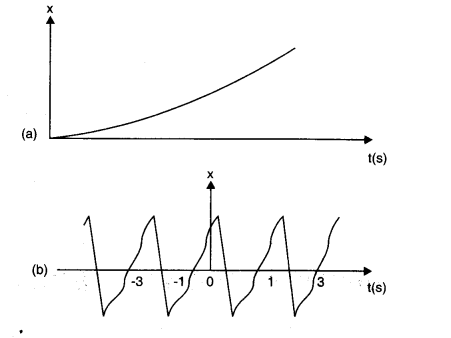
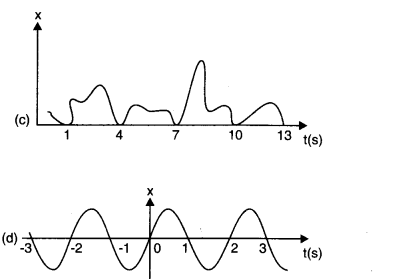
Ans : Figure (b) and (d) represent periodic motions and the time period of each of these is 2 seconds, (a) and (c) are non-periodic motions.
- #4-0Which of the following function of time represent |a) simple harmonic,(b)periodic but not simple harmonic, and non-periodic motion? Give period for each case of periodic motion (to is any positive constant).
Ans : The function will represent a periodic motion, if it is identically repeated after a fixed interval of time and will represent S.H.M if it can be written uniquely in the form of a cos

- #4-1(a) sin wt - cos wtAns : ``\sin \omega t - \cos \omega t``
=``\sin\omega t - \sin(\pi/2 -\omega t)`` ( as ``cos (\pi/2-\theta) = \sin \theta``)
(Again (`` \sin A - \sin B = 2\sin \frac{A-B}{2} \cos\frac{A+B}{2}``)
=``2 \cos \pi/4 \sin(\omega t - \pi/4)``
= ``\sqrt{2} \sin(\omega t - \pi/4)``
( shm equation ``x(t) = a\sin(\omega t + \alpha)``
comparing with shm,
A= ``\sqrt2`` and Time period T = ``2\pi/\omega`` and phase angle = ``\pi/4`` or ``( 2\pi-\pi/4) = 7\pi/4``.
- #4-2(b) sin3 wtAns :
