NEET-XI-Biology
15: Plant Growth and Development
- #3Describe briefly:
(a) Arithmetic growth
(b) Geometric growth
(c) Sigmoid growth curve
(d) Absolute and relative growth rates
(a) Arithmetic growth
(b) Geometric growth
(c) Sigmoid growth curve
(d) Absolute and relative growth rates
(a) Arithmetic growth
(b) Geometric growth
(c) Sigmoid growth curve
(d) Absolute and relative growth ratesAns : null (a) Arithmetic growth
In arithmetic growth, one of the daughter cells continues to divide, while the other differentiates into maturity. The elongation of roots at a constant rate is an example of arithmetic growth.
(b) Geometric growth
Geometric growth is characterised by a slow growth in the initial stages and a rapid growth during the later stages. The daughter cells derived from mitosis retain the ability to divide, but slow down because of a limited nutrient supply.
(c) Sigmoid growth curve
The growth of living organisms in their natural environment is characterised by an S-shaped curve called sigmoid growth curve. This curve is divided into three phases - lag phase, log phase or exponential phase of rapid growth, and stationary phase.
E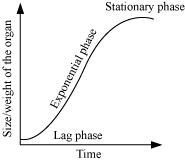 xponential growth can be expressed as:

Where,
W1 = Final size
W0 = Initial size
r = Growth rate
t= Time of growth
e = Base of natural logarithms
(d) Absolute and relative growth rates
Absolute growth rate refers to the measurement and comparison of total growth per unit time.
Relative growth rate refers to the growth of a particular system per unit time, expressed on a common basis.
(a) Arithmetic growth
In arithmetic growth, one of the daughter cells continues to divide, while the other differentiates into maturity. The elongation of roots at a constant rate is an example of arithmetic growth.
(b) Geometric growth
Geometric growth is characterised by a slow growth in the initial stages and a rapid growth during the later stages. The daughter cells derived from mitosis retain the ability to divide, but slow down because of a limited nutrient supply.
(c) Sigmoid growth curve
The growth of living organisms in their natural environment is characterised by an S-shaped curve called sigmoid growth curve. This curve is divided into three phases - lag phase, log phase or exponential phase of rapid growth, and stationary phase.
Exponential growth can be expressed as:
Where,
W1 = Final size
W0 = Initial size
r = Growth rate
t= Time of growth
e = Base of natural logarithms
(d) Absolute and relative growth rates
Absolute growth rate refers to the measurement and comparison of total growth per unit time.
Relative growth rate refers to the growth of a particular system per unit time, expressed on a common basis.
(a) Arithmetic growth
In arithmetic growth, one of the daughter cells continues to divide, while the other differentiates into maturity. The elongation of roots at a constant rate is an example of arithmetic growth.
(b) Geometric growth
Geometric growth is characterised by a slow growth in the initial stages and a rapid growth during the later stages. The daughter cells derived from mitosis retain the ability to divide, but slow down because of a limited nutrient supply.
(c) Sigmoid growth curve
The growth of living organisms in their natural environment is characterised by an S-shaped curve called sigmoid growth curve. This curve is divided into three phases - lag phase, log phase or exponential phase of rapid growth, and stationary phase.
Exponential growth can be expressed as:
Where,
W1 = Final size
W0 = Initial size
r = Growth rate
t= Time of growth
e = Base of natural logarithms
(d) Absolute and relative growth rates
Absolute growth rate refers to the measurement and comparison of total growth per unit time.
Relative growth rate refers to the growth of a particular system per unit time, expressed on a common basis.
- #3-aArithmetic growthAns : Arithmetic growth
In arithmetic growth, one of the daughter cells continues to divide, while the other differentiates into maturity. The elongation of roots at a constant rate is an example of arithmetic growth.
- #3-bGeometric growthAns : Geometric growth
Geometric growth is characterised by a slow growth in the initial stages and a rapid growth during the later stages. The daughter cells derived from mitosis retain the ability to divide, but slow down because of a limited nutrient supply.
- #3-cSigmoid growth curveAns : Sigmoid growth curve
The growth of living organisms in their natural environment is characterised by an S-shaped curve called sigmoid growth curve. This curve is divided into three phases - lag phase, log phase or exponential phase of rapid growth, and stationary phase.
Exponential growth can be expressed as:
Where,
W1 = Final size
W0 = Initial size
r = Growth rate
t= Time of growth
e = Base of natural logarithms
- #3-dAbsolute and relative growth ratesAns : Absolute and relative growth rates
Absolute growth rate refers to the measurement and comparison of total growth per unit time.
Relative growth rate refers to the growth of a particular system per unit time, expressed on a common basis.