NEET-XI-Biology
14: Respiration in Plants
Note: Please signup/signin free to get personalized experience.
Note: Please signup/signin free to get personalized experience.
10 minutes can boost your percentage by 10%
No item to list.
Note: Please signup/signin free to get personalized experience.
- #14 - Respiration in Plants
- #Section : IPage No 238:
- #1-aRespiration and CombustionAns : Respiration and combustion
Respiration
Combustion
1. It is a biochemical process. 1. It is a physiochemical process. 2. It occurs in the living cells. 2. It does not occur in the living cells. 3. ATP is generated 3. ATP is not generated 4. Enzymes are required 4. Enzymes are not required 5. It is a biologically-controlled process. 5. It is an uncontrolled process.
- #1-bGlycolysis and Krebs’ cycleAns : Glycolysis and Krebs cycle
Glycolysis
Krebs cycle
1. It is a linear pathway. 1. It is a cyclic pathway. 2. It occurs in the cell cytoplasm. 2. It occurs in the mitochondrial matrix. 3. It occurs in both aerobic and anaerobic respiration. 3. It occurs in aerobic respiration. 4. It generates 2 NADH2 and 2 ATP molecules on the breakdown of one glucose molecule. 4. It produces 6 NADH2, 2FADH2, and 2 ATP molecules on the breakdown of two acetyl-CoA molecules.
- #1-cAerobic respiration and FermentationAns : Aerobic respiration and fermentation
Aerobic respiration
Fermentation
1. Oxygen is used for deriving energy 1. Occurs in the absence of oxygen 2. Occurs in the cytoplasm and mitochondria 2. Occurs in the cytoplasm 3. End products are carbon dioxide and water 3. End products are ethyl alcohol and carbon dioxide 4. Complete oxidation of the respiratory substrate takes place 4. Incomplete oxidation of the respiratory substrate takes place 5. About 36 ATP molecules are produced 5. Only 2 ATP molecules are produced
- Qstn #2What are respiratory substrates? Name the most common respiratory substrate.
Ans : The compounds oxidised during the process of respiration are called respiratory substrates. Carbohydrates, especially glucose, act as respiratory substrates. Fats, proteins, and organic acids also act as respiratory substrates.
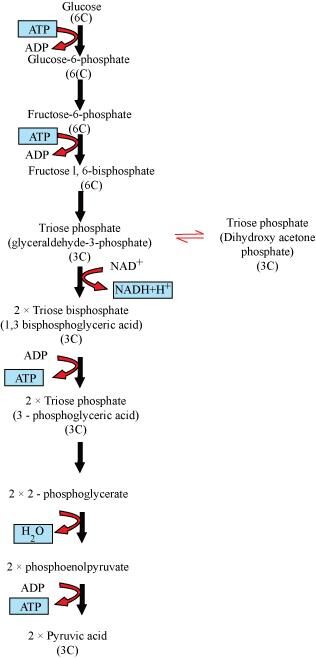
- Qstn #4What are the main steps in aerobic respiration? Where does it take place?
Ans : The major steps in aerobic respiration and the sites where they occur are listed in the given table.
Step
Site of occurrence
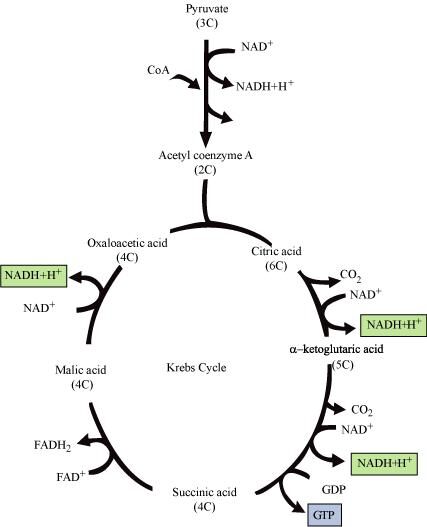
1. Glycolysis 1. Cytoplasm 2. Krebs cycle 2. Matrix of mitochondria 3. Electron transport system 3. Inner mitochondrial membrane 4. Oxidative phosphorylation 4. F0-F1 particles in the inner mitochondrial membrane
- Qstn #6Explain ETS.
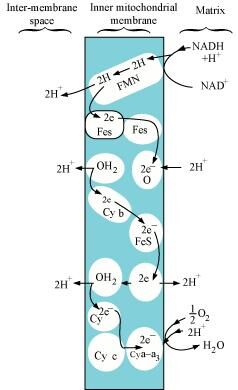
Ans : ETS or electron transport system is located in the inner mitochondrial membrane. It helps in releasing and utilizing the energy stored in NADH+H+ and FADH2. NADH + H+, which is formed during glycolysis and citric acid cycle, gets oxidized by NADH dehydrogenase (complex I). The electrons so generated get transferred to ubiquinone through FMN. In a similar manner, FADH2 (complex II) generated during citric acid cycle gets transferred to ubiquinone. The electrons from ubiquinone are received by cytochrome bc1 (complex III) and further get transferred to cytochrome c. The cytochrome c acts as a mobile carrier between complex III and cytochrome c oxidase complex, containing cytochrome a and a3, along with copper centres (complex IV).
During the transfer of electrons from each complex, the process is accompanied by the production of ATP from ADP and inorganic phosphate by the action ATP synthase (complex V). The amount of ATP produced depends on the molecule, which has been oxidized. 2 ATP molecules are produced by the oxidation of one molecule of NADH. One molecule of FADH2, on oxidation, gives 3 ATP molecules.
- #7-aAerobic respiration and Anaerobic respirationAns : Aerobic respiration and Anaerobic respiration
Aerobic respiration
Anaerobic respiration
1. It uses oxygen for deriving energy. 1. It occurs in the absence of oxygen. 2. It occurs in cytoplasm and mitochondria. 2. It occurs in cytoplasm. 3. The end products of aerobic respiration are carbon dioxide and water. 3. The end products of fermentation are ethyl alcohol and carbon-dioxide. 4. Complete oxidation of respiratory substrate takes place. 4. Incomplete oxidation of respiratory substrate takes place. 5. 36-38 ATP molecules are produced. 5. Only 2 ATP molecules are produced.
- #7-bGlycolysis and FermentationAns : Glycolysis and Fermentation
Glycolysis
Fermentation
1. Glycolysis occurs during aerobic and anaerobic respiration. 1. Fermentation is a type of anaerobic respiration. 2. Pyruvic acid is produced as its end product. 2. Ethanol or lactic acid is produced as its end product.
- #7-cGlycolysis and Citric acid CycleAns : Glycolysis and citric acid cycle
Glycolysis
Citric acid cycle (Krebs cycle)
1. It is a linear pathway. 1. It is a cyclic pathway. 2. It occurs in the cell cytoplasm. 2. It occurs in the mitochondrial matrix. 3. It occurs in both aerobic and anaerobic respiration. 3. It occurs in aerobic respiration. 4. One glucose molecule breaks down to generate 2 NADH2 and 2 ATP molecules. 4. It produces 6 NADH2, 2 FADH2, and 2 ATP molecules on breakdown of two acetyl-coA molecules.