NEET-XI-Biology
07: Structural Organisation in Animals
Note: Please signup/signin free to get personalized experience.
Note: Please signup/signin free to get personalized experience.
10 minutes can boost your percentage by 10%
No item to list.
Note: Please signup/signin free to get personalized experience.
- #5-bSeptal nephridium and pharyngeal nephridiumAns :
Septal nephridium
Pharyngeal nephridium
They are present on both sides of inter-segmental septa behind the 15th segment. They open into the intestines. They are present as three paired tufts in the fourth, fifth, and sixth segments.
- Qstn #6What are the cellular components of blood?
Ans : Components of blood include erythrocytes (RBCs), leucocytes (WBCs), and thrombocytes (platelets). These components form 45% of blood. They are suspended in the remaining fluid portion, called plasma.
Mammalian erythrocytes are biconcave, coloured cells devoid of a nucleus. They help in transporting respiratory gases.
Leucocytes or white blood cells are nucleated cells. They can be divided into two types, granulocytes (neutrophils, eosinophils, and basophils) and agranulocytes (lymphocytes and monocytes). They help fight against various disease-causing germs entering the body.
Thrombocytes are cell fragments produced from megarkaryocytes of the bone. They play a major role during blood coagulation.
- Qstn #7What are the following and where do you find them in animal body
Ans : Chondriocytes:
They are cells of cartilages, and are present in small cavities within the matrix secreted by them.
Axons:
They are long, slender projections of neurons that help in carrying nerve impulses from the neuron body. Axons aggregate in bundles which make up the nerves.
Ciliated epithelium:
It consists of simple columnar or cuboidal epithelium with cilia on their free surfaces. It is present on the inner surface of the oviducts and bronchioles. It helps in the movement of eggs or mucus in specific directions.
- #7-aChondriocytes
- #7-bAxons
- #7-cCiliated epithelium
- Qstn #8Describe various types of epithelial tissues with the help of labelled diagrams.
Ans : Epithelial tissue lines the surface of a body and forms a protective covering. Epithelium cells are packed tightly together with little intercellular matrix. Epithelial tissue in the body is of two types.
(a) Simple epithelium: It consists of a single layer of cells where cells are in direct contact with the basement membrane. It is further sub-divided into the following types:
(i) Simple squamous epithelium: It consists of a single layer of flat cells with irregular boundaries. It is found in the walls of the blood vessels and in the lining of alveoli.
(ii) Simple cuboidal epithelium: It consists of a single layer of cube-like cells. It is present in regions where secretion and absorption of substances takes place such as the proximal convoluted tubule region of the nephron.
(iii) Simple columnar epithelium: It consists of a single layer of tall, slender cells with their nuclei present at the base of the cells. They may bear micro-villi on the free surfaces. Columnar epithelium forms the lining of the stomach and intestines, and is involved in the function of secretion and absorption.
(iv) Ciliated epithelium: It consists of columnar or cuboidal cells with cilia on their free surfaces. They are present in bronchioles and oviducts from where they direct mucus and eggs in specific directions.
(v) Glandular epithelium:It consists of columnar or cuboidal cells involved in the secretion of substances. Glands are of two types, unicellular glands (goblet cells of the alimentary canal) and multicellular glands (salivary glands). They can be classified as exocrine (ductless glands) and endocrine glands (duct glands) by the method through which they release enzymes.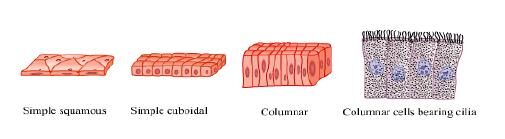
(b)
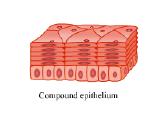
Compound epithelium: It consists of many layers of cells. It is involved mainly in the function of providing protection and has a limited role in secretion and absorption.
Examples of compound epithelium include the dry surface of the skin or moist inner lining of the buccal cavity, pharynx, pancreatic ducts, and the inner lining of ducts of salivary glands.
- #9-aSimple epithelium and compound epithelium.Ans :
Simple epithelium
Compound epithelium
1. It is composed of only one layer of cells.
2. It is mainly involved in the function of absorption and secretion.
3. It is present in the lining of the stomach, intestine.
1. It is composed of many layers of cells.
2. It is mainly involved in the function of protection and has a limited role in absorption and secretion.
3. It is present in the lining of the pharynx and buccal cavity.
- #9-bCardiac muscle and striated muscleAns :
Cardiac muscles
Striated muscles
1. They are involuntary in function.
2. They are multi-nucleate and branched.
3. They are found only in the heart.
1. They are voluntary in function.
2. They are multi-nucleate and unbranched.
3. They are found only in triceps, biceps, and limbs.
- #9-cDense regular and dense irregular connective tissuesAns :
Dense regular connective tissues
Dense irregular connective tissues
1. In dense regular connective tissues, collagen fibres are present in rows between parallel boundless fibres.2. They are present in tendons and ligaments. 1. In dense irregular connective tissues, fibres are arranged irregularly.2. They are present in the skin.
- #9-dAdipose and blood tissueAns :
Adipose tissue
Blood tissue
1. It is composed of collagen fibres, elastin fibres, fibroblasts, macrophages, and adipociytes.2. It helps in the synthesis, storage, and metabolism of fats.3. It is present beneath the skin. 1. It is composed of RBCs, WBCs, platelets, and plasma.
2. It helps in the transportation of food, wastes, gases, and hormones.
3. It is present in the blood vessels.
- #9-eSimple gland and compound glandAns :
Simple glands
Compound glands
1. They contain isolated glandular cells.
2. They are unicellular.
3. Examples include goblet cells of the alimentary canal.
1. They contain a cluster of secretory cells.
2. They are multicellular.
3. Examples include salivary glands.
- #10-aAreolar tissue; blood; neuron; tendonAns : Areolar tissue, blood, and tendons are examples of connective tissues. Neuron is an example of neural tissue.