ICSE-X-Physics
Previous Year Paper year:2011
Note: Please signup/signin free to get personalized experience.
Note: Please signup/signin free to get personalized experience.
10 minutes can boost your percentage by 10%
Note: Please signup/signin free to get personalized experience.
- #ICSE | PHYSICS
Board Paper 2011
Class X Physics
ICSE Board
Maximum Marks: 80 Time: One hour and a half
___________________________________________________________
Answers to this Paper must be written on the paper provided separately. You will not be allowed to write during the first 15 minutes. This time is to be spent in reading the Question Paper. The time given at the head of this Paper is the time allowed for writing the answers.
Section I is compulsory. Attempt any four questions from Section II.
The intended marks for questions or parts of questions are given in brackets 11.
- #Section : I(40 Marks) Attempt all questions from this Section.
- #1
- #1-a [2]
- #1-a-iDefine one newton.Ans : One Newton is the amount of force required to produce an acceleration of 1 ms-2 in a body of mass 1 kg.
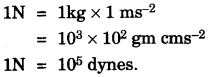
- #1-a-iiWrite the relation between S.I. unit and C.G.S unit of force.Ans :
- #1-b [2]Where does the position of centre of gravity lie for
- #1-b-ia circular laminaAns : Centre of the circle or the point of intersection of diameters.
- #1-b-iia triangular lamina?Ans : Centroid or the point of intersection of its medians.
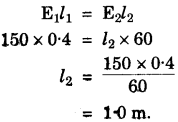
- #1-c [2]A man can open a nut by applying a force of 150 N by using a lever handle of length 0.4 m. What should be the length of the handle if he is able to open it by applying a force of 60 N?Ans : Equating the torque in both the cases :
- #1-d [2]Name a machine which can be used to (i) multiply force (ii) change the direction of force applied.Ans : (i.) Inclined plane
(ii.) Pulley
- #1-eThe diagram below shows a lever in use.
 Ans : (i) IInd class lever.
- #1-e-ii [2]If FA = 40 cm, AB = 60 cm, then find the mechanical advantage of
the lever.Ans :
- #2
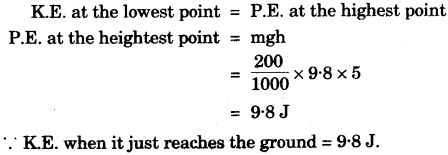
- #2-a [2]A ball of mass 200 g falls from a height of 5 m. What will be its kinetic
energy when it just reaches the ground? (g = 9.8 ``ms^{-2}``)Ans :