ICSE-X-Physics
Previous Year Paper year:2019
Note: Please signup/signin free to get personalized experience.
Note: Please signup/signin free to get personalized experience.
10 minutes can boost your percentage by 10%
No item to list.
Note: Please signup/signin free to get personalized experience.
- #3-bTwo waves of the same pitch have amplitudes in the ratio 1 : 3.
What will be the ratio of their:
- #3-b-iintensities andAns : Ratio of intensities will be 1: 9.
- #3-b-iifrequencies?
[2]
Ans : Ratio of frequencies will be 1:1.
- #3-cHow does an increase in the temperature affect the specific resistance of a :
- #3-c-iMetal andAns : Increases.
- #3-c-iiSemiconductor?
[2]
Ans : Decreases.
- #3-d
- #3-d-iDefine resonant vibrations.Ans : If a body is made to vibrate with its fundamental frequency by an external source, then the vibrations are called resonant vibrations.
- #3-d-iiWhich characteristic of sound, makes it possible to recognize a person by his voice without seeing him ?
[2]
Ans : Quality.
- #3-eIs it possible for a hydrogen (11H) nucleus to emit an alpha particle? Give a reason for your answer.
[2]
Ans : No, as it does not possess a helium nucleus.
- #4
- #4-aCalculate the effective resistance across AB :
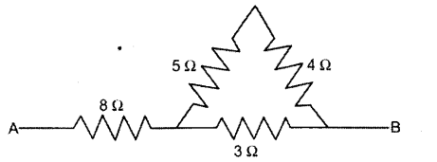
Ans : Resistors of 5 Ω and 4 Ω are in series, therefore, their net resistance is Rs = 5 + 4 = 9 Ω.
Now, this 9 Cl and 3 Ω are in parallel, hence net resistance RP = ``\frac{9 \times 3}{9+3}`` = ``\frac { 18 }{ 12 }`` = 1.5 Ω.
Now, this is in series with the 8 Cl resistor, hence net resistance of the circuit is RT = 8 + 1.5 = 9. 5
- #4-b
- #4-b-iState whether the specific heat capacity of a substance remains the same when its state changes from solid to liquid.Ans : No, specific heat capacity does not remain the same when it changes from solid to liquid.
- #4-b-iiGive one example to support your answer.
[2]
Ans : Let us take the example of water.
Specific heat capacity of water = 4.2 J kg-1 K-1
and specific heat capacity of ice = 2.1 J kg-1K-1