ICSE-X-HistCivics
Previous Year Paper year:2011
Note: Please signup/signin free to get personalized experience.
Note: Please signup/signin free to get personalized experience.
10 minutes can boost your percentage by 10%
No item to list.
Note: Please signup/signin free to get personalized experience.
- #8-a [3]Identify the event in the below picture. Name the Lady seen in the given picture. Mention the year when the event took place.
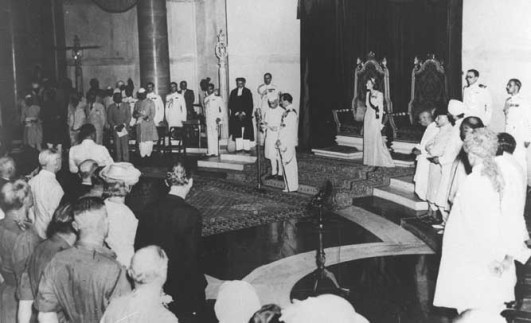 Ans : The event is the swearing in ceremony of Jawahar Lal Nehru as the Prime Minister of Independent India. The Lady is Lady Mountbatten the wife of the first Governer General of India Lord Mountbatten. The year is 1947.
- #8-b [3]What were the main provisions of the Indian Independence Act ?Ans :
- Two New Dominions
India would be partitioned and two independent Dominions—India and Pakistan—would be created from August 15, 1947. The Act provided legislative supremacy of both the Dominions. The territories of the two Dominions were divided in such terms that Pakistan would comprise Sindh, British Baluchistan, North West Frontier Province, the West Punjab and East Bengal. India was to comprise all the remaining territories included in British India. The exact boundaries of the Dominions would be determined by a Boundary Commission. - Provisions of Partition
(a) Both Bengal and Punjab would be divided if so desired by the people. The Provincial Assemblies of the two parts would meet separately representing Hindu majority districts and Muslim majority districts and would decide through majority vote whether they wanted the division of the province or not.
(b) A plebiscite would be held in NWFP as well as in Sylhet distict (Muslim majority area) in East Bengal to determine whether they would like to join Pakistan or India. (Both these provinces joined West and East Pakistan respectively.) - Governor-General for Each Dominion
There would be a Governor-General who would be appointed by the British King on the advice of the Cabinet of the concerned Dominion. This arrangement would work till the framing of the Constitutions. - Constituent Assemblies to Serve as Central Legislatures
The Constituent Assemblies of both the dominions were to act as the Central Legislatures and would have full powers to make laws for their respective Dominion. They would act. as sovereign bodies for legislative purposes.
- Two New Dominions
- #8-c [4]Mention the reasons that made the Congress accept the Partition Proposals.Ans : Acceptance by the Congress : The Congress accepted the plan on the following grounds :
- The delay of British rule was harmful for India. The British incited the native rulers to remain independent. The Congress realized that it would be better to accept partition of the country.
- It thought that united India was better than a bigger disorganized country.
- The Congress thought it would not be possible to run the administration jointly because of the interference by the Leagues.
- The communal riots that took place left the Congress with no alternative but to accept the partition of the country.
- The Congress leaders felt that partition would rid the constitution of separate electorates and India could then evolve a secular and democratic policy.
- #9-a [3]Explain any three causes of the First World War.Ans : Three causes of the First World War (1914):
- Militant Nationalism and Mutual Rivalries: Each nation thought about her own national interest. Nationalism had become competitive and aggressive. The spirit of Nationalism was a strong driving force in European politics of the 19th century. Thus the whole atmosphere was charged with narrow militant nationalism and inter-state rivalries.
- Europe Divided into Power Blocs: In Europe, there existed single nation states like France, Holland, Germany. There also existed some imperial states like Austria Hungarians empire, which included nationalities like Serbs, Hungarians, Bosanions and the Croats. There was the Russia empire which included Polish Ukranian, Turkish and Mages people. Great Britain was also a colonial empire. The major European nation were divided into two Bloc's. Germany, Austria, Hungary and Italy had made the Triple Alliance in 1882 A.D. and the Dual Alliance united France and Russia. At the dawn of the 20th Century Europe was divided into two hostile camps. Tension prevailed in their relations with each other, bloc-wise.
- The immediate cause: The Sarajevo Incident: In June 1914, The Archduke Francis Ferdinand, The Heir-Apparent to the throne of Austria went to Sarajevo, the Capital of Bosnia, on an official visit. On June 28, 1914, he and his wife were shot dead. The assassin, Gavrilo Princep, was a nineteen years old Bosnian student. This dual murder had been planned in Serbia by a secret society of patriotic terrorists called the "Black hand". The Austrians blamed the Serbians for this crime, as the assassin and fellow conspirators had received their guns and bombs in Serbian Capital with the help of Serbian officials.
- #9-b [3]Mention three points under the Treaty of Versailles, which affected Germany.Ans :
- The Treaty of Versailles declared Germany guilty of aggression.
- Germany was required to pay for the loss and damages suffered by the allies during the war. Germany had to cede her merchant ship to the allies as compensation. It had to supply huge quantities of coal to France, Italy and Belgium for 10 years.
- The area of Rhine Valley was to be demilitarized and German territory west of Rhine was to be occupied by the allied troops for 15 years.
- Germany lost Alsace Lorraine to France and Malmedy to Belgium, Schieswig to Denmark; Dazling become a free port in polish territory. (any three)
- #9-c [4]What were the objectives of the League of Nations ? Name the organization formed in October, 1945 with objectives similar to those of the League of Nations.Ans : All the States of the world were prohibited from entering into any Secret Treaties and alliances. The member states were not supposed to maintain huge army worship and destructive armament. All states were to respect each other's independence. All states were to be refer their mutual disputes if any, to the league of nation for a peaceful settlement. The member states were to take necessary action as directed by the League against any state which tried to disturb world peace and order. Apart from the political function the League of Nation won supposed to promote cultural social and economic cooperation among the member states.
The United Nation organisation was formed on 24 October, 1945 with objectives similar to those of the League of Nation.
- #10-a [3]The failure of the League of Nations.Ans : Failure of the League of Nations:
- All the great powers were not its members. The United States was not a member at all. In 1925, Germany joined the organization while Russia was allowed entry in 1934. Later, both Germany and Japan left the League. The League, therefore, lacked universal representation.
- The permanent members always opposed decisions which went against their own interests.
- #10-b [3]The Aggressive Nationalism of Germany.Ans : Aggressive Nationalism of Germany: Germany's desire to become a world power and the adoption of policy of militarisation greatly contributed to the Second World War. Hitler, after gaining power, embarked on the path of expansion of German Empire. He annexed Austria, occupied Rhineland and proceeded to occupy Czechoslovakia. Thereafter, he set his eyes on Danzia and Poland. It was the aggressive nationalism of Hitler which led to the Second World War.
- #10-c [4]The Policy of Appeasement.Ans : Policy of Appeasement: Appeasement meant a policy of conciliating an aggressive power at the expense of some other country. The Western Powers followed the policy of appeasement because they felt that the dictators had a real cause of grievance and if their grievances were removed they would leave others alone. The Western Powers wanted to check the rising tide of Communism and Russian Bolshevism. They, therefore allowed Germany to re-arm and to remilitarise the Rhineland and capture Austria and Czechoslovakia. But for the Western countries policy of appeasement, Fascism or Nazism could not have survived so long and would not have been able to unleash the Second World War. The League of Nations watched helplessly when Italy attacked and annexed Abyssinia.