ICSE-X-HistCivics
Previous Year Paper year:2017
- #7-a [3]The Split in the Congress [3] (b) With reference to the picture given below, answer the following:
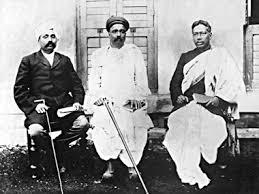 (b) What were the three personalities popularly known as? (b) Which section of the Congress did they represent? (b) Mention two of their popular beliefs. (c) State any four methods that they advocated for the achievement of their aims. (b) With reference to the picture given below, answer the following: (b) What were the three personalities popularly known as? (b) Which section of the Congress did they represent? (b) Mention two of their popular beliefs. (c) State any four methods that they advocated for the achievement of their aims. Ans : The Swadeshi Movement created a rift between early and assertive nationalists.
While the assertive nationalists wanted to use the Swadeshi and Boycott
Movements as a weapon to unsettle the British in India, the early nationalists did
not support the Boycott Movement as it was contrary to their policy of ‘petition and
persuasion’. While the assertive nationalists wanted to spread the movement
outside Bengal, the early nationalists wanted the movement to remain confined
within Bengal. The differences between the two sections of the INC became
apparent in the 1907 session of Congress held in Surat. While the assertive
nationalists proposed the name of Lala Lajpat Rai as the President of the Surat
session, the early nationalists proposed the name of Rashbehari Ghosh for the chair.
There were discussions and debates in the Surat session among both factions.
However, there was no conciliation between both groups leading to the split in
Congress in 1907. (b) (i) The three personalities were popularly known as ‘Lal, Bal and Pal’.
(ii)They represented the Assertive nationalists.
(iii)The Assertive Nationalists had faith in the masses and proposed to win freedom
through mass action. They also believed that India could not gain independence
from the British rule until and unless a fierce fight is given to them in the form of
Swadeshi and the boycott movement. (b) null (b) null (b) null (c) Four methods that were advocated by the Assertive Nationalists for the
achievement of their aims were:
(i) Swadeshi: Swadeshi means the use of goods which are produced by indigenous
industries. It aimed at making the country self-reliant and self-sufficient. The
assertive nationalists used Swadeshi as a tool not only to promote the Indian
industries but also to hit the British economic interests.
(ii) Boycott: The assertive nationalists stressed on the boycott of foreign goods in an
effort to boost local Indian industries. It also aimed at providing employment
opportunities to the people.
(iii)National Education: A national scheme of education was planned as an
alternative of the government-controlled universities.
(iv)Passive Resistance: The Assertive Nationalists followed the policy of non-
violent resistance and strong political action to achieve independence of the
country. (b) (i) The three personalities were popularly known as ‘Lal, Bal and Pal’.
(ii)They represented the Assertive nationalists.
(iii)The Assertive Nationalists had faith in the masses and proposed to win freedom
through mass action. They also believed that India could not gain independence
from the British rule until and unless a fierce fight is given to them in the form of
Swadeshi and the boycott movement. (b) null (b) null (b) null (c) Four methods that were advocated by the Assertive Nationalists for the
achievement of their aims were:
(i) Swadeshi: Swadeshi means the use of goods which are produced by indigenous
industries. It aimed at making the country self-reliant and self-sufficient. The
assertive nationalists used Swadeshi as a tool not only to promote the Indian
industries but also to hit the British economic interests.
(ii) Boycott: The assertive nationalists stressed on the boycott of foreign goods in an
effort to boost local Indian industries. It also aimed at providing employment
opportunities to the people.
(iii)National Education: A national scheme of education was planned as an
alternative of the government-controlled universities.
(iv)Passive Resistance: The Assertive Nationalists followed the policy of non-
violent resistance and strong political action to achieve independence of the
country.
- #7-b [3]With reference to the picture given below, answer the following: Ans : (i) The three personalities were popularly known as ‘Lal, Bal and Pal’.
(ii)They represented the Assertive nationalists.
(iii)The Assertive Nationalists had faith in the masses and proposed to win freedom
through mass action. They also believed that India could not gain independence
from the British rule until and unless a fierce fight is given to them in the form of
Swadeshi and the boycott movement.
- #7-b-iWhat were the three personalities popularly known as?
- #7-b-iiWhich section of the Congress did they represent?
- #7-b-iiiMention two of their popular beliefs.
- #7-c [4]State any four methods that they advocated for the achievement of their aims.Ans : Four methods that were advocated by the Assertive Nationalists for the
achievement of their aims were:
(i) Swadeshi: Swadeshi means the use of goods which are produced by indigenous
industries. It aimed at making the country self-reliant and self-sufficient. The
assertive nationalists used Swadeshi as a tool not only to promote the Indian
industries but also to hit the British economic interests.
(ii) Boycott: The assertive nationalists stressed on the boycott of foreign goods in an
effort to boost local Indian industries. It also aimed at providing employment
opportunities to the people.
(iii)National Education: A national scheme of education was planned as an
alternative of the government-controlled universities.
(iv)Passive Resistance: The Assertive Nationalists followed the policy of non-
violent resistance and strong political action to achieve independence of the
country.