ICSE-X-HistCivics
Previous Year Paper year:2017
Note: Please signup/signin free to get personalized experience.
Note: Please signup/signin free to get personalized experience.
10 minutes can boost your percentage by 10%
No item to list.
Note: Please signup/signin free to get personalized experience.
- #4-a [3]State the position of the Prime Minister and state any two of his powers in relation
to the President.Ans : Position of the Prime Minister: He is the real head of the state as he has the
support of the majority of members of the Lok Sabha. Though, the Prime Minister is
the real head of the government, he cannot act as a dictator as his acts are closely
followed by the Members of the Parliament. He may also not get elected in the next
general elections. Thus, the Prime Minister is answerable to the people of the
country. His powers in relation to the President are:
(i) All authority vested in the President is actually exercised by the Prime
Minister.
(ii) The President can summon and prorogue the Parliament and dissolves the
Lok Sabha on the advice of the Prime Minister.
- #4-b [3]Mention the three categories of Ministers in order of their rank and status.Ans : Three categories of ministers in order of their rank and status are:
(i) Cabinet Ministers: They are the most important members of the Council of
Ministers.
(ii) Ministers of State: They are a second category of ministers and may or may
not hold an independent portfolio.
(iii) Deputy Ministers: They are the third category of ministers who help the
cabinet and Council of ministers.
- #4-c [4]Mention any four legislative powers of the Cabinet. .Ans : Four legislative powers of the Cabinet are:
(i) The cabinet ministers can introduce bills in the Parliament. More than 95%
of the bills are initiated by the Cabinet.
(ii) The Cabinet is instrumental in planning and making an amendment to the
constitution.
(iii) The President summons the Houses pf Parliament on the advice of the
cabinet.
- Qstn #5With reference to the powers and functions of the High Court, explain briefly the meaning
and scope of the following:
- #5-a [3]Its Appellate JurisdictionAns : Appellate jurisdiction of the High Court means that the High Court has the power
to hear appeal against the decisions of the lower courts like the district court in
civil and in criminal matters.
In civil cases, appeals can be brought before the High Court if they are concerned
with the matters of land revenue or if an injustice is done by the tribunal. In
criminal cases, it can hear appeals where the sentence of imprisonment exceeds
seven years, in case of a death sentence and in cases against the state where an
order of acquittal has been passed by a Session Judge.
- #5-b [3]The High Court as a Court of RecordAns : The High Court is a court of law as its judgments and orders are preserved as a
record to be referred by its court in future cases. The law laid down by the High
Court is binding on all subordinate courts. Further, the High Court can punish
anyone who commits a contempt of its order.
- #5-c [4]Judicial ReviewAns : High Courts like the Supreme Court have the power of judicial review. Any law
passed by the State Legislature violates any term of the Constitution or take
away the fundamental right of a person, the High Court can declare the law as
null and void.
- # [30]Section : B(Attempt any three questions from this Section)
- #6-a [3]The influence of the Western EducationAns : The introduction of Western education filled the hearts of the Indians with the ideas
of liberty, equality and justice. The educated Indians also became acquainted with
the concept of self-rule and democracy. They started to demand independence from
the British rule to establish a democratic rule in India. The spread of English in all
parts of India gave to educated Indians- a common language in which all could
communicate to each other. This brought the people together.
- #6-b [3]Any three contribution of Raja Ram Mohan RoyAns : Three contributions of Raja Ram Mohan Roy were:
(i) It was largely due to the efforts of raja Ram Mohan Roy that the practice of
sati was made a crime punishable by law.
(ii) He opposed the caste system and stressed over the equality of all human
beings. He founded the famous Brahmo Samaj in 1828.
(iii) He also opposed restrictions on the freedom of press.
- #6-c [4]The development of modern means of transport and communicationAns : The development of the means of transport such as the railways facilitated the
growth of nationalism in India. The railways helped the people to travel to different
parts of the country and fostered the spirit of unity among them. The development
of the post and telegraph also unified the people across all the regions in the country
as they enabled Indians to come in contact with one another and discuss the
problems facing the country.
- Qstn #7The conflict between two sections of the Congress came to surface in its Session in 1906 at
Calcutta. In this context, explain the following:
- #7-a [3]The Split in the Congress [3]Ans : The Swadeshi Movement created a rift between early and assertive nationalists.
While the assertive nationalists wanted to use the Swadeshi and Boycott
Movements as a weapon to unsettle the British in India, the early nationalists did
not support the Boycott Movement as it was contrary to their policy of ‘petition and
persuasion’. While the assertive nationalists wanted to spread the movement
outside Bengal, the early nationalists wanted the movement to remain confined
within Bengal. The differences between the two sections of the INC became
apparent in the 1907 session of Congress held in Surat. While the assertive
nationalists proposed the name of Lala Lajpat Rai as the President of the Surat
session, the early nationalists proposed the name of Rashbehari Ghosh for the chair.
There were discussions and debates in the Surat session among both factions.
However, there was no conciliation between both groups leading to the split in
Congress in 1907.
- #7-b [3]With reference to the picture given below, answer the following:
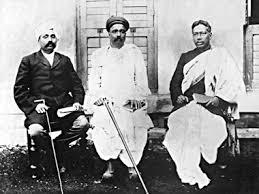 Ans : (i) The three personalities were popularly known as ‘Lal, Bal and Pal’.
(ii)They represented the Assertive nationalists.
(iii)The Assertive Nationalists had faith in the masses and proposed to win freedom
through mass action. They also believed that India could not gain independence
from the British rule until and unless a fierce fight is given to them in the form of
Swadeshi and the boycott movement.