ICSE-X-Chemistry
Previous Year Paper year:2016
Note: Please signup/signin free to get personalized experience.
Note: Please signup/signin free to get personalized experience.
10 minutes can boost your percentage by 10%
Note: Please signup/signin free to get personalized experience.
- #1-e-iiiThe catalyst used in the conversion of ethyne to ethane.Ans : The catalyst used in the conversion of ethyne to ethane: Lindlar
catalyst
- #1-e-ivThe type of reactions alkenes undergo.Ans : The type of reactions alkenes undergo: Addition reaction
- #1-e-vThe electrons present in the outermost shell of an atom.Ans : The electrons present in the outermost shell of an atom: Valence
electrons
- #1-f
- #1-f-iA gas of mass 32 gms has a volume of 20 litres at S.T.P. Calculate the
gram molecular weight of the gasAns : Given:
Mass of gas = 32 g
Volume occupied by 32 gms of gas =20 litres
Number of moles of gas = ``{\text{volume of gas} \over \text{molar gas volume}}``
`` = \frac{20}{22.4} = 0.89 \approx 0.9 ``
Number of moles of gas = ``{\text{Mass of Gas} \over \text{Gram Molecular weight of Gas}}``
hence
Gram molecular weight of gas = ``\text{Mass of gas} \over \text{Number of moles of gas} = \frac{32}{0.9}= 35.55 g``
- #1-f-ii [5]How much Calcium oxide is formed when 82g of calcium nitrate is heated?
Also find the volume of nitrogen dioxide evolved :
$$\ce{2Ca(NO3)2 -> 2CaO + 4NO2 + O2}$$
Ca=40,N=14,O=16Ans : $$\ce{2Ca(NO3)2 -> 2CaO + 4NO2 (^) + O2 }$$
At STP , 1 mole of any gas contains 22.4L
Since, 4 moles of ``\ce{NO2}`` are produced,
volume of nitrogen dioxide obtained = ``4 \cdot 22.4 = 89.6 L``
2 moles of ``\ce{Ca(NO3)2}`` produces 2 moles of CaO
∵328 g ``\ce{Ca(NO3)2}`` produces 112 g CaO
∴1 g ``\ce{Ca(NO3)2}`` produces ``\frac{112}{328}`` of CaO
∴ Hence, 82 g of Ca(NO ) will produce
``\require{cancel} \frac{112 \cdot \cancel{82} }{\cancelto{4}{328}} = \frac{112}{4} = 28 g ``
- #1-g [5]Match the salts given in Column I with their method of preparation given in
Column II :
Column I Column II (i) ``\ce{Pb(NO3)2 from PbO }`` A) Simple displacement (ii) ``\ce{MgCl2 from Mg }`` B) Titration (iii) ``\ce{FeCl3 from Fe }``
C) Neutralization (iv) ``\ce{NaNO3 from NaOH }`` D) Precipitation (v) ``\ce{ZnCO3 from ZnSO4 }`` E) Combination Ans :
(h)Column-I Column-II ``\ce{Pb(NO3)2}`` from PbO Precipitation ``\ce{MgCl2}`` from Mg Simple displacement ``\ce{FeCl3}`` from Fe Combination ``\ce{NaNO3}`` from NaOH Neutralisation ``\ce{ZnCO3}`` from ``\ce{ZnSO4}`` Titration
- #1-h
- #1-i [5]Write the IUPAC names of each of the following :
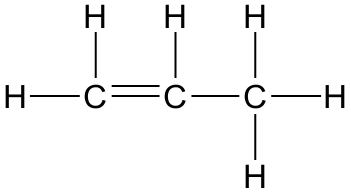
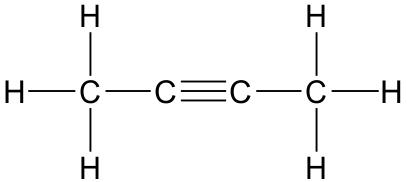
 Ans : -1. 1-Propene
-2. 2-Butyne
-3. Ethanal
- #1-iiRewrite the following sentences by using the correct symbol > (greater
than) or < (less than) in the blanks given :
1. The ionization potential of potassium is _________________ that of
sodium.
2. The electronegativity of lodine is ___________ that of Chlorine.Ans : -1. less than
-2. less than
- # [40]Section : IIAttempt any four questions from this Section
- #2Ans : 2.
- #2-a [4]Use the letters only written in the Periodic Table given below to answer the
questions that follow :
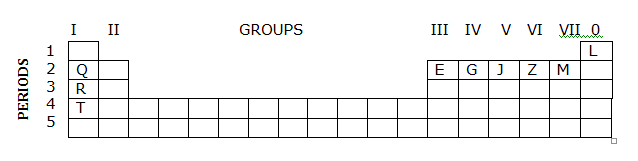
- #2-a-iState the number of valence electrons in atom J.Ans : 5
Atom J is a Group 5 element and a group is determined by the number of
electrons present in the outermost shell.
- #2-a-iiWhich element shown forms ions with a single negative charge?Ans : Element M from Group 7 accepts one electron to form an ion with a single
negative charge.