ICSE-X-Biology
Previous Year Paper year:2014
Note: Please signup/signin free to get personalized experience.
Note: Please signup/signin free to get personalized experience.
10 minutes can boost your percentage by 10%
Note: Please signup/signin free to get personalized experience.
- #1-c [5]Copy and complete the following by filling in the blanks 1 to 5 with appropriate
words:
The human female gonads are ovaries. A maturing egg in the ovary is present in a
sac of cells called ___________(1). As the egg grows larger, the follicle enlarges and gets
filled with a fluid and is now called the ______________(2) follicle. The process of
releasing the egg from the ovary is called _______________(3). The ovum is picked up by
the oviducal funnel and fertilisation takes place in the ______________(4). In about a
week, the blastocyst gets fixed in the endometrium of the uterus and this process is
called ____________________(5).Ans : The human female gonads are ovaries. A maturing egg in the ovary is present in a sac of cells called ovarian follicle
(1). As the egg grows larger, the follicle enlarges and gets filled with a fluid and is now called the Graafian
(2) follicle. The process of releasing the egg from the ovary is called ovulation
(3). The ovum is picked up by the oviducal funnel and fertilization takes place in the oviduct
(4). In about a week the blastocyst gets fixed in the endometrium of the uterus and this process is called implantation (5).
- #1-d [5]Given below are six sets with four terms each. In each set one term is odd and cannot
be grouped in the same category to which the other three belong. Identify the odd one
in each set and name the category to which the remaining three belong. The first one
has been done as an example.
Example: Calyx, Corolla, Stamens, Midrib
Odd term: midrib
Category: Parts of a flower
- #1-d-iHaemoglobin, Glucagon, Iodopsin, RhodopsinAns : Odd term: Glucagon
Category: Pigments
- #1-d-iiUrethra, Uterus, Urinary bladder, UreterAns : Odd term: Uterus
Category: Parts of excretory system
- #1-d-iiiTranspiration, Photosynthesis, Phagocytosis, GuttationAns : Odd term: Phagocytosis
Category: Processes in plants
- #1-d-ivCyton, Photon, Axon, DendronAns : Odd term: Photon
Category: Parts of a neuron.
- #1-d-vOxytocin,Insulin,Prolactin, ProgesteroneAns : Odd term: Insulin
Category: Female reproductive/sex hormona.
- #1-e [5]The figure given below represents an experimental setup with a weighing machine to
demonstrate a particular process in plants. The experimental setup was placed in
bright sunlight. Study the diagram and answer the following questions:
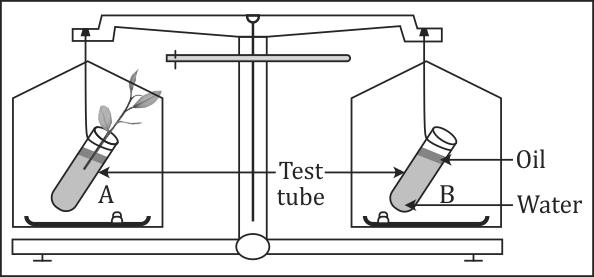
- #1-e-iName the process intended for study.Ans : Transpiration.
- #1-e-iiDefine the above mentioned process.Ans : It is the process in which water is lost in the form of vapour from the aerial parts of the plant.
- #1-e-iiiWhen the weight of the test tube (A & B) is taken before and after the experiment,
what is observed? Give reasons to justify your observation in A & B.Ans : After the experiment, we observe test tube A is raised up i.e., a loss of weight. In test tube B, the weight remains unchanged.
Reason: In test tube A, loses weight due to the plant transpires and loses water. In B there is no plant so there is no transpiration and the oil on the surface prevents direct evaporation and so weight remains unchanged.
- #1-e-ivWhat is the purpose of keeping the test tube B in the experimental setup?Ans : As a control experiment.
- #1-f [5]Match the items given in Column A with the most appropriate ones in Column B and
rewrite the correct matching pairs from Column A and Column B:
Sr. No. Column A Column B 1. Pituitary gland a. Testosterone 2. Sulphur dioxide b. Calcium 3. Seminiferous tubules c. Growth hormone 4. Clotting of blood d. Acid rain 5. Guttation e. Sperms f. Global warming g. Magnesium h. Hydathodes Ans :Column A Column B (1) Pituitary gland (c) Growth hormone (2) Sulphur dioxide (d) Acid rain (3) Seminiferous tubules (e) Sperms (4) Clotting of blood (b) Calcium (5) Guttation (h) Hydathodes
- #1-g [5]Choose the correct answer from the options given below:
- #1-g-iCretinism and Myxoedema are due to
A. Hypersecretion of thyroxin
B. Hypersecretion of growth hormone
C. Hyposecretion of thyroxin
D. Hyposecretion of growth hormoneAns : (C) Hyposecretion of thyroxin