ICSE-VIII-Mathematics
17: Special Types of Quadrilaterals Class 8 Maths
Note: Please signup/signin free to get personalized experience.
Note: Please signup/signin free to get personalized experience.
10 minutes can boost your percentage by 10%
Note: Please signup/signin free to get personalized experience.
- Qstn #10In an Isosceles-trapezium, show that the opposite angles are supplementary.Ans :

Given: ABCD is isosceles trapezium in which AD = BC
To Prove : (i) ∠A + ∠C = 180°
(ii) ∠B + ∠D = 180°
Proof: AB || CD
⇒ ∠A + ∠D = 180°
But ∠A = ∠B [Trapezium is isosceles]
∠B + ∠D = 180°
Similarly ∠A + ∠C = 180°
Hence the result.
- #11-iAC = BD and AC is perpendicular to BD?Ans :
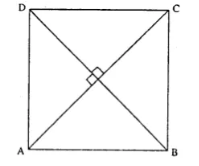
AC = BD (Given)
& AC ⊥ BD (Given)
i.e., Diagonals of quadrilateral are equal and they are ⊥r to each other.
∴ ABCD is square.
- #11-iiAC is perpendicular to BD but is not equal to it?Ans :
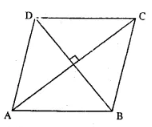
AC ⊥BD (Given)
But AC & BD are not equal
∴ ABCD is a Rhombus.
- #11-iiiAC = BD but AC is not perpendicular to BD?Ans :
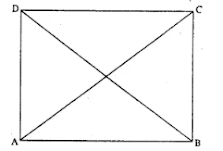
AC = BD but Ac & BD are not ⊥r to each other.
∴ ABCD is a rectangle.
- Qstn #12Prove that the diagonals of a parallelogram bisect each other.Ans : dlt21985512572657282403">

Given: ||gm ABCD in which diagonals AC and BD bisect each other.
To Prove: OA = OC and OB = OD
Proof: AB || CD (Given)
∠1 = ∠2 (alternate ∠s)
∠3 = ∠4 (alternate ∠s)
and AB = CD (opposite sides of //gm)
∆COD = ∆AOB (A.S.A. rule)
OA = OC and OB = OD
Hence the result.
- Qstn #13If the diagonals of a parallelogram are of equal lengths, the parallelogram is a rectangle. Prove it.Ans :

Given: //gm ABCD in which AC = BD
To Prove : ABCD is rectangle.
Proof : In ∆ABC and ∆ABD
AB = AB (Common)
AC = BD (Given)
BC = AD (opposite sides of ||gm)
∆ABC = ∆ABD (S.S.S. Rule)
∠A = ∠B
But AD // BC (opp. sides of ||gm are ||)
∠A + ∠B = 180°
∠A = ∠B = 90°
Similarly, ∠D = ∠C = 90°
Hence, ABCD is a rectangle.
- Qstn #14In parallelogram ABCD, E is the mid-point of AD and F is the mid-point of BC. Prove that BFDE is a parallelogram.Ans :

Given: //gm ABCD in which E and F are mid-points of AD and BC respectively.
To Prove: BFDE is a ||gm.
Proof : E is mid-point of AD. (Given)
DE = 1/2 AD
Also F is mid-point of BC (Given)
BF = 1/2 BC
But AD = BC (opp. sides of ||gm)
BF = DE
Again AD || BC
⇒ DE || BF
Now DE || BF and DE = BF
Hence BFDE is a ||gm.
- Qstn #15In parallelogram ABCD, E is the mid-point of side AB and CE bisects angle BCD. Prove that : (i) AE = AD, (ii) DE bisects and ∠ADC and (iii) Angle DEC is a right angle.Ans :

Given: ||gm ABCD in which E is mid-point of AB and CE bisects ZBCD.
To Prove : (i) AE = AD
(ii) DE bisects ∠ADC
(iii) ∠DEC = 90°
Const. Join DE
Proof :(i) AB || CD (Given)
and CE bisects it.
∠1 = ∠3 (alternate ∠s) ...(i)
But ∠1 = ∠2 (Given) ...(ii)
From (i) & (ii)
∠2 = ∠3
BC = BE (sides opp. to equal angles)
But BC = AD (opp. sides of ||gm)
and BE = AE (Given)
AD = AE
∠4 = ∠5 (∠s opp. to equal sides)
But ∠5 = ∠6 (alternate ∠s)
⇒ ∠4 = ∠6
DE bisects ∠ADC.
Now AD // BC
⇒ ∠D + ∠C = 180°
⇒ 2∠6 + 2∠1 = 180°
DE and CE are bisectors.
∠6 + ∠1 = 180°/2
⇒ ∠6 + ∠1 = 90°
But ∠DEC + ∠6 + ∠1 = 180°
⇒ ∠DEC + 90° = 180°
⇒ ∠DEC = 180° - 90°
⇒ ∠DEC = 90°
Hence the result.
- Qstn #16In the following diagram, the bisectors of interior angles of the parallelogram PQRS enclose a quadrilateral ABCD.

Show that:Ans : Given: In parallelogram ABCD bisector of angles P and Q, meet at A, bisectors of ∠R and ∠S meet at C. Forming a quadrilateral ABCD as shown in the figure.
To prove:
- #16-i∠PSB + ∠SPB = 90°Ans : ∠PSB + ∠SPB = 90°
- #16-ii∠PBS = 90°Ans : ∠PBS = 90°
- #16-iii∠ABC = 90°Ans : ∠ABC = 90°
- #16-iv∠ADC = 90°Ans : ∠ADC = 90°
- #16-v∠A = 90°Ans : ∠A = 9°