ICSE-VIII-Mathematics
17: Special Types of Quadrilaterals Class 8 Maths
Note: Please signup/signin free to get personalized experience.
Note: Please signup/signin free to get personalized experience.
10 minutes can boost your percentage by 10%
Note: Please signup/signin free to get personalized experience.
- #
- #Section : A
- Qstn #1In parallelogram ABCD, ∠A = 3 times ∠B. Find all the angles of the parallelogram. In the same parallelogram, if AB = 5x - 7 and CD = 3x + 1 ; find the length of CD.Ans :
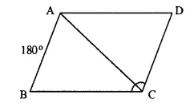
Let ∠B = x
∠A = 3 ∠B = 3x
AD || BC
∠A + ∠B = 180°
3x + x = 180°
⇒ 4x = 180°
⇒ x = 45°
∠B = 45°
∠A = 3x = 3 x 45 = 135°
and ∠B = ∠D = 45°
opposite angles of ||gm are equal.
∠A = ∠C = 135°
opposite sides of //gm are equal.
AB = CD
5x - 7 = 3x + 1
⇒ 5x - 3x = 1+7
⇒ 2x = 8
⇒ x = 4°
CD = 3 x 4 + 1 = 13
Hence, 135°, 45°, 135° and 45°; 13
- Qstn #2In parallelogram PQRS, ∠Q = (4x - 5)° and ∠S = (3x + 10)°. Calculate : ∠Q and ∠R.Ans : In parallelogram PQRS,
∠Q = (4x - 5)° and ∠S = (3x + 10)°
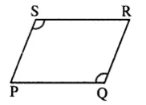
opposite ∠s of //gm are equal.
∠Q = ∠S
4x - 5 = 3x + 10
⇒ 4x - 3x = 10 + 5
⇒ x = 15
∠Q = 4x - 5 = 4×15 - 5 = 55°
Also ∠Q + ∠R = 180°
⇒ 55° + ∠R = 180°
∠R = 180° - 55° = 125°
∠Q = 55° ; ∠R = 125°
- Qstn #3In rhombus ABCD ;Ans : AD || BC
∠A + ∠B = 180°
⇒ 74° + ∠B = 180°
⇒ ∠B = 180° - 74° = 106°
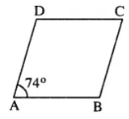
opposite angles of Rhombus are equal.
∠A = ∠C = 74°
Sides of Rhombus are equal.
BC = CD = AD = 7.5 cm
- #3-iif ∠A = 74° ; find ∠B and ∠C.Ans : ∠B = 106° ; ∠C = 74°
- #3-iiif AD = 7.5 cm ; find BC and CD.Ans : BC = 7.5 cm and CD = 7.5 cm
- #4-iif PQ = 3x - 7 and QR = x + 3 ; find PSAns : sides of square are equal.
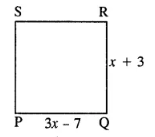
PQ = QR
⇒ 3x - 7 = x + 3
⇒ 3x - x = 3 + 7
⇒ 2x = 10
⇒ x = 5
PS = PQ = 3x - 7 = 3×5 - 7 =8
- #4-iiif PR = 5x and QR = 9x - 8. Find QSAns : PR = 5x and QS = 9x - 8
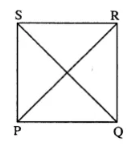
As diagonals of square are equal.
PR = QS
5x = 9x - 8
⇒ 5x - 9x = -8
⇒ -4x = -8
⇒ x = 2
QS = 9x - 8 = 9 ×2 - 8 = 10
- Qstn #5ABCD is a rectangle, if ∠BPC = 124°
Calculate: (i) ∠BAP (ii) ∠ADP
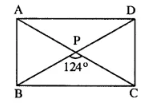 Ans : Diagonals of rectangle are equal and bisect each other.
∠PBC = ∠PCB = x (say)
But ∠BPC + ∠PBC + ∠PCB = 180°
124° + x + x = 180°
⇒ 2x = 180° - 124°
⇒ 2x = 56°
⇒ x = 28°
∠PBC = 28°
But ∠PBC = ∠ADP [Alternate ∠s]
∠ADP = 28°
Again ∠APB = 180° - 124° = 56°
Also PA = PB
∠BAP = 1/2 (180° - ∠APB)
= 1/2 ×(180°- 56°)= 1/2 ×124° = 62°
Hence (i) ∠BAP = 62° (ii) ∠ADP = 28°
- Qstn #6ABCD is a rhombus. If ∠BAC = 38°, find : (i) ∠ACB (ii) ∠DAC (iii) ∠ADC.
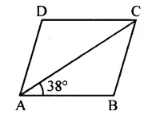 Ans : ABCD is Rhombus (Given)
AB = BC
∠BAC = ∠ACB (∠s opp. to equal sides)
But ∠BAC = 38° (Given)
∠ACB = 38°
In ∆ABC,
∠ABC + ∠BAC + ∠ACB = 180°
⇒ ∠ABC + 38° + 38° = 180°
⇒ ∠ABC = 180° - 76° = 104°
But ∠ABC = ∠ADC (opp. ∠s of rhombus)
∠ADC = 104°
⇒ ∠DAC = ∠DCA ( AD = CD)
⇒ ∠DAC = 1/2 [180° - 104°]
⇒ ∠DAC = 1/2 x 76° = 38°
Hence (i) ∠ACB = 38° (ii) ∠DAC = 38° (iii) ∠ADC = 104°
- Qstn #7ABCD is a rhombus. If ∠BCA = 35°. find ∠ADC.Ans : Given: Rhombus ABCD in which ∠BCA = 35°
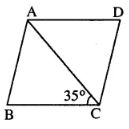
To find : ∠ADC
Proof : AD || BC
∠DAC = ∠BCA (Alternate ∠s)
But ∠BCA = 35° (Given)
∠DAC = 35°
But ∠DAC = ∠ACD (AD = CD)& ∠DAC +∠ACD + ∠ADC = 180°
⇒ 35° + 35° + ∠ADC = 180°
⇒ ∠ADC = 180° - 70° = 110°
Hence, ∠ADC = 110°
- Qstn #8PQRS is a parallelogram whose diagonals intersect at M.
If ∠PMS = 54°, ∠QSR = 25° and ∠SQR = 30° ; find : (i) ∠RPS (ii) ∠PRS (iii) ∠PSR.Ans : Given : ||gm PQRS in which diagonals PR & QS intersect at M.
∠PMS = 54° ; ∠QSR = 25° and ∠SQR = 30°
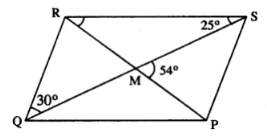
To find : (i) ∠RPS (ii) ∠PRS (iii) ∠PSR
Proof : QR || PS
⇒ ∠PSQ = ∠SQR (Alternate ∠s)
But ∠SQR = 30° (Given)
∠PSQ = 30°
In ∆SMP,
∠PMS + ∠PSM + ∠MPS = 180° or 54° + 30° + ∠RPS = 180°
⇒ ∠RPS = 180°- 84° = 96°
Now ∠PRS + ∠RSQ = ∠PMS
∠PRS + 25° = 54°
⇒ ∠PRS = 54° - 25° = 29°
⇒ ∠PSR = ∠PSQ + ∠RSQ = 30° + 25° = 55°
Hence (i) ∠RPS = 96° (ii) ∠PRS = 29° (iii) ∠PSR = 55°
- Qstn #9Given: Parallelogram ABCD in which diagonals AC and BD intersect at M.
Prove: M is mid-point of LN.Ans :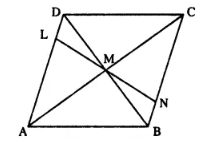
Proof: Diagonals of //gm bisect each other.
MD = MB
Also ∠ADB = ∠DBN (Alternate ∠s)
& ∠DML = ∠BMN (Vert. opp. ∠s)
∆DML = ∆BMN
LM = MN
M is mid-point of LN.
Hence proved.