CBSE-XI-Physics
38: Electromagnetic Induction
Note: Please signup/signin free to get personalized experience.
Note: Please signup/signin free to get personalized experience.
10 minutes can boost your percentage by 10%
Note: Please signup/signin free to get personalized experience.
- #Section : i
- Qstn #1A metallic loop is placed in a nonuniform magnetic field. Will an emf be induced in the loop?Ans : If the flux through the loop does not vary, there will be no induced emf. Because the magnetic field is non-uniform and does not change with time, there will be no change in the magnetic flux through the loop. Hence, no emf will be induced in the loop.
Page No 303:
- Qstn #2An inductor is connected to a battery through a switch. Explain why the emf induced in the inductor is much larger when the switch is opened as compared to the emf induced when the switch is closed.Ans : When we close the switch, the current takes some time to grow in the circuit. Due to this growth of current, the flux increases; hence, an emf is induced. On the other hand, when we open the switch, there is no path for the current to flow; hence, it suddenly drops to zero. This rate of decrease of current is much greater than the rate of growth of current when the switch is closed. So, when the switch is opened, the induced emf is more.
Page No 303:
- Qstn #3The coil of a moving-coil galvanometer keeps on oscillating for a long time if it is deflected and released. If the ends of the coil are connected together, the oscillation stops at once. Explain.Ans : When the ends of the coil are not connected, the coil acts as an inductor in which oscillations persist until the current decays slowly. When these ends are connected, the coil forms a close loop; hence, there is inductance across the ends and the coil does not behave like an inductor. Therefore, all oscillations stop at once.
Page No 303:
- Qstn #4A short magnet is moved along the axis of a conducting loop. Show that the loop repels the magnet if the magnet is approaching the loop and attracts the magnet if it is going away from the loop.Ans :

Consider the above situation in which a magnet is moved towards a conducting circular loop. The north pole of the magnet faces the loop. As the magnet comes closer to the loop, the magnetic field increases; hence, flux through the loop increases. According to Lenz's law, the direction of induced current is such that it opposes the magnetic field that has induced it. Thus, the induced current produces a magnetic field in the direction opposite to the original field; hence, the loop repels the magnet.

On the other hand, when the magnet is going away from the loop, the magnetic field decreases. Hence, flux through the loop decreases. According to Lenz's law, the induced current produces a magnetic field in the opposite direction of the original field; hence, the loop attracts the magnet.
Page No 303:
- Qstn #5Two circular loops are placed coaxially but separated by a distance. A battery is suddenly connected to one of the loops establishing a current in it. Will there be a current induced in the other loop? If yes, when does the current start and when does it end? Do the loops attract each other or do they repel?Ans :
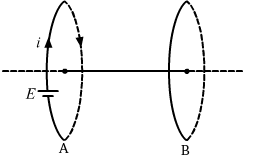
Consider loops A and B placed coaxially as shown above. Let the direction of the current in loop A be clockwise when the battery is connected to it. According to the right-hand screw rule, the direction of the magnetic field due to this current will be towards left, as seen from the side of B. Due to a sudden flux through loop B, a current will be induced in it. It will only be induced for a moment when the current suddenly jumps from zero to a constant value. After it has attained a constant value, there will be no induced current. Now, according to Lenz's law, the direction of the induced current in loop B will be such that it will oppose the magnetic field due to loop A. Hence, a current will be induced in anti-clockwise direction in loop B. The induced current will flow in loop B as soon as the current grows in loop A and will end when the current through loop A becomes zero. Because the directions of the currents in the loops are opposite, they will repel each other.
Page No 303:
- Qstn #6The battery discussed in the previous question is suddenly disconnected. Is a current induced in the other loop? If yes, when does it start and when does it end? Do the loops attract each other or repel?Ans : When the battery is suddenly disconnected, a current is induced in loop B due to a sudden change in the flux through it. It is only induced for a moment when the current suddenly falls to zero. There is no induced current after it has fallen to zero. According to Lenz's law, the induced current is such that it increases the decreasing magnetic field. So, if the current in loop A is in clockwise direction, the induced current in loop B will also be in clockwise direction. Hence, the two loops will attract each other.
Page No 303:
- Qstn #7If the magnetic field outside a copper box is suddenly changed, what happens to the magnetic field inside the box? Such low-resistivity metals are used to form enclosures which shield objects inside them against varying magnetic fields.Ans : The varying magnetic field induces eddy currents on the walls of the copper box. There is a magnetic field due to the induced eddy currents, that is in opposite direction. As copper has good conductivity, thus the magnetic field due to the eddy currents will be strong. The magnetic field induced due to eddy currents in the copper walls cancel the original magnetic field. Thus, magnetic field does not penetrate the enclosure made of copper. The magnetic field inside the box remains zero. This is how a copper box protects the inside material from varying magnetic fields.
Page No 303:
- Qstn #8Metallic (nonferromagnetic) and nonmetallic particles in a solid waste may be separated as follows. The waste is allowed to slide down an incline over permanent magnets. The metallic particles slow down as compared to the nonmetallic ones and hence are separated. Discuss the role of eddy currents in the process.Ans : When solid waste is allowed to slide over a permanent magnet, an emf is induced in metallic particles. This is because magnetic flux linked with the particles changes in this case. According to Lenz's law this induced emf opposes its cause i.e. downward motion along the inclined plane of the permanent magnet. On the other hand, non-metallic or insulating particles are free from such effects. As a result, the metallic particles slow down and hence get separated from the waste (or non-metallic particles).
Page No 303:
- Qstn #9A pivoted aluminium bar falls much more slowly through a small region containing a magnetic field than a similar bar of an insulating material. Explain.Ans : An aluminium bar falls slowly through a small region containing a magnetic field because of the induced eddy currents (or induced emf) in it. According to Lenz's law this induced eddy current oppose its cause (its motion). Hence, it slows down while falling through a region containing a magnetic field. On the other hand, non-metallic or insulating materials are free from such effects.
Page No 303:
- Qstn #10A metallic bob A oscillates through the space between the poles of an electromagnet (figure). The oscillations are more quickly damped when the circuit is on, as compared to the case when the circuit is off. Explain.
FigureAns : When the circuit is on, eddy currents are produced on the surface of the metallic bob. Due to these eddy currents, thermal energy is generated in it. This thermal energy comes at the cost of the kinetic energy of the bob; hence, oscillations are more quickly damped when the circuit is on compared to when the circuit is off.
Page No 304:
- Qstn #11Two circular loops are placed with their centres separated by a fixed distance. How would you orient the loops to have
- #11-athe largest mutual inductanceAns : For the largest mutual inductance, the two loops should be placed coaxially. In this case, flux through a loop due to another loop is the largest; hence, mutual inductance is the largest.
- #11-bthe smallest mutual inductance?Ans : For the smallest mutual inductance, the two loops should be placed such that their axes are perpendicular to each other. In this case, flux through a loop due to another loop is the smallest (zero); hence, mutual inductance is the smallest.
Page No 304: