CBSE-XI-Physics
30: Gauss's Law
Note: Please signup/signin free to get personalized experience.
Note: Please signup/signin free to get personalized experience.
10 minutes can boost your percentage by 10%
Note: Please signup/signin free to get personalized experience.
- #Section : i
- Qstn #1A small plane area is rotated in an electric field. In which orientation of the area, is the flux of the electric field through the area maximum? In which orientation is it zero?Ans : The flux of an electric field `` \stackrel{\to }{E}`` through a surface area `` ∆\stackrel{\to }{S}`` is given by `` ∆\varphi =\stackrel{\to }{E}.∆\stackrel{\to }{S}`` , where `` ∆\varphi `` is the flux. Therefore, `` ∆\varphi =E∆SCos\theta ``. Here, `` \theta `` is the angle between the electric field `` \stackrel{\to }{E}`` and the normal to the surface area.
Thus, for the flux to be maximum, cos `` \theta `` should be maximum. Thus, for `` \theta `` = 0, the flux is maximum, i.e. the electric field lines are perpendicular to the surface area.
The flux is minimum if `` \theta `` = 90. Thus, cos `` \theta `` = 0 and, hence, flux is also 0. Thus, if the electric field lines are parallel to the surface area, the flux is minimum.
Page No 139:
- Qstn #2A circular ring of radius r made of a non-conducting material is placed with its axis parallel to a uniform electric field. The ring is rotated about a diameter through 180°. Does the flux of the electric field change? If yes, does it decrease or increase?Ans : It is given that the circular ring, made of a non-conducting material, of radius r is placed with its axis parallel to a uniform electric field.This means that both the electric field and the area vector are parallel to each other (area vector is always perpendicular to the surface area). Thus, the flux through the ring is given by `` \stackrel{\to }{E}.\stackrel{\to }{S}`` = ES cos 0 = E(`` \,\mathrm{\,\pi \,}{r}^{\mathit{2}}``).
Now, when the ring is rotated about its diameter through 1800, the angle between the area vector and the electric field becomes 1800. Thus, the flux becomes `` -``E `` \left(\,\mathrm{\,\pi \,}{r}^{\mathit{2}}\right)``.
Page No 139:
- Qstn #3A charge Q is uniformly distributed on a spherical shell. What is the field at the centre of the shell? If a point charge is brought close to the shell, will the field at the centre change? Does your answer depend on whether the shell is conducting or non-conducting?Ans : The field at the centre of the shell is zero. As all the charge given to a conductor resides on the surface, the field at any point inside the conducting sphere is zero. Also, the charge distribution at the surface is uniform; so all the electric field vectors due to these charges at the centre are equal and opposite. So, they cancel each other, resulting in a zero net value of the field.
When a charge is brought near the shell, due to induction, opposite polarity charges induce on the surface nearer to the charge and the same polarity charges appear on the face farther from the charge. In this way, a field is generated inside the shell. Hence, the field at the centre is non-zero.
Yes, our answer changes in case of a non-conducting spherical shell. As the charge given to the surface of a non-conducting spherical shell spreads non-uniformly, there is a net electric field at the centre of the sphere.
Page No 139:
- Qstn #4A spherical shell made of plastic, contains a charge Q distributed uniformly over its surface. What is the electric field inside the shell? If the shell is hammered to deshape it, without altering the charge, will the field inside be changed? What happens if the shell is made of a metal?Ans : As the shell is made of plastic, it is non-conducting. But as the charge is distributed uniformly over the surface of the shell, the sum of all the electric field vectors at the centre due to this kind of distribution is zero. But when the plastic shell is deformed, the distribution of charge on it becomes non-uniform. In other words, the sum of all the electric field vectors is non-zero now or the electric field exists at the centre now.
In case of a deformed conductor, the field inside is always zero.
Page No 139:
- Qstn #5A point charge q is placed in a cavity in a metal block. If a charge Q is brought outside the metal, will the charge q feel an electric fore?Ans : Yes, the charge Q will feel an electric force, as the charge q given to the metal block appears on the surface. Hence, it exerts an electric force on the charge Q.
Page No 139:
- Qstn #6A rubber balloon is given a charge Q distributed uniformly over its surface. Is the field inside the balloon zero everywhere if the balloon does not have a spherical surface?Ans : No, the field is not zero everywhere, as the electric field vector due to the charge distribution does not cancel out at any place inside the balloon because of its non-spherical shape.
Page No 139:
- Qstn #7It is said that any charge given to a conductor comes to its surface. Should all the protons come to the surface? Should all the electrons come to the surface? Should all the free electrons come to the surface?Ans : Protons never take part in any electrical phenomena because they are inside the nuclei and are not able to interact easily. These are the free electrons that are responsible for all electrical phenomena. So, if a conductor is given a negative charge, the free electrons come to the surface of the conductor. If the conductor is given a positive charge, electrons move away from the surface and leave a positive charge on the surface of the conductor.
Page No 139:
- #Section : ii
- Qstn #1A charge Q is uniformly distributed over a large plastic plate. The electric field at a point P close to the centre of the plate is 10 V m-1. If the plastic plate is replaced by a copper plate of the same geometrical dimensions and carrying the same charge Q, the electric field at the point P will become
(a) zero
(b) 5 V m-1
(c) 10 V m-1
(d) 20 V m-1digAnsr: cAns : (c) 10 V m-1
The electric field remains same for the plastic plate and the copper plate, as both are considered to be infinite plane sheets. So, it does not matter whether the plate is conducting or non-conducting.
The electric field due to both the plates,
E = `` \frac{\sigma }{{\epsilon }_{0}}``
Page No 139:
- Qstn #2A metallic particle with no net charge is placed near a finite metal plate carrying a positive charge. The electric force on the particle will be
(a) towards the plate
(b) away from the plate
(c) parallel to the plate
(d) zerodigAnsr: aAns : (a) towards the plate
The particle is a conductor. When it is brought near a positively charged metal plate, opposite charge is induced on its face nearer to the plate, i.e. negative and the same amount of charge, but of opposite polarity, goes to the farther end, i.e. positive.
Now, the attractive force is due to charges of opposite polarity. As they are at a lesser distance than the same polarity charges, the force of attraction is greater than the force of repulsion. In other words, the force on the particle is towards the plate.
Page No 139:
- Qstn #3A thin, metallic spherical shell contains a charge Q on it. A point charge q is placed at the centre of the shell and another charge q1 is placed outside it as shown in the figure (30-Q1). All the three charges are positive. The force on the charge at the centre is
(a) toward left
(b) towards right
(c) upward
(d) zero
Figure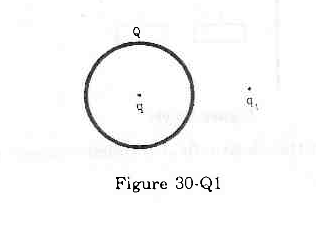 digAnsr: dAns : (d) zero
A charge placed outside a conductor can induce a charge on it or can affect the charge on its surface. But it does not affect what is contained inside the conductor. Similarly, charge q1 can affect charge Q; still, the force inside the conductor remains zero. An analogy to the above statement is that when lightning strikes a car, the charge that appears on the car's metal surface does not affect its interior. Due to this passengers are recommended to sit inside the car.
Page No 140:
- Qstn #4Consider the situation of the previous problem. The force on the central charge due to the shell is
(a) towards left
(b) towards right
(c) upward
(d) zerodigAnsr: bAns : (b) towards right
This question can be answered using the concept of electric field lines.
We know that electric field lines emerge from a positive charge and move towards a negative charge. Now, charge Q, on the face in front of charge q1, tries to nullify the field lines emerging from charge q1. So, the charge on the farther face of the conductor dominates and, hence, a force appears to the right of charge q.
Page No 140:
- Qstn #5Electric charges are distributed in a small volume. The flux of the electric field through a spherical surface of radius 10 cm surrounding the total charge is 25 V m. The flux over a concentric sphere of radius 20 cm will be
(a) 25 V m
(b) 50 V m
(c) 100 V m
(d) 200 V mdigAnsr: aAns : (a) 25 V m
The flux through a surface does not depend on its shape and size; it only depends upon the charge enclosed inside the volume. Here, the charge enclosed by the sphere of radius 10 cm and the sphere of radius 20 cm is same so the flux through them will also be same.
Page No 140: