CBSE-XI-Physics
29: Electric Field and Potential
Note: Please signup/signin free to get personalized experience.
Note: Please signup/signin free to get personalized experience.
10 minutes can boost your percentage by 10%
Note: Please signup/signin free to get personalized experience.
- Qstn #14When a charged comb is brought near a small piece of paper, it attracts the piece. Does the paper become charged when the comb is brought near it?Ans : When a charged comb is brought near a small piece of paper, it attracts the piece due to induction. There's a distribution of charges on the paper. When a charged comb is brought near the pieces of paper then an opposite charge is induced on the near end of the pieces of paper so the charged comb attracts the opposite charge on the near end of paper and similar on the farther end. The net charge on the paper remains zero.
Page No 119:
- #Section : ii
- Qstn #1Figure shows some of the electric field lines corresponding to an electric field. The figure suggests that
(a) EA > EB > EC
(b) EA = EB = EC
(c) EA = EC > EB
(d) EA = EC < EB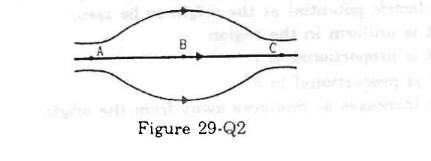 digAnsr: cAns : (c) EA = EC > EB
The crowding of electric field lines at a point shows the strength of the field at that point. More the crowding of field lines, more will be the field strength. At points A and C, there's equal crowding, whereas at point B, the lines are far apart. Therefore, EA = EC > EB
Page No 119:
- Qstn #2When the separation between two charges is increased, the electric potential energy of the charges
(a) increases
(b) decreases
(c) remains the same
(d) may increase or decreasedigAnsr: dAns :
(d) may increase or decrease
The electric potential energy, E, between the two charges, q1 and q2, separated by the distance, r, is given as
`` E=k\frac{{q}_{1}{q}_{2}}{r},``
`` \,\mathrm{\,where\,}k=\,\mathrm{\,constant\,}``
As the distance between the charges is increased, the energy will decrease if both the charges are of similar nature. But if the charges are oppositely charged, the energy will become less negative and, hence, will increase.
Page No 119:
- Qstn #3If a positive charge is shifted from a low-potential region to a high-potential region, the electric potential energy
(a) increases
(b) decreases
(c) remains the same
(d) may increase of decreasedigAnsr: aAns : (a) increases
The electric potential energy, E, of a positive charge, q, in a potential, V, is given by E = qV. As the charge is moved from a low-potential region to a high-potential region, i.e. as V is increased, E will increase.
Page No 120:
- Qstn #4Two equal positive charges are kept at points A and B. The electric potential at the points between A and B (excluding these points) is situated while moving from A to B. The potential
(a) continuously increases
(b) continuously decreases
(c) increases then decreases
(d) decreases then increasesdigAnsr: dAns : (d) decreases then increases
Let the distance between the points A and B be r.
Let us take a point P at a distance x from A (x < r).
Electric potential V at point P due to two charges of equal magnitude q is given by
`` V=\frac{q}{4\pi {\in }_{0}x}+\frac{q}{4\pi {\in }_{0}(r-x)}``
`` \Rightarrow V=\frac{qr}{4\pi {\in }_{0}x(r-x)}``
Now, differentiating V with respect to x, we get
`` \frac{\,\mathrm{\,d\,}V}{\,\mathrm{\,d\,}x}=\frac{-qr(r-2x)}{4\pi {\in }_{0}{x}^{2}(r-x{)}^{2}}``
Therefore, x = r/2.
It can be observed that `` \frac{\,\mathrm{\,d\,}V}{\,\mathrm{\,d\,}x}<0`` for x < r/2. Thus, the potential is decreasing first. At
x = r/2, the potential is minimum.
As `` \frac{\,\mathrm{\,d\,}V}{\,\mathrm{\,d\,}x}>0`` for x > r/2, the potential is increasing after x = r/2.
Page No 120:
- Qstn #5The electric field at the origin is along the positive x-axis. A small circle is drawn with the centre at the origin, cutting the axes at points A, B, C and D with coordinates (a, 0), (0, a), (-a, 0), (0, -a), respectively. Out of the points on the periphery of the circle, the potential is minimum at
(a) A
(b) B
(c) C
(d) DdigAnsr: aAns : (a) A
The potential due to a charge decreases along the direction of electric field. As the electric field is along the positive x-axis, the potential will decrease in this direction. Therefore, the potential is minimum at point (a,0).
Page No 120:
- Qstn #6If a body is charged by rubbing it, its weight
(a) remains precisely constant
(b) increases slightly
(c) decreases slightly
(d) may increase slightly or may decrease slightlydigAnsr: dAns : (d) may increase slightly or may decrease slightly
If a body is rubbed with another body, it'll either gain some electrons from the other body and become negatively charged or it'll lose some electrons to the other body and become positively charged. Gain of electrons increases the weight of a body slightly and loss of electrons reduces the weight slightly.
Page No 120:
- Qstn #7An electric dipole is placed in a uniform electric field. The net electric force on the dipole
(a) is always zero
(b) depends on the orientation of the dipole
(c) can never be zero
(d) depends on the strength of the dipoledigAnsr: aAns : (a) is always zero
An electric dipole consists of two equal and opposite charges. When the dipole is placed in an electric field, both its charges experience equal and opposite forces. Therefore, the net resultant force on the dipole is zero. But net torque on the dipole is not zero.
Page No 120:
- Qstn #8Consider the situation in the figure. The work done in taking a point charge from P to A is WA, from P to B is WB and from P to C is WC.
(a) WA < WB < WC
(b) WA > WB > WC
(c) WA = WB = WC
(d) None of these
Figure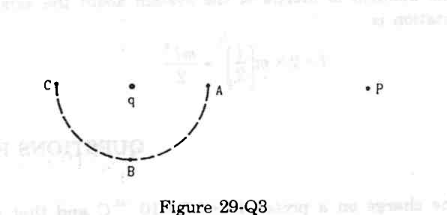 digAnsr: cAns : (c) WA = WB = WC
Points A, B and C lie at the same distance from the charge q, i.e. they are lying on an equipotential surface. So, work done in moving a charge from A to B (WAB) or B to C (WBC) is zero.
Hence, work done in bringing a charge from P to A = WA,
from P to B, WB = WA+WAB = WA
and from P to C, WC = WA + WAB + WBC = WA
Hence, WA = WB = WC
Page No 120:
- Qstn #9A point charge q is rotated along a circle in an electric field generated by another point charge Q. The work done by the electric field on the rotating charge in one complete revolution is
(a) zero
(b) positive
(c) negative
(d) zero if the charge Q is at the centre, otherwise non-zerodigAnsr: aAns : (a) zero
The electrostatic field is conservative and the work done by the field is a state function, i.e. it only depends on the initial and final positions of the charge but not on the path followed by it. In completing one revolution, the charge has the same initial and final positions. Therefore, the work done by the field on rotating the charge in one complete revolution is zero.
Page No 120:
- #Section : iii
- Qstn #1Mark out the correct options.
(a) The total charge of the universe is constant.
(b) The total positive charge of the universe is constant.
(c) The total negative charge of the universe is constant.
(d) The total number of charged particles in the universe is constant.digAnsr: aAns : (a) The total charge of the universe is constant.
According to the principal of conservation of charge, the net amount of positive charge minus the net amount of negative charge in the universe is always constant. Thus, the total charge of the universe is constant. The total positive charge of the universe may increase or decrease, depending on the total increase or decrease in negative charge. This is the principle of conservation of charge that is universal in nature.
Page No 120:
- Qstn #2A point charge is brought inside an electric field. The electric field at a nearby point
(a) will increase if the charge is positive
(b) will decrease if the charge is negative
(c) may increase if the charge is positive
(d) may decrease if the charge is negativedigAnsr: c,dAns : (c) may increase if the charge is positive
(d) may decrease if the charge is negative
Electric field is a vector quantity. The electric field at a point due to a number of point charges is the vector sum of electric field due to individual charges. So, when a positive charge is brought into an electric field, the electric field due to the positive charge is added to the electric field already present. Therefore, the electric field increases.
When a negative charge is brought into an electric field, the electric field due to the negative charge is subtracted from the electric field already present. Therefore, the electric field decreases.
Page No 120:
- Qstn #3The electric field and the electric potential at a point are E and V, respectively.
(a) If E = 0, V must be zero.
(b) If V = 0, E must be zero.
(c) If E ≠ 0, V cannot be zero.
(d) If V ≠0, E cannot be zero.Ans : None of the above.
Electric field,
`` E=\frac{-dV}{dr}``, where V = electric potential
For E = 0, V should be constant.
So, when E = 0, it is not necessary that V should be 0.
Hence, none of the above signifies the correct relation.
Page No 120: