CBSE-XI-Physics
29: Electric Field and Potential
Note: Please signup/signin free to get personalized experience.
Note: Please signup/signin free to get personalized experience.
10 minutes can boost your percentage by 10%
Note: Please signup/signin free to get personalized experience.
- #Section : i
- Qstn #1The charge on a proton is +1.6 × 10⁻¹⁹ C and that on an electron is -1.6 × 10⁻¹⁹ C. Does it mean that the electron has 3.2 × 10⁻¹⁹ C less charge than the proton?Ans : An electron and a proton have equal and opposite charges of magnitude 1.6 × 10⁻¹⁹ C. But it doesn't mean that the electron has 3.2 × 10⁻¹⁹ C less charge than the proton.
Page No 119:
- Qstn #2Is there any lower limit to the electric force between two particles placed at a separation of 1 cm?Ans : Yes, there's a lower limit to the electric force between two particles placed at a separation of 1 cm, which is equal to the magnitude of force of repulsion between two electrons placed at a separation of 1 cm.
Page No 119:
- Qstn #3Consider two particles A and B of equal charges placed at some distance. Particle A is slightly displaced towards B. Does the force on B increase as soon as particle A is displaced? Does the force on particle A increase as soon as it is displaced?Ans : Electrostatic force follows the inverse square law, `` F=\frac{k}{{r}^{2}}``. This means that the force on two particles carrying charges increases on decreasing the distance between them. Therefore, as particle A is slightly displaced towards B, the force on B as well as A will increase.
Page No 119:
- Qstn #4Can a gravitational field be added vectorially to an electric field to get a total field?Ans : No, a gravitational field cannot be added vectorially to an electric field.
This is because for electric influence, one or both the bodies should have some net charge and for gravitational influence both the bodies should have some mass. Also, gravitational field is a weak force,while electric field is a strong force.
Page No 119:
- Qstn #5Why does a phonograph record attract dust particles just after it is cleaned?Ans : When a phonograph record is cleaned, it develops a charge on its surface due to rubbing. This charge attracts the neutral dust particles due to induction.
Page No 119:
- Qstn #6Does the force on a charge due to another charge depend on the charges present nearby?Ans : Coulomb's Law states that the force between two charged particle is given by
`` F=\frac{{q}_{1}{q}_{2}}{4\pi {\in }_{0}{r}^{2}}``,
where
q1 and q2 are the charges on the charged particles
r = separation between the charged particles
`` {\in }_{0}``= permittivity of free space
According to the Law of Superposition, the electrostatic forces between two charged particles are unaffected due to the presence of other charges.
Page No 119:
- Qstn #7In some old texts it is mentioned that 4π lines of force originate from each unit positive charge. Comment on the statement in view of the fact that 4π is not an integer.Ans : 4π is the total solid angle. "4π lines of force" is just a way of stating that the field lines extend uniformly in all directions away from the charge.
Page No 119:
- Qstn #8Can two equipotential surfaces cut each other?Ans : At the point of intersection, two normals can be drawn. Also, we know that electric field lines are perpendicular to the equipotential surface. This implies that at that point two different directions of the electric field are possible, which is not possible physically. Hence, two equipotential surfaces cannot cut each other.
Page No 119:
- Qstn #9If a charge is placed at rest in an electric field, will its path be along a line of force? Discuss the situation when the lines of force are straight and when they are curved.Ans : If a charge is placed at rest in an electric field, its path will be tangential to the lines of force. When the electric field lines are straight lines then the tangent to them will coincide with the electric field lines so the charge will move along them only. When the lines of force are curved, the charge moves along the tangent to them.
Page No 119:
- Qstn #10Consider the situation shown in the figure. What are the signs of q1 and q2? If the lines are drawn in proportion to the charges, what is the ratio q1/q2?
Figure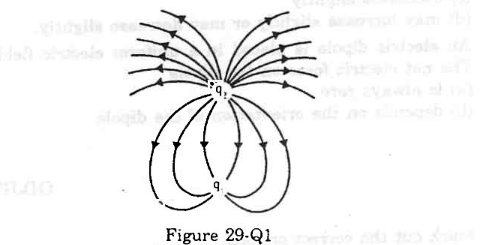 Ans : The electric lines of force are entering charge q1; so, it is negative. On the other hand, the lines of force are originating from charge q2; so, it is positive. If the lines are drawn in proportion to the charges, then
`` \frac{{q}_{1}}{{q}_{2}}=\frac{6}{18}``
`` \Rightarrow \frac{{q}_{1}}{{q}_{2}}=\frac{1}{3}``
6 lines are entering q1 and 18 are coming out of q2.
Page No 119:
- Qstn #11A point charge is taken from a point A to a point B in an electric field. Does the work done by the electric field depend on the path of the charge?Ans : Electrostatic field is a conservative field. Therefore, work done by the electric field does not depend on the path followed by the charge. It only depends on the position of the charge, from which and to which the charge has been moved.
Page No 119:
- Qstn #12It is said that the separation between the two charges forming an electric dipole should be small. In comparison to what should this separation be small?Ans : The separation between the two charges forming an electric dipole should be small compared to the distance of a point from the centre of the dipole at which the influence of the dipole field is observed.
Page No 119:
- Qstn #13The number of electrons in an insulator is of the same order as the number of electrons in a conductor. What is then the basic difference between a conductor and an insulator?Ans : The outer electrons of an atom or molecule in a conductor are only weakly bound to it and are free to move throughout the body of the material. On the other hand, in insulators, the electrons are tightly bound to their respective atoms and cannot leave their parent atoms and move through a long distance.
Page No 119: