CBSE-XI-Physics
22: Photometry
Note: Please signup/signin free to get personalized experience.
Note: Please signup/signin free to get personalized experience.
10 minutes can boost your percentage by 10%
Note: Please signup/signin free to get personalized experience.
- #Section : i
- Qstn #1What is the luminous flux of a source emitting radio waves?Ans : The luminous flux of a source emitting radio waves will be zero, as the luminosity of radio waves is zero.
Page No 453:
- Qstn #2The luminous flux of a 1 W sodium vapour lamp is more than that of a 10 kW source of ultraviolet radiation. Comment.Ans : The luminous flux of a 1 W sodium vapour lamp is more than that of a 10 kW source of ultraviolet radiation. This is because the luminosity of a 1 W sodium vapour lamp is 589 nm or 589.6 nm, whereas the luminosity of UV radiation is zero.
Page No 453:
- Qstn #3Light is incident normally on a small plane surface. If the surface is rotated by an angle of 30° about the incident light, does the illuminance of the surface increase, decreases or remain same? Does your answer change if the light did not fall normally on the surface?Ans : If the surface is rotated by 300, the illuminance will decrease. This is because illuminance depends upon the cosine of the normal angle.
Yes, if the light does not fall normally on the surface initially, it may increase or decrease depending upon the former's angle. If the 300 rotation brings the table closer to the normal of the surface, the illuminance will increase; otherwise, it will decrease.
Page No 453:
- Qstn #4A bulb is hanging over a table. At which portion of the table is the illuminance maximum? If a plane mirror is placed above the bulb facing the table, will the illuminance on the table increase?Ans : The illuminance will be maximum on the area just below the bulb that is normal to the table.
Yes, the plane mirror will increase the radiant flux on the table, which will further increase the luminance flux of the table. Therefore, illuminance will increase.
Page No 453:
- Qstn #5The sun is less bright at morning and evening as compared to at noon although its distance from the observer is almost the sam.e Why?Ans : During noon, the Sun's rays fall directly on the Earth's surface. The Sun being a yellow star, its rays also appear yellow at noon. Since yellow light has a high relative luminosity, it produces a high sensation of visibility in our eyes, thereby making the Sun appear brighter.
However, in the morning and evening, due to the slanting rays of the Sun on the Earth's surface, the smaller and middle range wavelength of the rays get scattered in the upper atmosphere. Thus, the sun appears orange during these two times. Since red/orange light has a low relative luminosity, it produces a low sensation of visibility in our eyes, thereby making the Sun appear less brighter.
Page No 453:
- Qstn #6Why is the luminous efficiency small for a filament bulb as compared to a mercury vapour lamp?Ans : In a filament bulb, heat energy is converted into light energy. Most of the electrical energy supplied to the bulb is radiated as heat and only a small percentage is radiated as visible light. Since heat waves are not visible, they don't contribute to visibility. Thus, its luminous flux is lesser than the total radiant flux; hence, its luminous efficiency is low.
In a mercury vapour lamp, a greater amount of electrical energy supplied is converted into visible radiation. Thus, its luminous flux is relatively higher than incandescent lamps.
Page No 453:
- Qstn #7The yellow colour has a greater luminous efficiency as compared to the other colours. Can we increase the illuminating power of a white light source by putting a yellow plastic paper around this source?Ans : No, we cannot increase the illuminating power of any white light source by wrapping a yellow plastic around them.
White light emits power in all wavelengths of visible radiation, and the yellow plastic will block all the other wavelengths other than the yellow one. This means that it will allow only a small amount of power, emitted by the white light, in the yellow coloured wavelength and block the rest. Thus, it will decrease the illuminating power of the source.
Page No 454:
- #Section : ii
- Qstn #1The one parameter that determines the brightness of a light source sensed by an eye is
(a) energy of light entering the eye per second
(b) wavelength of the light
(c) total radiant flux entering the eye
(d) total luminous flux entering the eye.digAnsr: dAns : Correct option
(d)
Total luminous flux is the total brightness producing capability of a radiating source. Or, it is the measurement of the total energy entering our eyes that produces the sensation of vision.
(a) This cannot be the correct answer because all energies cannot be sensed by our eyes.
(b) This cannot be the correct answer because all wavelengths do not produce any sensation in our eyes.
(c) This cannot be the correct answer because all wavelengths contributing the radiant flux are not always visible to our eyes. There may be a large radiant flux yet there may not be any sensation of vision.
Page No 454:
- Qstn #2Three light sources A, B and C emit equal amount of radiant energy per unit time. The wavelengths emitted by the three source are 450 nm, 555 nm and 700 nm respectively. The brightness sensed by an eye for the sources are XA, XB and XC respectively. Then,
(a) XA > XB, XC > XB
(b) XA > XB, XB > XC
(c) XB > XA, XB > XC
(d) XB > XA, XC > XBdigAnsr: CAns : Correct option
(c)
Wavelength of light B is 555 nm. It has the highest luminosity; hence, XB will be highest.
Again, 450 nm is nearer to 555 nm than 700 nm.
∴ 555 - 450 = 105
But 700 - 555 = 145
So, XA's brightness will be greater than that of XC.
Page No 454:
- Qstn #3As the wavelength is increased from violet to red, the luminosity
(a) continuously increases
(b) continuously decreases
(c) increases then decreases
(d) decreases then increasesdigAnsr: cAns : The correct option is
(c).
The luminosity first increases up to 555 nm and then decreases.
Page No 454:
- Qstn #4An electric bulb is hanging over a table at a height of 1 m above it. The illuminance on the table directly below the bulb is 40 lux. The illuminance at a point on the table 1 m away from the first point will be about
(a) 10 lux
(b) 14 lux
(c) 20 lux
(d) 28 luxdigAnsr: bAns : Correct option
(b)
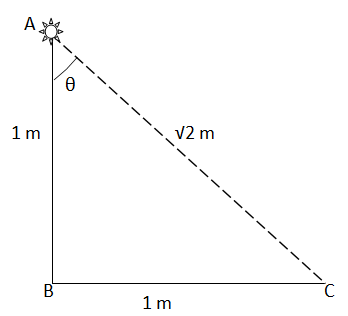
`` \,\mathrm{\,Here\,},``
`` \,\mathrm{\,r\,}=\sqrt{2}``
`` \,\mathrm{\,tan\theta \,}=\frac{\,\mathrm{\,BC\,}}{\,\mathrm{\,AB\,}}=1``
`` {\,\mathrm{\,I\,}}_{\,\mathrm{\,o\,}}=40\,\mathrm{\,lux\,}``
`` \,\mathrm{\,\theta \,}={\,\mathrm{\,tan\,}}^{-1}\left(1\right)={45}^{0}``
`` \,\mathrm{\,The\,}\,\mathrm{\,illuminance\,}\,\mathrm{\,is\,}\,\mathrm{\,given\,}\,\mathrm{\,by\,}``
`` \,\mathrm{\,E\,}=\frac{{\,\mathrm{\,I\,}}_{\,\mathrm{\,o\,}}\,\mathrm{\,cos\theta \,}}{{\,\mathrm{\,r\,}}^{2}}``
`` =\frac{40\times \,\mathrm{\,cos\,}\left({45}^{0}\right)}{{\left(\sqrt{2}\right)}^{2}}``
`` =14\,\mathrm{\,lux\,}``
`` ``
`` ``
Page No 454:
- Qstn #5Light from a point source falls on a screen. If the separation between the source and the screen is increased by 1%, the illuminance will decrease (nearly) by
(a) 0.5%
(b) 1%
(c) 2%
(d) 4%digAnsr: CAns : Correct option
(c)
Illuminance is given by:
`` E=\frac{{I}_{o}\,\mathrm{\,cos\,}\theta }{{r}^{2}}``
`` ``
`` \theta ={0}^{0}``
`` \frac{\Delta r}{r}=1\%``
`` E=\frac{{I}_{o}}{{r}^{2}}``
`` \,\mathrm{\,Differentiating\,},``
`` dE=-2\frac{{I}_{o}}{{r}^{3}}dr``
`` \,\mathrm{\,As\,}\,\mathrm{\,approximation\,}\,\mathrm{\,differentials\,}\,\mathrm{\,are\,}\,\mathrm{\,replaced\,}\,\mathrm{\,by\,}\,\mathrm{\,\Delta \,},``
`` \,\mathrm{\,\Delta E\,}=-2\frac{{\,\mathrm{\,I\,}}_{\,\mathrm{\,o\,}}}{{\,\mathrm{\,r\,}}^{3}}\,\mathrm{\,\Delta r\,}``
`` \Rightarrow \,\mathrm{\,\Delta E\,}=-2\frac{{\,\mathrm{\,I\,}}_{\,\mathrm{\,o\,}}}{{\,\mathrm{\,r\,}}^{2}}\left(\frac{\,\mathrm{\,\Delta r\,}}{\,\mathrm{\,r\,}}\right)``
`` \Rightarrow \,\mathrm{\,\Delta E\,}=-2\,\mathrm{\,E\,}\left(\frac{\,\mathrm{\,\Delta r\,}}{\,\mathrm{\,r\,}}\right)``
`` \Rightarrow \frac{\,\mathrm{\,\Delta E\,}}{\,\mathrm{\,E\,}}=-2\left(\frac{\,\mathrm{\,\Delta r\,}}{\,\mathrm{\,r\,}}\right)``
`` \Rightarrow \frac{\,\mathrm{\,\Delta E\,}}{\,\mathrm{\,E\,}}=-2\times 1\%=-2\%``
Since negative sign implies decrease hence illuminance decrease by 2 %.
Page No 454: