CBSE-XI-Physics
16: Sound Wave
Note: Please signup/signin free to get personalized experience.
Note: Please signup/signin free to get personalized experience.
10 minutes can boost your percentage by 10%
Note: Please signup/signin free to get personalized experience.
- #Section : i
- Qstn #1If you are walking on the moon, can you hear the sound of stones cracking behind you? Can you hear the sound of your own footsteps?Ans : No, we cannot hear the sound of stones. Sound is a mechanical wave and requires a medium to travel; there is no medium on the moon.
No, we cannot hear the sound of our own footsteps because the vibrations of sound waves from the footsteps must travel through our body to reach our ears. By that time however, the sound waves diminish in magnitude.
Page No 351:
- Qstn #2Can you hear your own words if you are standing in a perfect vacuum? Can you hear your friend in the same conditions?Ans : Yes, we can hear ourselves speak. The ear membrane, being a part of our body, vibrates and allows sound to travel through our body.
No, we cannot hear our friend speak as there is no medium (air) through which sound can travel.
Page No 351:
- Qstn #3A vertical rod is hit at one end. What kind of wave propagates in the rod if (a) the hit is made vertically (b) the hit is made horizontally?digAnsr: AAns : A longitudinal wave propagates when the rod is hit vertically.

When hit horizontally too, a longitudinal wave is produced (sound wave). However, if the rod vibrates, the wave so developed is transverse in nature.
Page No 351:
- Qstn #4Two loudspeakers are arranged facing each other at some distance. Will a person standing behind one of the loudspeakers clearly hear the sound of the other loudspeaker or the clarity will be seriously damaged because of the ‘collision’ of the two sounds in between?Ans : It depends on the position of the speakers. The placement decides whether the interference so formed is constructive or destructive.
Page No 351:
- Qstn #5The voice of a person, who has inhaled helium, has a remarkably high pitch. Explain on the basis of resonant vibration of vocal cord filled with air and with helium.Ans : The frequency of sound produced by vibration of vocal chords is amplified by resonance in the voice box. Now resonant frequency is directly proportional to the velocity of sound present in the voice box. Now as Helium has less density than air, velocity of sound in Helium is higher than that in air. Higher velocity of sound in Helium implies that the resonant frequency of the sound in voice chamber filled with Helium will be higher than with air. Thus the voice is high pitched in Helium filled voice box.
Page No 351:
- Qstn #6Draw a diagram to show the standing pressure wave and standing displacement wave for the 3rd overtone mode of vibration of an open organ pipe.Ans :
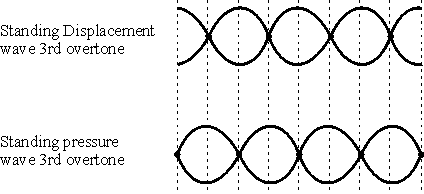
The displacement node is a pressure anti-node and via-versa.
Page No 351:
- Qstn #7Two tuning forks vibrate with the same amplitude but the frequency of the first is double the frequency of the second. Which fork produces more intense sound in air?Ans : We know that: intensity ∝ (amplitude)2.
However, the intensity is independent of frequency. As the amplitude of the vibrating forks is the same, both the forks produce sounds of the same intensity in the air.
Page No 351:
- Qstn #8In discussing Doppler effect, we use the word “apparent frequency”. Does it mean that the frequency of the sound is still that of the source and it is some physiological phenomenon in the listener’s ear that gives rise to Doppler effect? Think for the observer approaching the source and for the source approaching the observer.Ans : The frequency of the sound is still that of the source. However, the frequency of the vibrations received by the observer changes due to relative motion.
If both (the observer and the source) move towards each other, then the frequency of the vibrations received by the observer will be higher compared to the original frequency.
Page No 351:
- #Section : ii
- Qstn #1Consider the following statements about sound passing through a gas.
(A) The pressure of the gas at a point oscillates in time.
(B) The position of a small layer of the gas oscillates in time.
(a) Both A and B are correct.
(b) A is correct but B is wrong.
(c) B is correct but A is wrong.
(d) Both A and B are wrong.digAnsr: aAns : (a) Both A and B are correct.
Sound is a longitudinal wave produced by the oscillation of pressure at a point, thus, forming compressions and rarefactions. That portion of gas itself does not move but the pressure variation causes a disturbance.
Page No 351:
- Qstn #2When we clap our hands, the sound produced is best described by
(a)
p=p0 sinkx-ωt
(b)
p=p0 sin kx cos ωt
(c)
p=p0 cos kx sin ωt
(d)
p=∑p0n sin knx-ωnt.
Here p denotes the change in pressure from the equilibrium value.digAnsr: dAns : (d) `` p=\sum {p}_{0n}\,\mathrm{\,sin\,}\left({k}_{n}x-{\omega }_{n}t\right)``.
When we clap, there is a change in pressure, which sets a disturbance and forms a wave. However, this variation is not uniform every time we clap (unlike in the case of a sound wave). Hence, we sum up all the disturbances.
Page No 351:
- Qstn #3The bulk modulus and the density of water are greater than those of air. With this much of information, we can say that velocity of sound in air
(a) is larger than its value in water
(b) is smaller than its value in water
(c) is equal to its value in water
(d) cannot be compared with its value in water.digAnsr: dAns : (d) cannot be compared with its value in water.
If B is the bulk modulus and ρ is the density, then the velocity of sound is given by:
`` \,\mathrm{\,Velocity\,}=\sqrt{\frac{B}{\,\mathrm{\,\rho \,}}}``
If both B and ρ are greater, then we cannot compare `` \frac{2B}{2\,\mathrm{\,\rho \,}}=\frac{3B}{3\,\mathrm{\,\rho \,}}=\frac{B}{\,\mathrm{\,\rho \,}}``.
For proper comparison, we need numerical values.
Page No 351:
- Qstn #4A tuning fork sends sound waves in air. If the temperature of the air increases, which of the following parameters will change?
(a) Displacement amplitude
(b) Frequency
(c) Wavelength
(d) Time perioddigAnsr: cAns : (c) Wavelength
The velocity of a sound wave varies with temperature as follows:
`` v\propto \sqrt{T}``
As the temperature increases, the speed also increases. However, since the frequency remains the same, its wavelength changes.
Page No 351: