NEET-XII-Chemistry
05: Biomolecules
- Qstn #12-iiiDenaturation.Ans : Denaturation:
In a biological system, a protein is found to have a unique 3-dimensional structure and a unique biological activity. In such a situation, the protein is called native protein. However, when the native protein is subjected to physical changes such as change in temperature or chemical changes such as change in pH, its H-bonds are disturbed. This disturbance unfolds the globules and uncoils the helix. As a result, the protein loses its biological activity. This loss of biological activity by the protein is called denaturation. During denaturation, the secondary and the tertiary structures of the protein get destroyed, but the primary structure remains unaltered.
One of the examples of denaturation of proteins is the coagulation of egg white when an egg is boiled.
- Qstn #13What are the common types of secondary structure of proteins?
Ans : There are two common types of secondary structure of proteins:
( i) ∝-helix structure
(ii) β-pleated sheet structure
∝- Helix structure:
In this structure, the -NH group of an amino acid residue forms H-bond with the group of the adjacent turn of the right-handed screw (∝-helix).
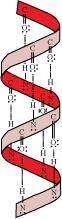
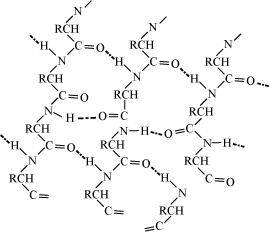
β-pleated sheet structure:
This structure is called so because it looks like the pleated folds of drapery. In this structure, all the peptide chains are stretched out to nearly the maximum extension and then laid side by side. These peptide chains are held together by intermolecular hydrogen bonds.
- Qstn #14What type of bonding helps in stabilising the ∝-helix structure of proteins?
Ans : The H-bonds formed between the -NH group of each amino acid residue and
the
.jpg) group of the adjacent turns of the ∝-helix help in stabilising the helix.
group of the adjacent turns of the ∝-helix help in stabilising the helix.
- Qstn #15Differentiate between globular and fibrous proteins.
Ans :-
Fibrous protein
Globular protein
1.
It is a fibre-like structure formed by the polypeptide chain. These proteins are held together by strong hydrogen and disulphide bonds.
1.
The polypeptide chain in this protein is folded around itself, giving rise to a spherical structure.
2.
It is usually insoluble in water.
2.
It is usually soluble in water.
3.
Fibrous proteins are usually used for structural purposes. For example, keratin is present in nails and hair; collagen in tendons; and myosin in muscles.
3.
All enzymes are globular proteins. Some hormones such as insulin are also globular proteins.
-
- Qstn #16How do you explain the amphoteric behaviour of amino acids?
Ans : In aqueous solution, the carboxyl group of an amino acid can lose a proton and the amino group can accept a proton to give a dipolar ion known as zwitter ion.
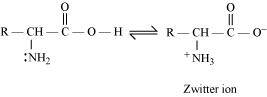
Therefore, in zwitter ionic form, the amino acid can act both as an acid and as a base.


Thus, amino acids show amphoteric behaviour.
- Qstn #17What are enzymes?
Ans : Enzymes are proteins that catalyse biological reactions. They are very specific in nature and catalyse only a particular reaction for a particular substrate. Enzymes are usually named after the particular substrate or class of substrate and some times after the particular reaction.
For example, the enzyme used to catalyse the hydrolysis of maltose into glucose is named as maltase.
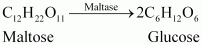
Again, the enzymes used to catalyse the oxidation of one substrate with the simultaneous reduction of another substrate are named as oxidoreductase enzymes.
The name of an enzyme ends with ‘- ase’.
- Qstn #18What is the effect of denaturation on the structure of proteins?
Ans : As a result of denaturation, globules get unfolded and helixes get uncoiled. Secondary and tertiary structures of protein are destroyed, but the primary structures remain unaltered. It can be said that during denaturation, secondary and tertiary-structured proteins get converted into primary-structured proteins. Also, as the secondary and tertiary structures of a protein are destroyed, the enzyme loses its activity.
- Qstn #19How are vitamins classified? Name the vitamin responsible for the coagulation of blood.
Ans : On the basis of their solubility in water or fat, vitamins are classified into two groups.
( i) Fat-soluble vitamins: Vitamins that are soluble in fat and oils, but not in water, belong to this group. For example: Vitamins A, D, E, and K
(ii) Water-soluble vitamins: Vitamins that are soluble in water belong to this group. For example: B group vitamins (B1, B2, B6, B12, etc.) and vitamin C
However, biotin or vitamin H is neither soluble in water nor in fat.
Vitamin K is responsible for the coagulation of blood.
- Qstn #20Why are vitamin A and vitamin C essential to us? Give their important sources.
Ans : The deficiency of vitamin A leads to xerophthalmia (hardening of the cornea of the eye) and night blindness. The deficiency of vitamin C leads to scurvy (bleeding gums).
The sources of vitamin A are fish liver oil, carrots, butter, and milk. The sources of vitamin C are citrus fruits, amla, and green leafy vegetables.
- Qstn #21What are nucleic acids? Mention their two important functions.
Ans : Nucleic acids are biomolecules found in the nuclei of all living cells, as one of the constituents of chromosomes. There are mainly two types of nucleic acids - deoxyribonucleic acid (DNA) and ribonucleic acid (RNA). Nucleic acids are also known as polynucleotides as they are long-chain polymers of nucleotides.
Two main functions of nucleic acids are:
(i) DNA is responsible for the transmission of inherent characters from one generation to the next. This process of transmission is called heredity.
(ii) Nucleic acids (both DNA and RNA) are responsible for protein synthesis in a cell. Even though the proteins are actually synthesised by the various RNA molecules in a cell, the message for the synthesis of a particular protein is present in DNA.
- Qstn #22What is the difference between a nucleoside and a nucleotide?
Ans : A nucleoside is formed by the attachment of a base to position of sugar.
Nucleoside = Sugar + Base
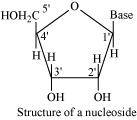
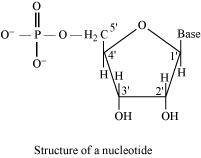
On the other hand, all the three basic components of nucleic acids (i.e., pentose sugar, phosphoric acid, and base) are present in a nucleotide.
Nucleotide = Sugar + Base + Phosphoric acid
- Qstn #23The two strands in DNA are not identical but are complementary. Explain.
Ans : In the helical structure of DNA, the two strands are held together by hydrogen bonds between specific pairs of bases. Cytosine forms hydrogen bond with guanine, while adenine forms hydrogen bond with thymine. As a result, the two strands are complementary to each other.
- Qstn #24Write the important structural and functional differences between DNA and RNA.
Ans : The structural differences between DNA and RNA are as follows:
-
DNA
RNA
1.
The sugar moiety in DNA molecules is β-D-2 deoxyribose.
1.
The sugar moiety in RNA molecules is β-D-ribose.
2.
DNA contains thymine (T). It does not contain uracil (U).
2.
RNA contains uracil (U). It does not contain thymine (T).
3.
The helical structure of DNA is double-stranded.
3.
The helical structure of RNA is single-stranded.
The functional differences between DNA and RNA are as follows:
-
DNA
RNA
1
DNA is the chemical basis of heredity.
1
RNA is not responsible for heredity.
2
DNA molecules do not synthesise proteins, but transfer coded message for the synthesis of proteins in the cells.
2
Proteins are synthesised by RNA molecules in the cells.
-
- Qstn #25What are the different types of RNA found in the cell?
Ans : (i) Messenger RNA (m-RNA)
(ii) Ribosomal RNA (r-RNA)
(iii) Transfer RNA (t-RNA)