ICSE-X-Mathematics
17: Circles
Chapter 17 Circles Class 10 ICSE Mathematics
Exercise 17.1
1. Find the length of the chord of a circle in each of the following when:
(i) Radius is 13 cm and the distance from the center is 12 cm
Answer
From the question it is given that,
Radius = 13 cm
Distance from the center is 12 cm
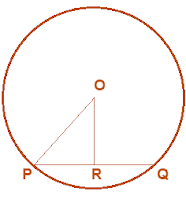
From the figure we can say that, PR = RQBecause, perpendicular from center to a chord bisects the chord.
Consider the ΔPRO,
By using Pythagoras theorem, OP2 = OR2 + PR2
132 = 122 + PR2
⇒ PR2 = 132 - 122
⇒ PR2 = 169 - 144
⇒ PR2 = 25
⇒ PR = √25
⇒ PR = 5 cm
Therefore, length of chord PQ = 2PR
= 2(5)
= 10 cm
(ii) Radius is 1.7 cm and the distance from the center is 1.5 cm.
Answer
From the question it is given that,
Radius = 1.7 cm
Distance from the center is 1.5 cm
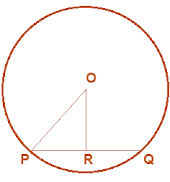
From the figure we can say that, PR = RQBecause, perpendicular from center to a chord bisects the chord.
Consider the ΔPRO,
By using Pythagoras theorem, OP2 = OR2 + PR2
(1.7)2 = (1.5)2 + PR2
⇒ PR2 = (1.7)2 - (1.5)2
⇒ PR2 = 2.89 - 2.25
⇒ PR2 = 0.64
⇒ PR = √0.64
⇒ PR = 0.8 cm
Therefore, length of chord PQ = 2PR
= 2(0.8)
= 1.6 cm
(iii) Radius is 6.5 cm and the distance from the center is 2.5 cm.
Answer
From the question it is given that,
Radius = 6.5 cm
Distance from the center is 2.5 cm
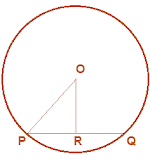
From the figure we can say that, PR = RQBecause, perpendicular from center to a chord bisects the chord.
Consider the ΔPRO,
By using Pythagoras theorem, OP2 = OR2 + PR2
(6.5)2 = (2.5)2 + PR2
⇒ PR2 = (6.5)2 - (2.5)2
⇒ PR2 = 42.25 - 6.25
⇒ PR2 = 36
⇒ PR = √36
⇒ PR = 6 cm
Therefore, length of chord PQ = 2PR
= 2(6)
= 12 cm
2.
Find the diameter of the circle if the length of a chord is 3.2cm and its distance from the center is 1.2 cm.
Answer
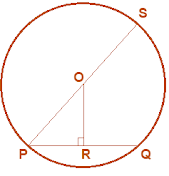
From the question it is given that,
length of a chord is 3.2cm
Distance from the center is 1.2cm
Then,
From the figure we can say that, PR = RQ = 1.6 cm
Because, perpendicular from center to a chord bisects the chord.
Consider the ΔPRO,
By using Pythagoras theorem, OP2 = OR2 + PR2
OP2 = (1.6)2 + (1.2)2
⇒ OP2 = 2.56 +1.44
⇒ OP2 = 4
⇒ OP = √4
⇒ OP = 2 cm
Therefore, Diameter of the circle PS = 2OP
= 2(2)
= 4 cm
3. A chord of length 16.8cm is at a distance of 11.2cm from the center of a circle. Find the length of the chord of the same circle which is at a distance of 8.4cm from the center.
Answer
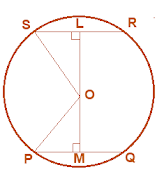
From the figure we can say that, PM = MQ = 8.4 cm
Because, perpendicular from center to a chord bisects the chord.
Consider the ΔPMO,
By using Pythagoras theorem, OP2 = PM2 + OM2
OP2 = (8.4)2 + (11.2)2
⇒ OP2 = 70.56 + 125.44
⇒ OP2 = 196
⇒ OP = √196
⇒ OP = 14 cm
Then, OP = OS = 14 cm because radii of same circle.
Now consider the ΔSLO
By using Pythagoras theorem, OS2 = SL2+ LO2
142 = (SL)2 + (8.4)2
⇒ SL2 = 142-8.42
⇒ SL2 = 196 - 70.56
⇒ SL2 = 125.44
⇒ SL = √125.44
⇒ SL = 11.2 cm
Therefore, the length of chord SR = 2SL
= 2(11.2)
= 22.4 cm
4. A chord of length 6 cm is at a distance of 7.2 cm from the center of a circle. Another chord of the same circle is of length 14.4 cm. Find its distance from the center.
Answer
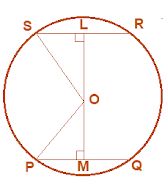
From the figure we can say that, PM = MQ = 3 cm
Because, perpendicular from center to a chord bisects the chord.
Consider the ΔPMO,
By using Pythagoras theorem, OP2 = PM2 + OM2
OP2 = (3)2 + (7.2)2
⇒ OP2 = 9 + 51.84
⇒ OP2 = 60.84
⇒ OP = √60.84
⇒ OP = 7.8 cm
Then, OP = OS = 7.8 cm because radii of same circle.
Now consider the ΔSLO
By using Pythagoras theorem, OS2 = SL2+ LO2
7.82 = (7.2)2 + LO2
⇒ LO2 = 7.82 - 7.22
⇒ LO2 = 60.84 - 51.84
⇒ LO2 = 9
⇒ LO = √9
⇒ LO = 3 cm
Therefore, distance of chord SR from the center is 3 cm.
5. A chord of length 8cm is drawn inside a circle of radius 6cm. Find the perpendicular distance of the chord from the center of the circle.
Answer
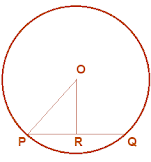
From the question it is given that, Length of chord is 8 cm.
Radius of circle is 6 cm.
From the figure we can say that, PR = RQ = 4 cm
Because, perpendicular from center to a chord bisects the chord.
Consider the ΔPRO,
By using Pythagoras theorem, OP2 = OR2 + PR2
62 = OR2 + 42
⇒ OR2 = 36-16
⇒ OR2 = 20
⇒ OR = √20
⇒ OR = 2√5 cm
Therefore, the perpendicular distance of the chord from the center of the circle is 2√5 cm.
6. Two circles of radii 5cm and 3cm with centers O and P touch each other internally. If the perpendicular bisector of the line segment OP meets the circumference of the larger circle at A and B, find the length of AB.
Answer
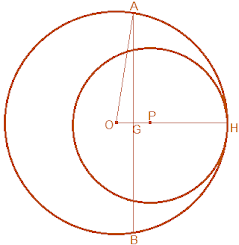
From the question it is given that,
Radius of bigger circle = 5 cm
Radius of smaller circle = 3 cm
Then,
OA = AH = 5 cm ... [because both are radius of bigger circle]
PH = 3 cm ... [because radius of smaller circle]
OP = 2 cm
So, perpendicular bisector of OP, i.e. AB meets OP at G.
OG = GP = ½ OP = 1 cm
Consider the ΔOGA,
By using Pythagoras theorem, OA2 = OG2 + GA2
52 = 12 + GA2
⇒ GA2 = 52-12
⇒ GA2 = 25 - 1
⇒ GA2 = 24
⇒ GA = √24
⇒ GA = 2√6 cm
So, GA = GB = 2√6 cm
AB = AG + GB
= 2√6 + 2√6
= 4√6 cm
Therefore, the length of AB 4√6 cm.
7.
Two chords AB and CD of lengths 6cm and 12cm are drawn parallel inside the circle. If the distance between the chords of the circle is 3cm, find the radius of the circle.
Answer
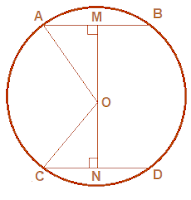
From the figure we can say that, AM = MB = 3 cm and CN = ND = 6 cm
Because, perpendicular from center to a chord bisects the chord.
Let us assume, OA = OC = p
OM = y
ON = 3 - y
Consider the ΔCNO,
By using Pythagoras theorem, OC2 = ON2 + CN2
p2 = (3 - y)2 + (6)2 ... [equation (i)]
Now consider the ΔOMA
By using Pythagoras theorem, OA2 = OM2+ AM2
p2 = y2 + 32 ... [equation (ii)]
Combining equation (i) and equation (ii) we get,
(3 - y)2 + 62 = y2 + 32
⇒ 9 + y2 - 6y + 36 = y2 + 9
By transposing we get,
9 - 9 + y2 - y2 - 6y + 36 = 0
⇒ -6y + 36 = 0
⇒ y = 36/6
⇒ y = 6
Now substitute the value of y in equation (ii) to find out the value p,
p2 = y2 + 32
⇒ p2 = 62 + 32
⇒ p2 = 36 + 9
⇒ p2 = 45
⇒ p = √45
⇒ p = 3√5
Therefore, the radius of circle is 3√5 cm.
8.
Two chords of lengths 10cm and 24cm are drawn parallel to each other in a circle. If they are on the same side of the center and the distance between them is 17cm, find the radius of the circle.
Answer
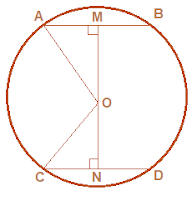
From the figure we can say that, AM = MB = 5 cm and CN = ND = 12 cm
Because, perpendicular from center to a chord bisects the chord.
Let us assume, OA = OC = p
OM = y
ON = 17 - y
Consider the ΔCNO,
By using Pythagoras theorem, OC2 = ON2 + CN2
p2 = (17 - y)2 + (12)2 ... [equation (i)]
Now consider the ΔOMA
By using Pythagoras theorem, OA2 = OM2+ AM2
p2 = y2 + 52 ... [equation (ii)]
Combining equation (i) and equation (ii) we get,
(17 - y)2 + 122 = y2 + 52
⇒ 289 + y2 - 34y + 144 = y2 + 25
By transposing we get,
289 + 144 - 25 + y2 - y2 - 34y = 0
⇒ 408 - 34y = 0
⇒ y = 408/34
⇒ y = 12
Now substitute the value of y in equation (ii) to find out the value p,
p2 = y2 + 52
⇒ p2 = 122 + 52
⇒ p2 = 144 + 25
⇒ p2 = 169
⇒ p = √169
⇒ p = 13
Therefore, the radius of circle is 13.
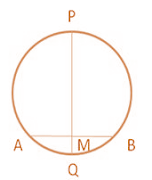
9. In fig, AB a chord of the circle is of length 18 cm. It is perpendicularly bisected at M by PQ. If MQ = 3 cm, find the length of PQ.
Answer
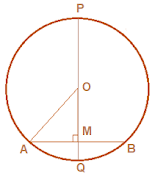
From the question it is given that,
Length of chord AB = 18 cm
MQ = 3 cm
From the figure we can say that, AM = MB = 5 cm
Because, perpendicular from center to a chord bisects the chord.
Let us assume, OA = OQ = p
OM = (r - 3)
Consider the ΔOMA,
By using Pythagoras theorem, OA2 = OM2 + MA2
r2 = (r - 3)2 + 92
⇒ r2 = r2 + 9 - 6r + 81
⇒ r2 - r2 + 6r = 90
⇒ 6r = 90
⇒ r = 15 cm
Then, PQ = 2r
= 2(15)
= 30 cm
10.
AB and CD are two equal chords of a circle intersecting at P as shown in fig. P is joined to O, the center of the circle. Prove that OP bisects
∠
CPB
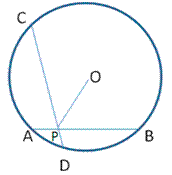
Answer
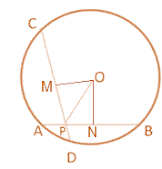
Construction: Draw perpendiculars OM and ON to AB and CD respectively.
Now, consider the ΔOMP and ΔONP,
OP = OP ... [common side for both triangles]
OM = ON ... [distance of equal chords from the center are equal]
∠PMO = ∠PNO ... [both angles are equal to 90o]
Therefore, ΔOMP ≅ΔONP
So, ∠MPO = ∠NPO
Hence, it is proved that, OP bisects ∠CPB.
11.
In fig, the center is O. PQ and RS are two equal chords of the circle which, when produced, meet at T outside the circle. Prove that
(a) TP = TR, (B) TQ = TS
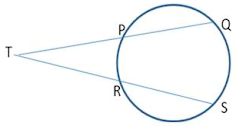
Answer
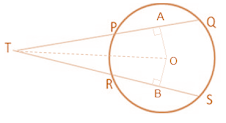
From the question it is given that PQ = RS
We have to prove that, TP = TR and TQ = TS
Then, Draw OA ⊥ PQ and OB ⊥ RS,
Since equal chords are equidistant from the circle therefore,
PQ = RS ⇒ OA = OB ... [equation (i)]
So, PA = AQ = ½ PQ and RB = BS = ½ RS
Given PQ = RS, we get
PA = RB ... [equation (ii)]
And, AQ = BS ... [equation (iii)]
Now, consider the ΔTAO and ΔTBO,
TO = TO [common side for both triangles]
AO = BO [from equation (i)]
∠TAO = ∠TBO [both angles are equal to 90o]
Therefore, ΔTAO ≅ ΔTBO [By RHS]
So TA = TB [By CPCT] ... [equation (iv)]
By subtracting equation (ii) from equation (iv), we get
TA - PA = TB - RB
⇒ TP = TR
Now adding equation (iii) and equation (iv), we get
TA + TQ = TB + BS
Therefore, TQ = TS
Hence proved.
12.
PQ and QR are two equal chords of a circle. A diameter of the circle is drawn through Q. Prove that the diameter bisect
∠
PQR.
Answer
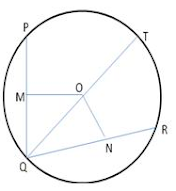
Let us assume that QT be the diameter of ∠PQR
Then, from question it is given that PQ = QR
So, OM = ON
Now, consider the ΔOMQ and ΔONQ,
∠OMQ = ∠ONQ ...[both angles are equal to 90o]
OM = ON ... [from question it is given that equal chords]
OQ = OQ ... [common side for both triangles]
Therefore, ΔOMQ ≅ ΔONQ [By RHS]
So, ∠OQM = ∠OQN [CPCT]
Hence QT i.e. diameter of the circle bisects ∠PQR
13. M and N are the midpoints of chords AB and CD. The line MN passes through the center O. Prove that AB ||
CD.
Answer
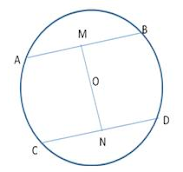
From the figure,
AM = MB
CN = ND
Therefore, OM ⊥ AB
Then, ON ⊥ CD
Because, a line bisecting the chord and passing through the centre of the circle is perpendicular to the chord.
So, ∠OMA = ∠OND ...[both angles are equal to 90o]
Therefore, AB ∥CD
14. Prove that the line segment joining the midpoints of two parallel chords of a circle passes through its centre.
Answer
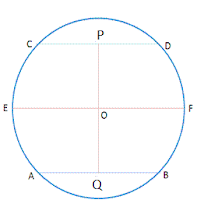
Let us assume AB and CD be two parallel chords having Q and P as their mid-points, respectively.
Let O be the centre of the circle.
Join OP and OQ and draw EF || AB | | CD. Since, P is the mid-point of CD.
OP ⊥ CD
∠CPO = ∠DPO = 90o
But OF || CD
∴ ∠POF = ∠CPO ... [alternate interior angle]
∠POF = 90o
Similarly, ∠FOQ = 90o
Now, ∠POF + ∠FOQ = 90o + 90o = 180o
Therefore, POQ is a straight line.
Hence, proved
15. Two congruent circles have their centers at O and P. M is the midpoint of the line segment OP. A straight line is drawn through M cutting the two circles at the points A, B, C and D. Prove that the chords AB and CD are equal.
Answer :
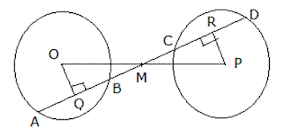
From the question it is given that, two congruent circles have their centers at O and P. M is the midpoint of the line segment OP.
We have to prove that, chord AB and CD are equal.
Then, draw OQ ⊥ AB and PR ⊥ CD.
Now consider the ΔOQM and ΔPRM
OM = MP ... [because M is the midpoint]
∠OQM = ∠PRC ...[both angles are equal to 90o]
∠OMQ = ∠PMR ...[vertically opposite angles are equal]
Therefore, ΔOQM ≅ ΔPRM [By AAS]
OQ = PR [By CPCT]
The perpendicular distances of two chords in two congruent circles are equal,
Therefore, chords are also equal
So, AB = CD
Hence proved
Exercise 17.2
1. In fig. (i), O is the centre of the circle. If
∠
APB = 50
°
then find
∠
AOB and
∠
OAB.

Answer

2. In fig., O is the centre of the circle and
∠
AOC = 150
°.
Find
∠
ABC.

Answer

3. In fig, O is the centre of the circle. Find
∠
BAC.

Answer

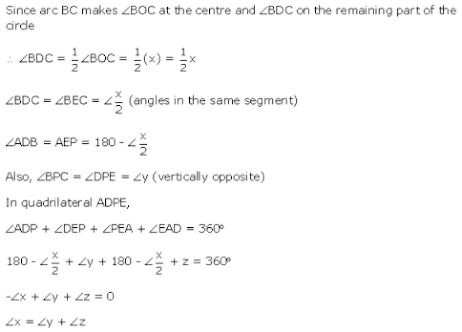
4. In fig, O is the centre of the circle, prove that
∠
x =
∠
y +
∠
z.

Answer
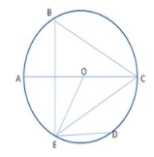
5. In fig., chord ED is parallel to the diameter AC of the circle. Given
∠
CBE = 65
°,
calculate
∠
DEC.
Answer

6. In fig., C is a point on the minor arc AB of the circle with centre O. Given
∠
ACB = p
°,
∠
AOB = q
°,
express q in terms of p. Calculate p if OACB is a parallelogram.

Answer

7. In fig., ΔPQR is an isosceles triangle with PQ = PR and m
∠
PQR = 35
°.
Find m
∠
QSR and m
∠
QTR.

Answer

8. In fig., ABCD is a cyclic quadrilateral. If
∠
BCD = 100
°
and
∠
ABD = 70
°,
find
∠
ADB.

Answer

dlt28827090412353557261">
9. In fig., O is the centre of the circle. Find
∠
CBD
.

Answer

10. In a cyclic quadrilateral ABCD, AB
|| CD and
∠
B = 65
°,
find the remaining angles.

Answer

11. In a cyclic quadrilateral ABCD, AB
|| CD and
∠
B = 65
°,
find the remaining angles.

Answer

12. In a cyclic quadrilateral ABCD, if m
∠
A = 3(m
∠
C). find m
∠
A.
Answer

13. In a circle with centre O, chords AB and CD intersect inside the circle at E. Prove that
∠
AOC +
∠
BOD = 2
∠
AEC.
Answer

14. AB and CD are two chords of a circle, intersecting each other at P such that AP = CP. Show that AB = CD.
Answer

15. MABN are points on a circle having centre O. AN and MB cut at Y. If
∠
NYB = 50
°
and
∠
YNB = 20
°,
find
∠
MAN and reflex angle MON.

Answer

16. In fig., PT is a tangent to the circle at T and PAB is a secant to the same circle. If PB = 9 cm and AB = 5 cm, find PT.

Answer

17. Two circles are drawn with sides AB, AC of a triangle ABC as diameters. They intersect at a point D. Prove that D lies on BC.
Answer

18. Prove that the circle drawn on any one of the equal sides of an isosceles triangle as diameter bisects the base.
Answer

19. Prove that the circle drawn with any side of a rhombus as a diameter, passes through the point of intersection of its diagonals.
Answer

20. ABCD is a cyclic quadrilateral. AB and DC are produced to meet in E. Prove that ΔEBC
≅
ΔEDA.

Answer

21. In triangle ABC, AB = AC. A circle passing through B and C intersects the sides AB and AC at D and E respectively. Prove that DE || BC.
Answer

22. The bisector of the opposite angles A and C of a cyclic quadrilateral ABCD intersect the circle at the points E and F, respectively. Prove that EF is a diameter of the circle.
Answer

23. Prove that the angles bisectors of the angles formed by producing opposite sides of a cyclic quadrilateral (provided they are not parallel) intersect at right triangle.

Answer

24. Bisectors of angles A, B and C of a triangle ABC intersect its circumcircle at D, E and F respectively. Prove that the angles of ΔDEF are 90° - A/2, 90° - B/2 and 90° - C/2 respectively.
Answer

Exercise 17.3
1. Find the length of the tangent from a point which is at a distance of 5 cm from the centre of the circle of radius 3 cm.
Answer

2. A point A is 17 cm from the canter of the circle. The length of the tangent drawn from A to the circle is 15 cm. Find the radius of the circle.
Answer

3. In the figure, XP and XQ are tangents from X to the circle with centre O. R is a point on the circle. Prove that XA + AR = XB + BR.

Answer
XP = XQAR = AP (Length of tangents drawn from an external point to a circle are equal)BR = BQXP = XQ⇒ XA + AP = XB + BR⇒ XA + AR = XB + BR (Using 1)
4. PA and PB are tangents from P to the circle with centre O. At M, a tangent is drawn cutting PA at K and PB at N. Prove that KN = AK + BN.
Answer

5. Two tangents are drawn to a circle from an external point P, touching the circle at the points A and B. A third tangent intersects segment PA in C and segment PB in D and touches the circle at Q. If PA = 20 units, find the perimeter of ΔPCD.
Answer

6. In fig., the incircle of ΔABC, touches the sides BC, CA and AB at D, E and F respectively. Show AF + BD + CE = AE + BF + CD.

Answer
To prove: AF + BD + CE = AE + BF + CDProof:AF = AE ...(1) (Length of tangents drawn from an external point to a circle are equal)BD = BF ...(2)CE = CD ...(3)Adding (1), (2) and (3)AF + BD + CE = AE + BF + CD
7. In fig., a circle is touching the side BC of ΔABC at P and AB and AC produced at Q and R respectively. Prove that AQ is half the perimeter of ΔABC.

Answer :

8. If all the sides of a parallelogram touch a circle, show that the parallelogram is a rhombus.
Answer

9. If ΔPQR is isosceles with PQ = PR and a circle with centre O and radius r is the incircle of the ΔPQR touching QR at T, prove that the point T bisects QR.
Answer

10. From a point P outside a circle, with centre O, tangents PA and PB are drawn as shown in fig., Prove that
∠
AOP =
∠
BOP and OP is the perpendicular bisector of AB.

Answer

11. In fig. chords AB and CD of a circle intersect at P. AP = 5 cm, BP = 3 cm and CP = 2.5 cm. Determine the length of DP.
Answer :

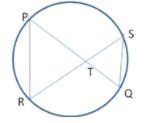
12. In fig., chords PQ and RS of a circle intersect at T. If RS = 18 cm, ST = 6 cm and PT = 18 cm, find the length of TQ.
Answer

13. In fig., AB and DC are two chords of a circle with centre O these chords when produced meet at P. If PB = 8 cm, BA = 7 cm and PO = 14.5 cm, find the radius of the circle.

Answer

14. In fig., PT is a tangent to the circle at T and PAB is a secant to the same circle. If PA = 4 cm and AB = 5 cm, find PT.

Answer
Let PT = x cmSince, PAB is secant and PT is a tangent to the given circle, we havePA. PB = PT2⇒ 4×9 = PT⇒ PT2 = 36⇒ PT = 6 cm
15. In fig., PT is a tangent to the circle at T and PAB is a secant to the same circle. If PA = 4 cm and AB = 5 cm, find PT.

Answer
Let PT = x cmSince, PAB is secant and PT is a tangent to the given circle, we have,PA. PB = PT2⇒ 4×9 = PT2⇒ PT2 = 36⇒ PT = 6 cm
16. In fig., is a tangent to the circle at T and PAB is a secant to the same circle. If PB = 9 cm and AB = 5 cm, find PT.

Answer
Let PT = x cmPA = PB - AB⇒ PA = 9-5 = 4 cmSince, PAB is secant and PT is a tangent to the given circle, we have,PA. PB = PT2⇒ 4×9 = PT2⇒ PT2 = 36⇒ PT = 6 cm
17. In fig., PT is tangent to the circle at T and Cd is a diameter of the same circle. If PC = 3 cm and PT = 6 cm, find the radius of the circle.

Answer

18. The length of the direct common tangent to two circles of radii 12 cm and 4 cm is 15 cm. Calculate the distance between their centres.
Answer

19. Calculate the length of direct common tangent to two circles of radii 3 cm and 8 cm with their centres 13 cm apart.

Answer To find: PQR1 = 3 cm, R2 = 8 cm, AB = 13 cmPQ2 = AB2 - (R2 - R1)2
⇒ PQ2 = 132 - (8 - 3)2⇒ PQ2 = 169 - 25⇒ PQ2 = 144⇒ PQ = 12 cmLength of direct common tangent is 12 cm.
20. In the given fig. (xi), AC is a transversal common tangent to two circles with centres P and Q and of radii 6 cm and 3 cm respectively. Given that AB = 8 cm, calculate PQ.

Answer

21. In fig. ABC is a right-angled triangle at A with sides Ab = 5 cm and BC = 13 cm. A circle with centre O has been inscribed in the triangle ABC. Calculate the radius of the incircle.

Answer

22. In fig., two concentric circles with centre O are of radii 5 cm and 3 cm, from an external point P, tangents PA and PB are drawn to these circles. If AP = 12 cm, find BP.

Answer
