ICSE-X-Mathematics
12: Distance and Section Formulae
Chapter 12 Distance and Section Formula Class 10 ICSE Mathematics
Exercise 12.1
1. Find the distance between the following pairs of points in the coordinate plane:
(a) (5, -2) and (1, 5)
(b) (1, 3) and (3, 9)
(c) (7, -7) and (2, 5)
(d) (4, 1) and (-4, 5)
(e) (13, 7) and (4, -5)
Answer
(a) (5, -2) and (1, 5)
A = (5, - 2)
B = (1, 5)
AB = √((x2 - x1)2 + (y2 - y1)2
Where, x1 = x coordinate of A = 5
y1 = y coordinate of A = - 2
x2 = x coordinate of B = 1
y2 = y coordinates of B = 5
= √((1 - 5)2 + (5 + 2)2)
= √((4)2 + (7)2)
= √(16 + 49)
= √65 units
(b) (1, 3) and (3, 9)
A = (1, 3), B = (3, 9)
AB = √((x2 - x1)2 + (y2 - y1)2
Where, x1 = x coordinate of A = 1
y1 = y coordinate of A = 3
x2 = x coordinate of B = 3
y2 = y coordinates of B = 9
= √((3 - 1)2 + (9 - 3)2)
= √((2)2 + (6)2)
= √(4 + 36)
= √40 units
= 2√10 units
(c) (7, -7) and (2, 5)
A = (7, -7), B = (2, 5)
AB = √((x2 - x1)2 + (y2 - y1)2
Where, x1 = x coordinate of A = 7
y1 = y coordinate of A = -7
x2 = x coordinate of B = 2
y2 = y coordinates of B = 5
= √((2 - 7)2 + (5 + 7)2)
= √((-5)2 + (12)2)
= √(25 + 144)
= √169 units
= 13 units
(d) (4, 1) and (-4, 5)
A = (4, 1), B = (-4, 5)
AB = √((x2 - x1)2 + (y2 - y1)2
Where, x1 = x coordinate of A = 4
y1 = y coordinate of A = 1
x2 = x coordinate of B = -4
y2 = y coordinates of B = 5
= √((4 + 4)2 + (1 - 5)2)
= √((8)2 + (4)2)
= √(64 + 16)
= √80 units
= 4√5 units
(e) (13, 7) and (4, -5)
A = (13, 7), B = (4, -5)
AB = √((x2 - x1)2 + (y2 - y1)2
Where, x1 = x coordinate of A = 13
y1 = y coordinate of A = 7
x2 = x coordinate of B = 4
y2 = y coordinates of B = -5
= √((4 - 13)2 + (- 5 - 7)2)
= √((-9)2 + (-12)2)
= √(81 + 144)
= √225 units
= 15 units
2.
Find the distances of the following points from the origin.
(a) (5, 12)
(b) (6, 8)
(c) (8, 15)
(d) (0, 11)
(e) (13, 0)
Answer
(a) (5, 12)
Origin A = (0, 0), B = (5, 12)
AB = √((x2 - x1)2 + (y2 - y1)2
Where, x1 = x coordinate of A = 0
y1 = y coordinate of A = 0
x2 = x coordinate of B = 5
y2 = y coordinates of B = 12
= √((5 - 0)2 + (12 - 0)2)
= √((5)2 + (12)2)
= √(25 + 144)
= √169 units
= 13 units
(b) (6, 8)
Origin A = (0, 0), B = (6, 8)
AB = √((x2 - x1)2 + (y2 - y1)2
Where, x1 = x coordinate of A = 0
y1 = y coordinate of A = 0
x2 = x coordinate of B = 6
y2 = y coordinates of B = 8
= √((6 - 0)2 + (8 - 0)2)
= √((6)2 + (8)2)
= √(36 + 64)
= √100 units
= 10 units
(c) (8, 15)
Origin A = (0, 0), B = (8, 15)
AB = √((x2 - x1)2 + (y2 - y1)2
Where, x1 = x coordinate of A = 0
y1 = y coordinate of A = 0
x2 = x coordinate of B = 8
y2 = y coordinates of B = 15
= √((8 - 0)2 + (15 - 0)2)
= √((8)2 + (15)2)
= √(64 + 225)
= √289 units
= 17 units
(d) (0, 11)
Origin A = (0, 0), B = (0, 11)
AB = √((x2 - x1)2 + (y2 - y1)2
Where, x1 = x coordinate of A = 0
y1 = y coordinate of A = 0
x2 = x coordinate of B = 0
y2 = y coordinates of B = 11
= √((0 - 0)2 + (11 - 0)2)
= √((0)2 + (11)2)
= √(0 + 121)
= √121 units
= 11 units
(e) (13, 0)
Origin A = (0, 0), B = (13, 0)
AB = √((x2 - x1)2 + (y2 - y1)2
Where, x1 = x coordinate of A = 0
y1 = y coordinate of A = 0
x2 = x coordinate of B = 13
y2 = y coordinates of B = 0
= √((13 - 0)2 + (0 - 0)2)
= √((13)2 + (0)2)
= √(169 + 0)
= √169 units
= 13 units
3.
Find the distance between the following points.
(a) (p + q, p - q) and (p - q, p - q)
(b) (sin θ, cos θ) and (cos θ, -sin θ)
(c) (sec θ, tan θ) and (-tan θ, sec θ)
(d) (sin θ - cosec θ, cos θ - cot θ) and (cos θ - cosec θ, - sin θ - cot θ)
Answer
(a) (p + q, p - q) and (p - q, p - q)
A (p + q, p - q), B (p - q, p - q)
AB = √((x2 - x1)2 + (y2 - y1)2
Where, x1 = x coordinate of A = p + q
y1 = y coordinate of A = p - q
x2 = x coordinate of B = p - q
y2 = y coordinates of B = p - q
= √[((p - q) - (p + q))2 + ((p - q) - (p - q))2]
= √[(p - q - p - q)2 + (p - q - p + q)2]
= √[(-2q)2 + (0)2]
= √4q units
(b) (sin θ, cos θ) and (cos θ, -sin θ)
A (sin θ, cos θ), B (cos θ, -sin θ)
AB = √((x2 - x1)2 + (y2 - y1)2
Where, x1 = x coordinate of A = sin θ
y1 = y coordinate of A = cos θ
x2 = x coordinate of B = cos θ
y2 = y coordinates of B = - sin θ
= √[(cos θ - sin θ)2 + (- sin θ - cos θ)2]
= √[cos2 θ + sin2 θ - 2 cos θ sin θ + sin2 θ + cos2 θ + 2 cos θ sin θ]
= √2 units
(c) (sec θ, tan θ) and (-tan θ, sec θ)
A (sec θ, tan θ), B (-tan θ, sec θ)
AB = √((x2 - x1)2 + (y2 - y1)2
Where, x1 = x coordinate of A = sec θ
y1 = y coordinate of A = tan θ
x2 = x coordinate of B = -tan θ
y2 = y coordinates of B = sec θ
= √[(- tan θ - sec θ)2 + (sec θ - tan θ)2]
= √[tan2 θ + sec2 θ - 2 tan θ sec θ + sec2 θ + tan2 θ - 2 tan θ sec θ]
= √(2 sec2 θ + 2 tan2 θ) units
(d) (sin θ - cosec θ, cos θ - cot θ) and (cos θ - cosec θ, - sin θ - cot θ)
A (sin θ - cosec θ, cos θ - cot θ), B (cos θ - cosec θ, - sin θ - cot θ)
AB = √((x2 - x1)2 + (y2 - y1)2
Where, x1 = x coordinate of A = sin θ - cosec θ
y1 = y coordinate of A = cos θ - cot θ
x2 = x coordinate of B = cos θ - cosec θ
y2 = y coordinates of B = - sin θ - cot θ
= √[((cos θ - cosec θ) - (sin θ - cosec θ))2 + ((- sin θ - cot θ) - (cos θ - cot θ))2]
= √[(cos θ - cosec θ - sin θ + cosec θ)2 + (- sin θ - cot θ - cos θ + cot θ)2]
= √[(cos θ - sin θ)2 + (- sin θ - cos θ)2]
= √(cos2 θ + sin2 θ - 2 cos θ sin θ + sin2 θ + cos 2 θ + 2 sin θ cos θ)
= √2 units
4.
Find the distance of a point (7, 5) from another point on the x - axis whose abscissa is - 5.
Answer
From the question it is given that, abscissa is - 5.
Let us assume point on x - axis be (x, 0)
So, point P (-5, 0)
Point Q (7, 5)
PQ = √((7 + 5)2 + (5 - 0)2)
= √((12)2 + (5)2)
= √(144 + 25)
= √169
= 13 units
5. Find the distance of a point (13, -9) from another point on the line y = 0 whose abscissa is 1.
Answer
From the question it is given that point on the line y = 0 whose abscissa is 1.
So, point is P(1, 0)
Let us assume (13, -9) be point Q.
PQ = √((13 - 1)2 + (-9 - 0)2)
= √((12)2 + (-9)2)
= √(144 + 81)
= √225
= 15 units
6.
Find the distance of a point (12, 5) from another point on the line x = 0 whose ordinate is 9.
Answer
From the question it is given that, point on the line x = 0 whose ordinate is 9.
So, point is P(0,9)
Let us assume that point (12, 5) be Q.
PQ = √((12 - 0)2 + (5 - 9)2)
= √((12)2 + (-4)2)
= √(144 + 16)
= √160
= 4√10 units
7.
Find the value of a if the distance between the points (5, a) and (1, 5) is 5 units.
Answer
From the question it is given that,
The distance between the points (5, a) and (1, 5), assume the two points be A and B respectively.
AB = 5 units
√((5 - 1)2 + (a + 5)2) = 5
Now, squaring on both side we get,
(5 - 1)2 + (a + 5)2 = 25
⇒ (25 + 1 - 10) + (a2 + 25 + 10a) = 25
⇒ 16 + a2 + 25 + 10a = 25
⇒ a2 + 10a + 16 = 25 - 25
⇒ a2 + 10a + 16 = 0
⇒ a2 + 8a + 2a + 16 = 0
Now, take out common in above terms we get,
a(a + 8) + 2(a + 8) = 0
⇒ (a + 8) (a + 2) = 0
⇒ a + 8 = 0, a + 2 = 0
⇒ a = -8, a = - 2
8.
Find the value of m if the distance between the points (m, -4) and (3, 2) is 3√5 units.
Answer
From the question it is given that,
The distance between the points (m, -4) and (3, 2), assume the two points be A and B respectively.
AB = 3√5 units
√((m - 3)2 + (-4 - 2)2) = 3√5
Now, squaring on both side we get,
(m - 3)2 + (-4 - 2)2 = 45
⇒ (m2 + 9 - 6m) + (16 + 4 + 16) = 45
⇒ m2 + 9 - 6m + 36 = 45
By transposing we get,
m2 - 6m + 45 - 45 = 0
⇒ m2 - 6m = 0
Now, take out common in above terms we get,
m(m - 6) = 0
⇒ m = 0, m - 6 = 0
⇒ m = 0, m = 6.
9.
Find the relation between a and b if the point P(a, b) is equidistant from A(6, -1) and B(5, 8).
Answer
From the question it is given that, point A (6, -1), point B (5, 8)
Then, P(a, b) is equidistant
So, PA = PB
PA2 = PB2
(a - 6)2 + (b + 1)2 = (a - 5)2 + (b - 8)2
We know that,
(a + b)2 = a2 + 2ab + b2 and (a - b)2 = a2 - 2ab + b2
a2 + 36 - 12a + b2 + 1 + 2b = a2 + 25 - 10a + b2 + 64 - 16b
By transposing we get,
a2 - a2 + 37 - 89 - 12a + 10a + b2 - b2 + 2b + 16b = 0
⇒ -52 - 2a + 18b = 0
Divide both side by 2 we get,
-2a/2 + 18b/2 - 52/2 = 0
⇒ -a + 9b - 26 = 0
⇒ a = 9b - 26
10.
Find the relation between x and y if the point M(x, y) is equidistant from R(0, 9) and T(14, 11).
Answer
From the question it is given that, point R(0, 9) and T(14, 11)
Then, M(x, y) is equidistant from R and T.
So, MR = MT
MR2 = MT2
(x - 0)2 + (y - 9)2 = (x - 14)2 + (y - 11)2
We know that,
(a + b)2 = a2 + 2ab + b2 and (a - b)2 = a2 - 2ab + b2
x2 + y2 + 81 - 18y = x2 + 196 - 28x + y2 + 121 - 22y
By transposing we get,
x2 - x2 + y2 - y2 + 81 - 317 - 18y + 22y + 28x = 0
⇒ - 236 + 4y + 28x = 0
Divide both side by 4 we get,
4y/4 + 28x/4 - 236/4 = 0
⇒ y + 7x - 59 = 0
11.
Find the distance between P and Q if P lies on the y - axis and has an ordinate 5 while Q lies on the x - axis and has an abscissa 12.
Answer
From the question it is given that,
P lies on the y - axis and has an ordinate 5.
Then, point P (0, 5)
And also in the question it is given that, Q lies on the x - axis and has an abscissa 12.
So, point Q (12, 0)
We know that, PQ = √((x2 - x1)2 + (y2 - y1)2
Where, x1 = x coordinate of P = 0
y1 = y coordinate of Q = 5
x2 = x coordinate of P = 12
y2 = y coordinates of Q = 0
= √((12 - 0)2 + (0 - 5)2)
= √((144) + (25))
= √(169)
= 13 units
12.
P and Q are two points lying on the x - axis and the y - axis respectively. Find the coordinates of P and Q if the difference between the abscissa of P and the ordinates of Q is 1 and PQ is 5 units.
Answer
From the question it is given that,
P and Q are two points lying on the x - axis and the y - axis respectively.
The difference between the abscissa of P and the ordinates of Q is 1 and PQ is 5 units.
Let us assume abscissa of P be ‘a’ the ordinate of Q is a - 1.
So, P(a, 0), Q(0, a - 1)
Then, √[(x - 0)2 + (0 - x + 1)2] = 5
Now, squaring on both side we get,
x2 + x2 + 1 - 2x = 25
⇒ 2x2 + 1 - 2x = 25
By transposing we get,
2x2 + 1 - 2x - 25 = 0
⇒ 2x2 - 2x - 24 = 0
Divide both side by 4 we get,
2x2/2 - 2x/2 - 24/2 = 0
⇒ x2 - x - 12 = 0
⇒ x2 - 4x + 3x - 12 = 0
Now, take out common in above terms we get,
x(x - 4) + 3(x - 4) = 0
⇒ (x - 4) (x + 3) = 0
⇒ x - 4 = 0, x + 3 = 0
⇒ x = 4, x = -3
Therefore, the coordinates of P are (4, 0) or (-3, 09)
And coordinates of Q are (0, 3) or (0, -4).
13.
Find the point on the x - axis equidistant from the points (5, 4) and (-2, 3).
Answer
Let us assume the point on x - axis be Q (x, 0) and point A (5, 4), point B (-2, 3)
From the question it is given that, QA = QB
So, QA2 = QB2
(x - 5)2 + (0 - 4)2 = (x + 2)2 + (0 - 3)2
⇒ x2 + 25 - 10x + 16 = x2 + 4 + 4x + 9
On simplification we get,
- 14x + 28 = 0
⇒ 14x = 28
⇒ x = 28/14
⇒ x = 2
Therefore, point on x - axis is (2, 0)
14.
A line segment of length 10 units has one end at A (-4, 3). If the ordinate of the other end B is 9, find the abscissa of this end.
Answer
From the question it is given that,
Length of line segment i.e. AB = 10 units
Point A is (-4, 3)
Let us assume point B is (y, 9)
Then,
√[(-4 - x)2 + (3 - 9)2] = 10
Now, squaring on both side we get,
(-4 - x)2 + (3 - 9)2 = 100
⇒ 16 + x2 + 8x + 36 = 100
By transposing we get,
16 + 36 - 100 + x2 + 8x = 0
⇒ x2 + 8x - 48
⇒ x2 + 12x - 4x - 48 = 0
Now, take out common in above terms we get,
x(x + 12) - 4(x + 12) = 0
⇒ (x - 4) (x + 12) = 0
⇒ x - 4 = 0, x + 12 = 0
⇒ x = 4, x = 12
Hence, the abscissa of other end is 4 or - 12.
15.
Prove that the following sets of points are collinear:
(a) (5, 5), (3, 4), (-7, -1)
(b) (5, 1), (3, 2), (1, 3)
(c) (4, -5), (1, 1), (-2, 7)
Answer
Three or more points that lie on the same line are called collinear points.
(a) Let us assume X (5, 5), Y (3, 4) and Z (-7, -1)
Then,
XY = √[(5 - 3)2 + (5 - 4)2]
= √[(2)2 + (1)2]
= √[4 + 1]
= √5 units
YZ = √[(3 + 7)2 + (4 + 1)2]
= √[(10)2 + (5)2]
= √[100 + 25]
= √100
= 5√5 units
XZ = √[(5 + 7)2 + (5 + 1)2]
= √[(12)2 + (6)2]
= √[144 + 36]
= √180
= 6√5 units
XY + YZ = √5 + 5√5
= 6√5
= XZ
So, XY + YZ = XZ
Therefore, X, Y and Z are collinear points.
(b) (5, 1), (3, 2), (1, 3)
Three or more points that lie on the same line are called collinear points.
Let us assume X (5, 1), Y (3, 2) and Z (1, 3)
Then,
XY = √[(5 - 3)2 + (1 - 2)2]
= √[(2)2 + (-1)2]
= √[4 + 1]
= √5 units
YZ = √[(3 - 1)2 + (2 - 3)2]
= √[(2)2 + (-1)2]
= √[4 + 1]
= √5 units
XZ = √[(5 - 1)2 + (1 - 3)2]
= √[(4)2 + (-2)2]
= √[16 + 4]
= √20
= 2√5 units
XY + YZ = √5 + √5
= 2√5
= XZ
So, XY + YZ = XZ
Therefore, X, Y and Z are collinear points.
(c) (4, -5), (1, 1), (-2, 7)
Three or more points that lie on the same line are called collinear points.
Let us assume X (4, -5), Y (1, 1) and Z (-2, 7)
Then,
XY = √[(4 - 1)2 + (-5 - 1)2]
= √[(3)2 + (-6)2]
= √[9 + 36]
= √45
= 3√5 units
YZ = √[(1 + 2)2 + (1 - 7)2]
= √[(3)2 + (6)2]
= √[9 + 36]
= √45
= 3√5
XZ = √[(4 + 2)2 + (-5 - 7)2]
= √[(6)2 + (-12)2]
= √[36 + 144]
= √180
= 6√5 units
XY + YZ = 3√5 + 3√5
= 6√5
= XZ
So, XY + YZ = XZ
Therefore, X, Y and Z are collinear points.
16. Find the coordinates of O, the centre of a circle passing through A (8, 12), B (11, 3) and C (0, 14). Also, find its radius.
Answer

17. Find the coordinates of O, the centre of a circle passing through P (3, 0), Q (2,
√5) and R (-2 √2,- 1). Also find its radius.
Answer

18. Find the coordinates of O, the centre passing through A (-2, - 3), B (-1, 0) and C(7, 6). Also, find its radius.
Answer

19. The centre of a circle passing through P(8, 5) is (x + 1, x - 4). Find the coordinates of the centre. If the diameter of the circle is 20 units.
Answer

20. A (-2, -3), B (-1, 0) and C(7, - 6) are the vertices of a triangle. Find the circumcentre and the circumradius of the triangle.
Answer

21. P (5, - B), Q (2, - 9) and R (2, 1) are the vertices of a triangle. Find the circumcentre and the circumradius of the triangle.
Answer

22. X (1, 2) and Y (3, - 4) and Z(5, - 6) are the vertices of a triangle. Find the circumcentre and the circumradius of the triangle.
Answer

23. Prove that the points (6, - 1), (5, 8) and (1, 3) are the vertices of an isosceles triangle.
Answer

24. Prove that the points (1, 1), (-4, 4) and (4, 6) are the vertices of an isosceles triangle.
Answer

25. Prove that the points (-2, 1), (- 1, 4) and (0, 3) are the vertices of a right-angled triangle.
Answer

26. Prove that the points (7, 10), (- 2, 5) and (3, - 4) are vertices of an isosceles right-angled triangle.
Answer

27. Prove that the points (1, 1), (- 1, - 1) and (√3
,
√3) are the vertices of an equilateral triangle.
Answer

28. Prove that the points (0, 3), (4, 3) and (2, 3 + 2
√3) are the vertices of an equilateral.
Answer

29. Prove that the points (5, 3), (1, 2), (2, - 2) and (6, - 1) are the vertices of a square.
Answer

30. Prove that the points (4, 6), (-1, 5), (2, 0) and (3, 1) are the vertices of a rhombus.
Answer

31. Prove that the points (0, 0), (3, 2), (7, 7) and (4, 5) are the vertices of a parallelogram.
Answer

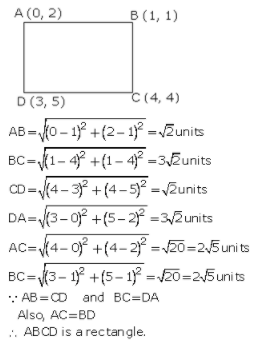
32. Prove that the points (0, 2), (1, 1), (4, 4) and (3, 5) are the vertices of a rectangle.
Answer
33. Prove that the points (a, b), (a + 3, b + 4), (a - 1, b + 7) and (a - 4, b + 3) are the vertices of parallelogram.
Answer

34. Prove that the points (0, - 4), (6, 2), (3, 5) and (- 3, - 1) and (- 3, - 1) are the vertices of rectangle.
Answer

35. ABCD is a square. If the coordinates of A and C are (5, 4) and (-1, 6); find the coordinates of B and D.
Answer

36. PQR is an isosceles triangle. If two of its vertices are P (2, 0) and Q (2, 5), find the coordinates of R. If the length of each of the two equal sides is 3.
Answer

dlt25101733355133835279">
37. ABC is an equilateral triangle. If the coordinates of A and B are (1, 1) and (- 1, - 1), find the coordinates of C.
Answer

Exercise 12.2
1. Find the coordinates of a point P which divides the line segment joining
(a) A (3, - 3) and B (6, 9) in the ratio 1 : 2.
(b) M (- 4, - 5) and N (3, 2) in the ratio 2 : 5.
(c) S (2, 6) and R (9, - 8) in the ratio 3 : 4.
(d) D (- 7, 9) and E (15, -2) in the ratio 3 : 4.
(e) A (- 8, - 5) and B (7, 10) in the ratio 2 : 3.
Answer
(a)

2. Find the points of trisection of the segment joining A (- 3, 7) and B (3, - 2).
Answer

3. Find the coordinates of the points of trisection of the line segment joining the points (3, - 3) and (6, 9).
Answer

4. Find the ratio in which the point P (2, 4) divides the line joining points (- 3, 1) and (7, 6).
Answer

5. Find the ratio in which the point R (1, 5) divides the line segment joining the points S (- 2, - 1) and T (5, 13).
Answer

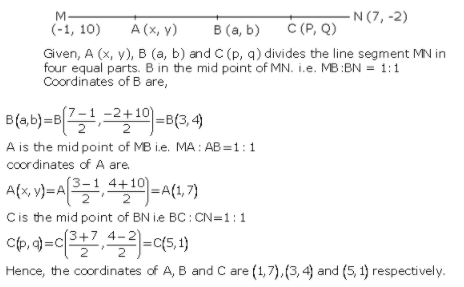
6. The points A, B and C divides the line segment MN in four equal parts. The coordinates of M and N are (- 1, 10) and (7, - 2) respectively. Find the coordinates of A, B and C.
Answer
7. Find the ratio in which the line segment joining A (2, - 3) and B (5, 6) is divide by the x-axis.
Answer

8. Find the ratio in which the line segment joining P (4, - 6) and Q (- 3, 8) is divided by the line y = 0.
Answer

9. In what ratio is the line joining (2, - 1) and (- 5, 6) divided by the y-axis ?
Answer

10. In what ratio is the line joining (2, - 4) and (- 3, 6) divided by the line y = 0 ?
Answer

11. Find the ratio in which the line x = 0 divides the join of (- 4, 7) and (3, 0). Also, find the coordinates of the point of intersection.
Answer

12. In what ratio does the point (1, a) divided the join of (-1, 4) and (4, - 1)? Also, find the value of a.
Answer

13. Find the coordinates of point P which divides line segment joining A (- 3, - 10) and B (3, 2) in such a way that PB : AB = 1.5.
Answer

14. Find the ratio in which the line x = - 2 divides the line segment joining (-6, - 1) and (1, 6). Find the coordinates of the point of intersection.
Answer

15. Find the ratio in which the line y = - 1 divides the line segment joining (6, 5) and (-2, - 11). Find the coordinates of the point of intersection.
Answer

16. The line joining P (- 5, - 6) and Q (3, 2) intersects the y-axis at R. PM and QN are perpendiculars from P and Q on the x-axis. Find the ratio PR : RQ.
Answer

17. B is a point on the line segment AC. The coordinates of A and B are (2, 5) and (1, 0). If AC = 3 AB, find the coordinates of C.
Answer

18. Q is a point on the line segment AB. The coordinates of A and B are (2, 7) and (7, 12) along the line AB so that AQ = 4BQ. Find the coordinates of Q.
Answer

19. The origin O (0, 0), P (- 6, 9) and Q (12, 3) are vertices of triangle OPQ. Point M divides OP in the ratio 1 : 2 and point N divides OQ in the ratio 1 : 2. Find the coordinates of points M and N. Also, show that 3MN = PQ.
Answer

20. A (2, 5), B (- 1, 2) and C (5, 8) are the vertices of triangle ABC. Point P and Q lie on AB and AC respectively, such that AP : PB = AQ : QC = 1 : 2. Calculate the coordinates of P and Q. Also, show that 3PQ = 3C.
Answer

21. A (30, 20) and B (6, - 4) are two fixed points. Find the coordinates of a point P in AB such that 2PB = AP. Also, find the coordinates of some other point Q in AB such that AB = 6AQ.
Answer

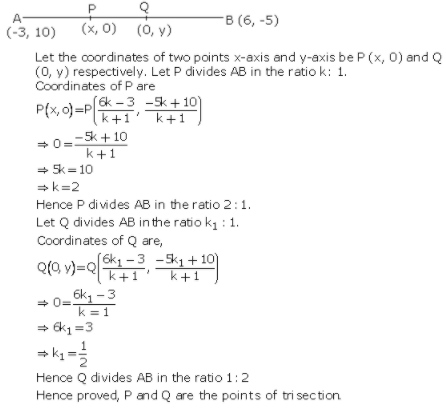
22. Show that he line segment joining the points (-3, 10) and (6, - 5) is trisected by the coordinates axis.
Answer
23. Show that the lines x = 0 and y = 0 trisect the line segment formed by joining the points (-10, - 4) and (5, 8). Find the points trisection.
Answer

Exercise 12.3
1. Find the midpoints of the line segment joining the following pairs points:
(a) (4, 7) and (10, 15)
(b) (-3, 5) and (9, - 9)
(c) (a + b, b - a) and (a - b, a + b)
(d) (3a - 2b, 5a + 7b) and (a + 4b, a - 3b)
(e) (a + 3, 5b), (3a - 1, 3b + 4)
Answer

2. The mid-point of the line segment joining A (- 2, 0) and B (x, y) is P (6, 3). Find the coordinates of B.
Answer

3. A lies on the x-axis and B lies on the y-axis. The midpoint of the line segment AB is (4, - 3). Find the coordinate of A and B.
Answer

4. P, Q and R are collinear such that PQ = QR. If the coordinates of P, Q and R are (- 5, x), (y, 7), (1, - 3) respectively, find the values of x and y.
Answer

5. A, B and C are collinear points such that AB = ½.AC. If the coordinates of A, B and C are (-4, - 4), (-2, b) and (a, 2), find the values of a and b.
Answer

6. The midpoint of the line segment joining the points P (2, m) and Q (n, 4) is R (3, 5). Find the values of m and n.
Answer

7. The midpoint of the line segment joining the points (p, 2) and (3, 6) is (2, q). Find the numerical values of a and b.
Answer

8. The coordinates of the end points of the diameter of a circle are (3, 1) and (7, 11). Find the coordinates of the centre of the circle.
Answer

9. AB is a diameter of a circle with centre O. If the coordinates of A and O are (1, 4) and (3, 6). Find the coordinates of B and the length of the diameter.
Answer

10. A (6,- 2), B (3, - 2) and C (8, 6) are the three vertices of a parallelogram ABCD. Find the coordinates of the fourth vertex C.
Answer

11. P (- 2, 5), Q (3, 6), R (-4, 3) and S (- 9, 2) are the vertices of a quadrilateral. Find the coordinates of the midpoints of the diagonals PR and QS. Give a special name to the quadrilateral.
Answer

12. (4, 2) and (-1, 5) are the adjacent vertices of a parallelogram. (-3, 2) are the coordinates of the points of intersection of its diagonal. Find the coordinates of the other two vertices.
Answer

13. Three consecutive vertices of a parallelogram ABCD are A (8, 5), B (- 7, - 5) and C (- 5, 5). Find the coordinates of the fourth vertex D.
Answer

14. The points (2, - 1), (-1, 4) and (- 2, 2) are midpoints of the sides of a triangle. Find its vertices.
Answer

15. The midpoints of the sides of a triangle are (- 2, 3), (4, - 3), (4, 5), find its vertices.
Answer

16. If (- 3, 2), (1, - 2) and (5, 6) are the midpoints of the sides of a triangle, find the coordinates of the vertices of the triangle.
Answer

17. Find the length of the median through the vertex A of triangle ABC whose vertices A (7, - 3), B (5, 3) and C (3, 1).
Answer

18. Find the centroid of a triangle whose vertices are (3, - 5), (- 7, 4) and (10, - 2).
Answer

19. Two vertices of a triangle are (1, 4) and (3, 1). If the centroid of the triangle is the origin, find the third vertex.
Answer

20. A (4, 2), B (- 2, -6) and C (1, 1) are the vertices of triangle ABC. Find its centroid and the length of the median through C.
Answer

21. A triangle is formed by line segments joining the points (5, 1), (3, 4) and (1, 1). Find the coordinates of the centroid.
Answer

22. The coordinates of the centroid I of triangle PQR are (2, 5). If Q = (-6, 5) and R = (7, 8). Calculate the coordinates of vertex P.
Answer

23. Two vertices of a triangle are (-1, 4) and (5, 2). If the centroid is (0, - 3), find the third vertex.
Answer

24. The midpoints of three sides of a triangle are (1, 2), (2, - 3) and (3, 4). Find the centroid of the triangle.
Answer

25. ABC is a triangle whose vertices are A (- 4, 2), B (0, 2) and C (-2, - 4). D, E and F are the midpoint of the sides BA, CA and AB respectively. Prove that the centroid of the ΔABC coincides with the centroid of the ΔDEF.
Answer

26. Prove that the points A (-5, 4), B (- 1, - 2) and C (5, 2) are the vertices of an isosceles right-angled triangle. Find the coordinates of D so that ABCD is a square.
Answer

27. The centre of a circle is (a + 2, a - 1). Find the value of a, given that the circle passes through the points (2, - 2) and (B, - 2).
Answer

28. Let A (- a, 0), B (0, a) and C (α, β) be the vertices of the ΔABC and G be its centroid. Prove that
GA2 + GB2 + GC2 = 1/3(AB2 + BC2 + CA2).
Answer

29. A (2, 5), B (- 2, 4) and C (- 2, 6) are the vertices of a vertices of a triangle ABC. Prove that ABC is an isosceles triangle.
Answer
