ICSE-X-Mathematics
12: Equation of Straight Line Class 10 Maths ML Aggarwal Solutions
Exercise 12.1
1. Find the slope of a line
whose inclination is
(i) 45°
(ii) 30
Answer
(i) tan 45° = 1
(ii) tan 30° =
1/√3
2. Find the inclination of a
line whose gradient is
(i) 1
(ii) √3
(iii) 1/√3
Answer
(i) tan θ = 1 ⇒ θ = 45°
(ii) tan
θ = √3 ⇒ θ = 60°
(iii) tan
θ = 1/√3 ⇒ θ = 30°
3. Find the equation of a
straight line parallel 1 to x-axis is at a distance
(i) 2 units above it
(ii) 3 units below it.
Answer
(i) A
line which is parallel to x-axis is y = a
⇒ y = 2
⇒ y - 2 = 0
(ii) A line which is parallel to x-axis is y = a
⇒ y = -
3
⇒ y + 3
= 0
4. Find the equation of a straight line parallel to
y-axis which is at a distance of :
(i) 3 units to the right.
(ii) 2 units to the left.
Answer
(i) The equation of line parallel
to y-axis is at a distance of 3 units to the right is x = 3
⇒ x - 3
= 0
(ii) The equation of line parallel
to y-axis at a distance of 2 units to the left is x = - 2
⇒ x + 2
= 0
5. Find the equation of a straight line parallel to y-axis and passing through
the point (- 3, 5).
Answer
The equation of the line parallel to y-axis passing through (-3,
5) to x = - 3
⇒ x + 3
= 0
6. Find the equation of a line whose
(i) slope = 3, y-intercept
= - 5
(ii) slope = - (2/7), y-intercept
= 3
(iii) gradient = √3, y-intercept
= - (4/3)
(iv) inclination =
30°, y-intercept = 2
Answer
Equation of a line whose slope and
y-intercept is given is
y = mx + c
where m is the slope and c is the
y-intercept
(i) y = mx + c
⇒ y = 3x
+ (-5)
⇒ y = 3x
- 5
(ii) y = mx + c
⇒ y =
-2/7.x + 3
⇒ 7y = -
21x + 21
⇒ 2x +
7y - 21 = 0
(iii) 
(iv) Inclination = 30°
∴ Slope = tan 30° = 1/√3
∴ Equation
y = mx + c
⇒ y =
1/√3 x + 2
⇒ √3y =
x + 2√3
⇒ x -
√3y + 2√3 = 0
7. Find the slope the y-intercept of the following
lines :
(i) x - 2y - 1 = 0
(ii) 4x - 5y - 9 = - 0
(iii) 3x + 5y + 7 = 0
(iv) x/3 + y/4 = 1
(v) y - 3 = 0
(vi) x - 3 = 0
Answer
We know that in the equation
y = mx + c, m is the slope and c is
the y-intercept.
Now using this, we find,
(i) x - 2y - 1 = 0
⇒ x - 1
= 2y
⇒ 2y = x
- 1
⇒ y =
1/2 x - 1/2
Here, slope = 1/2 and y-intercept =
-1/2
(ii) 4x - 5y - 9 = 0
⇒ 4x - 9
= 5y
⇒ 5y =
4x - 9
⇒ y =
4/5 x - 9/5
Here, slope = 4/5 and intercept =
-9/5
(iii) 3x + 5y + 7 = 0
⇒ 5y = - 3x - 7
⇒ y =
-3/5 x - 7/5
Here, slope = -3/5 and y-intercept =
-7/5
(iv) x/3 + y/4 = 1
⇒ 4x +
3y = 12
⇒ 3y = -
4x + 12
⇒ y =
-4/3.x + 12/3
⇒ y =
-4/3 x + 4
Here, slope = -4/3 and y-intercept =
4
(v) y - 3 = 0
⇒ y = 3
⇒ y = 0, x + 3
Here, slope = 0 and y-intercept = 3
(vi) x - 3 = 0
Here in this equation, slope cannot
be defined and does not meet y-axis.
8. The equation of the line PQ is 3y - 3x + 7 = 0
(i) Write down the slope of the line PQ.
(ii) Calculate the angle that the PQ makes with the positive
direction of x-axis.
Answer
Equation of line PQ is 3y - 3x + 7
= 0
Writing in form of y = mx + c
3y = 3x - 7
⇒ y =
3x/3 - 7/3
⇒ y = x
- 7/3
(i) Here slope = l
(ii) ∴ Angle which makes PQ with x-axis
is Q.
But tan θ = 1
∴ θ = 45°
9. The given figure
represents the line y = x + 1 and y = √3x - 1. Write down the angles which the
lines make with the positive direction of the x-axis. Hence determine θ. 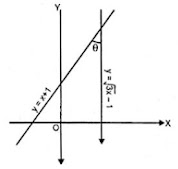
Answer
Slope of
the line y = x + 1 after comparing it with y = mx + c, m = 1
⇒ tan θ = 1
⇒ θ = 45°
and slope
of line y = √3x - 1
m = √3
⇒ tan θ = √3
⇒ θ = 60°
Now in ∆
formed by the given two lines and x-axis.
Ext.
angle = Sum of interior opposite angle.
⇒ 60° = θ + 45°
⇒ θ = 60°
- 45°
= 15°
10. Find the value of p, given that the line y/2 = x
- p passes through the point (- 4, 4).
Answer
Equation of line is y/2 = x - p
It passes through the points (- 4,
4) and it will satisfy the equation
⇒ 4/2 =
- 4 - p
⇒ 2 = -
4 - p
⇒ p = -
4 - 2
⇒ p = -
6
Hence, p = - 6
11. Find the value of p, given that the line y/2 = x
- p passes through the point (-4, 4).
Answer
Equation of line is y/2 = x - p
It passes through the points (- 4,
4) and it will satisfy the equation
⇒ 4/2 =
-4 - p
⇒ 2 = -4 - p
⇒ p = -4 - 2
⇒ p = -6
Hence, p = - 6
11. Given that (a, 2a) lies on the line y/2 = 3x - 6. Find the value of a.
Answer
∵ Point (a, 2a) lies on the line
y/2 = 3x - 6
∴ this point will satisfy the equation
∴ 2a/2 = 3
(a) - 6
⇒ a = 3a - 6
- 3a + a = - 6
⇒ - 2a = - 6
⇒ a = -6/-2
∴ a = 3
12. The graph of the equation y = mx + c passes through the points (1, 4) and (-2, -5). Determine the values of m and c.
Answer
Equation of the line is y = mx + c
∴ It passes through the points (1, 4)
∴ 4 = m×1 + c
⇒ 4 = m + c
Hence, m + c = 4 ...(i)
Again it passes through the point (- 2, - 5)
∴ 5 = m(-2) + c
⇒ 5 = -2m + c
So, 2m - c = 5 ...(ii)
Adding (i) and (iii)
3m = 9
⇒ m = 3
Substituting the value of m in (i)
3 + c = 4
⇒ c = 4 - 3 = 1
Hence, m = 3, c = 1
13. Find the equation of the line passing through the point (2, -5) and making an intercept of -3 on the y-axis.
Answer
∴ The line intersects y-axis making an intercept of -3
∴ The co-ordinates of point of intersect will be (0, - 3)
Now the slope of line (m) = (y2 - y1)/(x2 - x1)
= (-3+5)/(0 - 2)
= 2/-2
= - 1
∴ Equation of the line will be,
y - y1 = m(x - x1)
⇒ y - (-5) = -1(x - 2)
⇒ y + 5 = -x + 2
⇒ x + y + 5 - 2 = 0
⇒ x + y + 3 = 0
14. Find the equation of a straight line passing through (- 1, 2) and whose slope is 2/5.
Answer
Equation of the line will be
y - y1 = m(x - x1)
y - 2 = 2/5(x + 1)
⇒ 5y - 10 = 2x + 2
So, 2x - 5y + 2 + 10 = 0
Hence 2x - 5y + 12 = 0
15. Find the equation of a straight line whose inclination is 60° and which passes through the point (0, -3).
Answer
The equation of line whose slope is wand passes through a given point is y - y1 = m(x - x1)
Here m = tan 60° = √3 and point is (0, - 3)
∴ y + 3 = √3 (x - 0)
⇒ y + 3 = √3x
⇒ √3x - y - 3 = 0
16. Find the gradient of a line passing through the following pairs of points.
(i) (0, -2), (3, 4)
(ii) (3, -7), (-1, 8)
Answer
m = (y2 - y1)/(x2 - x1)
Given
(i) (0, - 2), (3, 4)
(ii) (3, - 7), (- 1, 8)
(i) m = (4 + 2)/(3 - 0) = 6/3 = 2
∴ gradient = 2
(ii) m = (8 + 7)/(-1 - 3) = 15/-4
∴ gradient = -(15/4)
17. The coordinates of two points E and F are (0, 4) and (3, 7) respectively. Find:
(i) The gradient of EF
(ii) The equation of EF
(iii) The coordinates of the point where the line EF intersects the x-axis.
Answer
Co-ordinates of points E (0, 4) and F (3, 7) are given, then
(i) The gradient of EF
∴ gradient (m) = (y2 - y1)/(x2 - x1)
= (7 - 4)/(3 - 0)
= 3/3
= 1
(ii) Equation of line EF,
y - y1 = m(x - x1)
⇒ y - 7 = 1(x - 3)
⇒ y - 7 = x - 3
⇒ x - y - 3 + 7 = 0
⇒ x - y + 4 = 0
(iii) Co-ordinates of point of intersection of EF and the x-axis will be y = 0,
Substitutes the value y in the above equation x - y + 4 = 0
⇒ x - 0 + 4 = 0 (∵ y = 0)
⇒ x = - 4
Hence co-ordinates are (- 4, 0)
18. Find the intercepts made by the line 2x - 3y + 12 = 0 on the co-ordinate axis.
Answer
Putting y = 0, we will get the intercept made on x-axis,
2x - 3y + 12 = 0
⇒ 2x - 3×0 + 12 = 0
⇒ 2x - 0 + 2 = 0
⇒ 2x = - 12
And x = - 6
And putting x = 0, we get the intercepts made on y-axis,
2x - 3y + 12 = 0
⇒ 2 × 0 - 3y + 12 = 0
⇒ -3y = - 12
⇒ y = -12/-3
= 4
19. Find the equation of the line passing through the points P (5, 1) and Q (1, -1). Hence, show that the points P, Q and R (11, 4) are collinear.
Answer
The two given points are P (5, 1), Q (1, -1).
∴ Slope of the line (m) = (y2 - y1)/(x2 - x1) = (- 1 - 1)/(1 - 5)
= -2/-4
= 1/2
Equation of the line,
y - y1 = m(x - x1)
⇒ y + 1 = 1/2(x-1)
⇒ 2y + 2 = x - 1
⇒ x - 2y - 1 - 2 = 0
⇒ x - 2y - 3 = 0
If point R (11, 4) be on it, then it will satisfy it.
Now substituting the value of x and y in
11 - 2×4 - 3
= 11 - 8 - 3
= 11 - 11
= 0
∴ R satisfies it.
Hence P, Q and R are collinear.
20. Find the value of ‘a’ for which the following points A (a, 3), B (2, 1) and C (5, a) are collinear. Hence find the equation of the line.
Answer
Given that
A (a, 3), B (2, 1) and C (5, a) are collinear.
Slope of AB = Slope of BC
⇒ (1 - 3)/(2 - a) = (a - 1)/(5 - 2)
⇒ -2/(2 - a) = (a - 1)/3
⇒ -6 = (a - 1)(2 - a) (Cross-multiplication)
⇒ -6 = 2a - a2 - 2 + a
⇒ -6 = 3a - a2 - 2
⇒ a2 - 3a + 2 - 6 = 0
⇒ a2 - 3a - 4 = 0
⇒ a2 - 4a + a - 4 = 0
⇒ a(a - 4) + 1(a - 4) = 0
⇒ (a + 1)(a - 4) = 0
⇒ a = -1, or a = 4
a = - 1 (∵ does not satisfy the equation)
∴ a = 4
Slope of BC = (a-1)/(5-2)
= (4-1)/3
= 3/3
= 1 m
Equation of BC ; (y-1) = 1(x-2)
y - 1 = x - 2
⇒ x - y = -1 + 2
⇒ x - y = 1
21. Use a graph paper for this question. The graph of a linear equation in x and y, passes through A (- 1, - 1) and B (2, 5). From your graph, find the values of h and k, if the line passes through (h, 4) and (1/2, k).
Answer
Points (h, 4) and (1/2, k) lie on the line passing through A (- 1, - 1) and B (2, 5)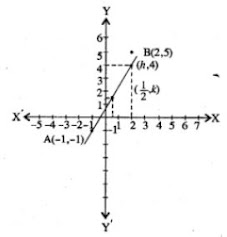
From your graph, we see that h = (3/2) and k = 2.
22. ABCD is a parallelogram where A (x, y), B (5, 8), C (4, 7) and D (2, -4). Find
(i) the coordinates of A
(ii) the equation of the diagonal BD.
Answer
Given that
ABCD is a parallelogram where A (x, y), B (5, 8), C (4, 7) and D (2, - 4).
(i) 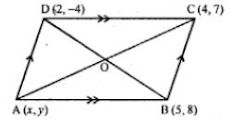
Co-ordinates of O = {(5+2)/2, (8-1 4)/2} = (3.5, 2)
For the line AC
3.5 = (x + 4)/2
2 = (y + 7)/2
⇒ x + 4 = 7
⇒ y + 7 = 4
⇒ x = 7 - 4 = 3
⇒ y = 4 - 7 = - 3
x = 3, y = - 3
Thus, the coordinates of A are (3, - 3)
(ii) Equation of diagonal BD is given by
y - 8 = {(- 4 - 8)/(2 - 5)}.(x - 5)
⇒ y - 8 = {(-12)/(-3)}.(x - 5)
⇒ y - 8 = 4x - 20
⇒ 4x - y - 12 = 0
23. In ∆ABC, A (3, 5), B (7, 8) and C (1, - 10). Find the equation of the median through A.
Answer
AD is median
⇒ D is mid point of BC
∴ D is (7+1)/2, (8-10)/2}
i.e., (4, -1)
Slope of AD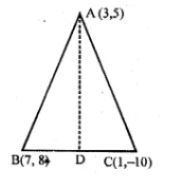
m = (y2 - y1)/(x2 - x1)
= (5+1)/(3-4) = 6/-1 = - 6
∴ Equation of AD
y - y1 = m(x - x1)
⇒ y + 1 = - 6(x - 4)
⇒ y + 1 = - 6x + 24
⇒ y + 6x = - 1 + 24
⇒ 6x + y = 23
24. Find the equation of a line passing through the point (-2, 3) and having x-intercept 4 units.
Answer
x-intercept = 4
∴ Co-ordinates of the point will be (4, 0)
Now slope of the line passing through the points (- 2, 3) and (4, 0)
(m) = (y2 - y1)/(x2 - x1)
= (0 - 3)/(4 + 2)
= - 3/6
= - (1/2)
∴ Equation of the line will be y - y1 = m(x - x1)
⇒ y - 0 = - {1/2(x - 4)}
⇒ 2y = - x + 4
⇒ x + 2y = 4
or, x + 2y - 4 = 0
25. Find the equation of the line whose x-intercept is 6 and y-intercept is - 4.
Answer
x-intercept = 6
∴ The line will pass through the point (6, 0)
y - intercept = - 4
⇒ c = - 4
∴ The line will pass through the point (0, - 4)
Now m = (y2 - y1)/(x2 - x1)
= (-4-0)/(0-6)
= -4/-6
= 2/3
∴ Equation of line will be y = mx + c
⇒ y = 2/3 x + (-4) = 2/3 x - 4
⇒ 3y = 2x - 12
⇒ 2x - 3y = 12
26. Write down the equation of the line whose gradient is 1/2 and which passes through P where P divides the line segment joining A (- 2, 6) and B (3, - 4) in the ratio 2 : 3.
Answer
P divides the line segment joining the points A (- 2, 6) and (3, - 4) in the ratio 2 : 3.
∴ Co-ordinates of P will be
x = (m1x2 + m2x1)/(m1 + m2)
= {2×3 + 3×(-2)}/(2+3)
= (6 - 6)/5
= 0/5
= 0
y = (m1y2 + m2y1)/(m1 + m2)
= {2×(-4) + 3×6}/(2 + 3)
= (- 8 + 18)/5
= 10/5
= 2
∴ Co-ordinates are (0, 2)
Now slope (m) of the line passing through (0, 2) = 3/2
∴ Equation of the line will be
y - y1 = m(x - x1)
⇒ y - 2 = 3/2 (x - 0)
⇒ 2y - 4 = 3x
⇒ 3x - 2y + 4 = 0
27. Find the equation of the line passing through the point (1, 4) and intersecting the line x - 2y - 11 = 0 on the y-axis.
Answer
Line x - 2y - 11 = 0 passes through y-axis
x = 0,
Now substituting the value of x in the equation x - 2y - 11 = 0
∴ - 2y - 11 = 0
⇒ - 2y = 11
⇒ y = - (11/2)
∴ Co-ordinates of point will be (0, - 11/2)
Now slope of the line joining the points (1, 4) and (0, - 11/2)
m = (y2 - y1)/(x2 - x1) = (- 11/2 - 4)/(0-1)
= (-19/2)/(-1)
= 19/2
And equation of the line will be
y - y1 = m(x - x1)
⇒ y + 11/2 = 19/2×(x - 0)
⇒ 2y + 11 = 19x
⇒ 19x - 2y - 11 = 0
28. Find the equation of the straight line containing the point (3, 2) and making positive equal intercepts on axes.
Answer 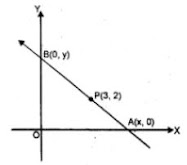
Let the line containing the point P (3, 2) passes through x-axis at A (x, 0) and y-axis at B (0, y)
OA = OB given
∴ x = y
Now slope of the line (m) = (y2 - y1) = (x2 - x1)
= (0 - y)/(x - 0) = - x/x = - 1 (∵ x = y)
∴ Equation of the line will be
y - y1 = m(x - x1)
⇒ y - 2 = -1×(x - 3)
⇒ y - 2 = -x + 3
⇒ x + y - 2 - 3 = 0
⇒ x + y - 5 = 0
⇒ x + y = 5
29. Three vertices of a parallelogram ABCD taken in order are A (3, 6), B (5, 10) and C (3, 2) find :
(i) the coordinates of the fourth vertex D.
(ii) length of diagonal BD.
(iii) equation of side AB of the parallelogram ABCD.
Answer
Three vertices of a parallelogram ABCD taken in order are A (3, 6), B (5, 10) and C (3, 2)
(i) We need to find the co-ordinates of D
We know that the diagonals of a parallelogram bisect each other
Let (x, y) be the co-ordinates of D
∴ Mid-point of diagonal AC = {(3 + 3)/2, (6 + 2)/2}
= (3, 4)
And, mid-point of diagonal BD = {(5 + x)/2, (10 + y)/2}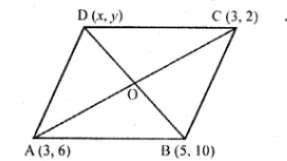
Thus, we have
(5 + x)/2 = 3 and (10 + y)/2 = 4
⇒ 5 + x = 6 and 10 + y = 8
⇒ x = 1 and y = - 2
∴ Co-ordinate of D = (1, - 2)
(ii) 
(iii) Equation of the side joining A (3, 6) and D (1, - 2) is given by
(x - 3)/(3 - 1) = (y - 6)/(6 + 2)
⇒ (x - 3)/2 = (y - 6)/8
⇒ 4(x - 3) = y - 6
⇒ 4x - 12 = y - 6
⇒ 4x - y = 6
Thus, the equation of the side joining A (3, 6) and D (1, - 2) is 4x - y = 6
30. A and B are two points on the x-axis and y-axis respectively. P (2, - 3) is the mid point of AB. Find the 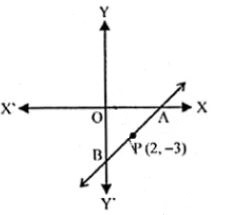
(i) the co-ordinates of A and B.
(ii) the slope of the line AB.
(iii) the equation of the line AB.
Answer
Points A and B on x-axis and y-axis respectively
Let co-ordinates of A be (X, O) and of B be (O, Y)
P (2, - 3) is the midpoint of AB
Then, 2 = (X + O)/2 and - 3 = (O + Y)/2
⇒ x = 4, y = - 6
(i) Hence, co-ordinates of A are (4, 0) and of B are (0, - 6)
(ii) Slope of AB = (y2 - y1)/(x2 - y1)
= (-6 - 0)/(0-4)
= -6/-4
= 3/2
(iii) Equation of AB will be y - y1 = m(x - x1)
⇒ y = (-3) = 3/2 (x - 2) (∵ P lies on it)
⇒ y + 3 = 3/2 (x - 2)
⇒ 2y + 6 = 3x - 6
⇒ 3x - 2y = 6 + 6
⇒ 3x - 2y = 12
31. Find the equations of the diagonals of a rectangle whose sides are x = - 1, x = 2, y = - 2 and y = 6.
Answer
The equations of sides of a rectangle whose equations are
x1 = - 1, x2 = 2, y1 = - 2, y2 = 6.
These lines form a rectangle when they intersect at A, B, C, D respectively.
Co-ordinates of A, B, C and D will be
(- 1, - 2), (2, - 2), (2, 6) and (- 1, 6) respectively.
AC and BD are its diagonals
(i) Slope of the diagonal AC = (y2 - y1)/(x2 - x1)
= (6 + 2)/(2 + 1)
= 8/3
∴ Equation of AC will be
y - y1 = m(x - x1)
= y + 2 = 8/3 (x + 1)
⇒ 3y + 6 = 8x + 8
8x - 3y + 8 - 6 = 0
⇒ 8x - 3y + 2 = 0
32. Find the equation of a straight line passing through the origin and through the point of intersection of the lines 5x + 1y - 3 and 2x - 3y = 7
Answer
5x + 7y = 3 ...(i)
2x - 3y = 7 ...(ii)
Multiply (i) by 3 and (ii) by 7,
15x + 21y = 9
14x - 21y = 49
Adding we get,
29x = 58
⇒ x = 58/29 = 2
Substituting the value of x in (i)
5 × 2 + 7y = 3
⇒ 10 + 7y = 3
⇒ 7y = 3 - 10
⇒ 7y = - 7
⇒ y = - 1
∴ Point of intersection of lines is (2, -1)
Now slope of the line joining the points (2, -1) and the origin (0, 0)
m = (y2 - y1)/(x2 - x1)
= (0 + 1)/(0 - 2)
= 1/2
Equation of line will be
y - y1 = m(x - x1)
⇒ y - 0 = - 1/2×(x - 0)
⇒ 2y = -x
⇒ x + 2y = 0
33. Point A (3, -2) on reflection in the x-axis is mapped as A’ and point B on reflection in the y-axis is mapped onto B’ (- 4, 3).
(i) Write down the co-ordinates of A’ and B.
(ii) Find the slope of the line A’B, hence find its inclination.
Answer
(i) A’ is the image of A (3, -2) on reflection in the x-axis.
∴ Co-ordinates of A’ will be (3, 2)
Again B’ (- 4, 3) in the image of A’, when reflected in the y-axis
∴ Co-ordinates of B will be (4, 3)
(ii) Slope of the line joining, the points A’ (3, 2) and B (4, 3)
= (y2 - y1)/(x2 - x1) = (2 - 3)/(3 - 4)
= -1/-1
= 1
Now tan θ= 1
∴ θ = 45°
Hence angle of inclination = 45°
Exercise 12.2
dlt26111241319475994903">
1. State which one of the following is true : The straight line y = 3x - 5 and 2y = 4x + 7 are
(i) Parallel
(ii) Perpendicular
(iii) neither nor perpendicular.
Answer
Slope of line y = 3x - 5 = 3
And slope of line = 4x + 7
⇒ y = 2x + 7/2 = 2
∴ Slope of both lines are neither equal nor their product is -1.
∴ These line are neither parallel nor perpendicular.
2. If 6x + 5y - 7 = 0 and 2px + 5y + 1 = 0 are parallel lines, find the value of p.
Answer
In equation
6x + 5y - 7 = 0
⇒ 5y = -6x + 7
⇒ y = -(6/5)x + 2/5
∴ Slope (m) = -6/5 ...(i)
Again in equation 2px + 5y + 1 = 0
⇒ 5y = - 2px - 1
⇒ y = -2/5 px - 1/5
∴ Slope (m) = -2/5 p ...(ii)
∵ lines are parallel
m1 = m2
From (i) and (ii) - (6/5) = -(2p/5)
⇒ p = -6/5 × (-5/2)
= 3
3. Lines 2x - by + 5 = 0 and ax + 3y = 2 are parallel. Find the relation connecting a and b.
Answer
In equation 2x - by + 5 = 0
⇒ -by = -2x - 5
⇒ y = 2/b + 5/b
Slope (m) = 2/b
And in equation ax + 3y = 2
⇒ 3y = -ax + 2
⇒ y = -(a/3)×x + 2/3
∴ slope (m2) = -(a/3)
∵ Lines are parallel
∴ m1 = m2
⇒ 2/b = -(a/3)
⇒ - ab = 6
⇒ ab = -6
4. Given that the line y/2 = x - p and the line ax + 5 = 3y are parallel, find the value of a.
Answer
In equation y = x - p
⇒ y = 2x - 2p
Slope (m1) = 2
In equation ax + 5 = 3y
⇒ y = a/3 ×x + 5/3
Slope (m2) = a/3
∵ Lines are parallel
∴ m1 = m2
a/3 = 2
⇒ a = 6
5. If the lines y = 3x + 7 and 2y + px = 3 perpendicular to each other, find the value of p.
Answer
Gradient m1 of the line y = 3x + 7 is 3
2y + px = 3
⇒ y = (-px)/2 + 3/2
Gradient m2 of this line is - (p/2)
Since, the given lines are perpendicular to each other.
∴ m1 × m2 = - 1
⇒ 3 × (-p/2) = - 1
⇒ p = 2/3
6. If the straight lines 3x - 5y + 4 = 0 and 4x - 2y + 5 = 0 are perpendicular to each other.
Answer
Given
In equation, 3x - 5y + 4 = 0
⇒ 5y = kx + 4
⇒ y = k/5 + 4/5
∴ Slope (m1) = k/5
And in equation, 4x - 2y + 5 = 0
⇒ 2y = 4x + 5
⇒ y = 2x + 5/2
Slope (m2) = 2
∵ Lines are perpendicular to each other
∴ m1m2 = - 1
k/5 × 2 = - 1
⇒ k = (-1 × 5)/2
= -5/2
7. If the lines 3x + by + 5 = 0 and ax - 5y + 7 = 0 are perpendicular to each other, find the relation connecting a and b.
Answer
Given,
In the equation 3x + by + 5 = 0
by = -3x - 5
⇒ y = -3/b ×x - 5/b
Slope (m1) = -3/b
And in the equation ax - 5y + 7 = 0
⇒ 5y = ax + 7
⇒ y = a/5 + 7/5
∴ Slope (m2) = a/5
∵ Lines are perpendicular to each other
∴ m1m2 = - 1
⇒ -3/b × a/5 = - 1
⇒ - 3a/5b = - 1
⇒ - 3a = - 5b
⇒ 3a = 5b
8. Is the line through (-2, 3) and (4, 1) perpendicular to the line 3x = y + 1? Does the line 3x = y + 1 bisect the join of (-2, 3) and (4, 1).
Answer
Slope of the line passing through the points (- 2, 3) and (4, 1) = (y2 - y1)/(x2 - x1)
= (1 - 3)/(4 + 2)
= -2/6
= -1/3
Slope of line 3x = y + 1
∵ m1 × m2 = -1/3 × 3 = - 1
∴ These lines are perpendicular to each other
Co-ordinates of mid-point of line joining the points (-2, 3) and (4, 1) will be {(-2+4)/2, (3+1)/2} or (2/2, 4/2) or (1, 2).
If mid-point (1, 2) lies on the line 3x = y + 1 then it will satisfy it.
Now substituting the value of x and y is 3x = y + 1
⇒ 3 ×1 = 2 + 1
⇒ 3 = 3 which is true.
Hence the line 3x = y + 1 bisects the line joining the points (-2, 3), (4, 1).
9. The line through A (- 2, 3) and B (4, b) is perpendicular to the line 2x - 4y = 5. Find the value of b.
Answer
Gradient (m1) of the line passing through the points A (- 2, 3) and B (4, b)
= (b - 3)/(4 + 2)
= (b - 3)/6
Gradient (m2) of the line 2x - 4y = 5
Or y = x/2 - 5/2 is 1/2
Since, the lines are perpendicular to each other,
∴ m1 × m2 = - 1
(b - 3)/6 × 1/2 = - 1
⇒ (b - 3)/12 = - 1
⇒ b - 3 = - 12
⇒ b = - 9
10. If the lines 3x + y = 4, x - ay + 7 = 0 and bx + 2y + 5 = 0 from three consecutive sides of a rectangle, find the value of a and b.
Answer
In the line 3x + y = 4 ...(i)
⇒ y = -3x + 4
Slope (m1) = - 3
In the line x - ay + 7 = 0 ...(ii)
⇒ ay = x + 7
⇒ y = (1/a)×x + 7/a
Slope (m2) = 1/a
And in the line bx + 2y + 5 = 0 ...(iii)
⇒ 2y = -bx - 5
⇒ y = (-b/2) ×x - 5/2
∴ Slope (m3) = - b/2
∵ These are the consecutive three sides of a rectangle.
∴ (i) and (ii) are perpendicular to each other
∴ m1m2 = - 1
⇒ -3 × 1/a = - 1
⇒ -3 = - a
⇒ a = 3
And (i) and (ii) are parallel to each other
∴ m1 = m3
⇒ -3 = (- b)/2
⇒ -b = - 6
⇒ b = 6
Hence a = 3, b = 6
11. Find the equation of a line, which has the y-intercept 4, and is parallel to the line 2x - 3y - 7 = 0. Find the coordinates of the point where it cuts the x-axis.
Answer
In the given line 2x - 3y - 7 = 0
⇒ 3y = 2x - 7
⇒ y = (2/3)×x - 7/3
Hence slope (m1) = 2/3
∴ Equation of the line parallel to the given line will be
y - y1 = m(x - x1)
∵ it passes through (0, 4), then
y - 4 = 2/3(x - 0)
⇒ 3y - 12 = 2x
⇒ 2x - 3y + 12 = 0 ...(i)
Now let it intersect x-axis at (x, y)
∴ y = 0
Substitute the value of y in (i)
2x - 3×0 + 12 = 0
⇒ 2x = - 12
x = - 6
12. Find the equation of a straight line perpendicular to the line 2x + 5y + 7 = 0 and with y-intercept - 3 units.
Answer
In the line 2x + 5y + 7 = 0
⇒ 5y = -2x - 7
⇒ y = (-2/5)×x - 7/5
Here slope (m1) = -(2/5)
Let the slope of the line perpendicular to the given line = m2
∴ m1m2 = - 1
⇒ -(2/5)m2 = - 1
∴ m2 = -1 × -5/2
= 5/2
∵ It makes y-intercept -3 units
∴ The point where it passes = (0, -3)
∴ Equations of the new line,
y - y1 = m(x - x1)
⇒ y - (-3) = 5/2×(x - 0)
⇒ y + 3 = (5/2)×x
⇒ 2y + 6 = 5x
⇒ 5x - 6y - 6 = 0
13. Find the equation of a straight line perpendicular to the line 3x - 4y + 12 = 0 and having same y-intercept as 2x - y + 5 = 0.
Answer
In the given line 3x - 4y + 12 = 0
⇒ 4y = 3x + 12
⇒ y = (3/4)x + 3
Here slope (m1) = 3/4
Let the slope of the line perpendicular to the given line be = m2
∴ m1m2 = - 1
⇒ 3/4m2 = - 1
m2 = -4/3
y-intercept in the equation
2x - y + 5 = 0
⇒ 2×0 - y + 5 = 0
⇒ y = 5
∴ The equation of the line passing through (0, 5) will be
y - y1 = m(x - x1)
⇒ y - 5 = -4/3 ×(x - 0)
⇒ 3y - 15 = - 4x
⇒ 4x + 3y - 15 = 0
14. Find the equation of the line which is parallel to 3x - 2y = - 4 and passes through the point (0, 3).
Answer
In the given line 3x - 2y = - 4
⇒ 2y = 3x + 4
⇒ y = 3/2×x + 2
Here slope (m1) = 3/2
∴ Slope of the line parallel to the given line = 3/2 and passes through (0, 3)
∴ Equation of the line will be y - y1 = m(x - x1)
⇒ y - 3 = 3/2 × (x - 0)
⇒ 2y - 6 = 3x
⇒ 3x - 2y + 6 = 0
15. Find the equation of the line passing through (0, 4) and parallel to the line 3x + 5y + 15 = 0.
Answer
In the given equation 3x + 5y + 15 = 0
⇒ 5y = - 3x - 15
⇒ y = -3/5 ×(x - 3)
How slope (m1) = -3/5
∴ Slope of the line parallel to the given line = -3/5 and passes through the point (0, 4)
∴ Equation of the line will be
y - y1 = m(x - x1)
⇒ y - 4 = -3/5 ×(x - 0)
5y - 20 = -3x
⇒ 3x + 5y - 20 = 0
16. The equation of a line is y = 3x - 5. Write down the slope of this line and the intercept made by it on the y-axis. Hence or otherwise, write down the equation of a line which is parallel to the line and which passes through the point (0, 5).
Answer
In the given line y = 3x - 5
Here slope (m1) = 3
Substituting x = 0, then y = - 5
y- intercept = - 5
The slope of the line parallel to the given line will be 3 and passes through the point (0, 5).
Equation of the line will be
y - y1 = m(x - x1)
⇒ y - 5 = 3(x - 0)
⇒ y - 5 = 3x
⇒ 3x - y + 5 = 0
⇒ y = 3x + 5
17. Write down the equation of the line perpendicular to 3x + 8y = 12 and passing through the point (-1, -2).
Answer
In the given line 3x + 8y = 12
⇒ 8y = - 3x + 12
⇒ y = -3/8 ×x + 12/8
Here slope (m1) = -3/8
Let the slope of the line perpendicular to the given line be = m2
∴ m1m2 = -1
⇒ -3/8 × m2 = -1
m2 = 8/3
∴ Equation of the line where slope is 8/3 and passes through the point (-1, -2) will be
y - y1 = m(x - x1)
⇒ y - (-2) = 8/3 [x - (-1)]
⇒ y + 2 = 8/3(x + 1)
⇒ 3y + 6 = 8x + 8
⇒ 8x - 3y + 8 - 6 = 0
⇒ 8x - 3y + 2 = 0
18. (i) The line 4x - 3y + 12 = 0 meets the x-axis at A. Write down the co-ordinates of A.
(ii) Determine the equation of the line passing through A and perpendicular to 4x - 3y + 12 = 0.
Answer
(i) In the line 4x - 3y + 12 = 0 ...(i)
3y = 4x + 12
⇒ y = 4/3 ×x + 4
Here slope (m1) = 4/3
Let the slope of the line perpendicular to the given line be = m2
∴ m1m2 = - 1
⇒ 4/3 ×m2 = - 1
⇒ m2 = -3/4
Let the point on x-axis be A (x, 0)
∴ Substituting the value of y in (i)
4x - 3×0 + 12 = 0
⇒ 4x + 12 = 0
⇒ 4x = -12
⇒ x = -3
∴ Co-ordinates of A will be (- 3, 0)
(ii) Equation of the line perpendicular to the given line passing through A will be.
y - y1 = m(x - x1)
⇒ y - 0 = -3/4 ×(x + 3)
⇒ 4y = - 3x - 9
⇒ 3x + 4y + 9 = 0
19. Find the equation of the line that is parallel to 2x + 5y - 7 = 0 and passes through the mid-point of the line segment joining the points (2, 7) and (- 4, 1).
Answer
The given line 2x + 5y - 7 = 0
5y = - 2x + 7
⇒ y = -2/5 ×x + 7/5
Here slope (m1) = -2/5
∴ Slope of the line parallel to the given line will be -2/5.
Co-ordinates of the mid-point joining the points (2, 7) and (-4, 1) will be = {(2-4)/2, (7+1)/2} or (-2/2, 8/2) or (-1, 4)
∴ Equation of the line will be,
y - y1 = m(x - x1)
⇒ y - 4 = -2/5 ×(x + 1)
⇒ 5y - 20 = -2x - 2
⇒ 2x + 5y - 20 + 2 = 0
⇒ 2x + 5y - 18 = 0
20. Find the equation of the line that is perpendicular to 3x + 2y - 8 = 0 and passes through the mid-point of the line segment joining the points (5, -2), (2, 2).
Answer
In the given line 3x + 2y - 8 = 0
⇒ 2y = -3x + 8
⇒ y = -3/2 ×x + 4
Here slope (m1) = -3/2
Co-ordinates of the mid-point of the line segment joining the points (5, -2) and (2, 2) will be {(5+2)/2, (-2+2)/2} or (7/2, 0)
And let the slope of the line perpendicular to the given line be = m2
∴ m1m2 = - 1
⇒ -3/2 m2 = - 1
⇒ m2 = 2/3
∴ Equations of the line perpendicular to the given line and passing through (7/2, 0) will be.
y - y1 = m(x - x1)
⇒ y - 0 = 2/3(x - 7/2)
⇒ 3y = 2x - 7
⇒ 2x - 3y - 7 = 0
26. Show that the triangle formed by the points A (1, 3), B (3, - 1) and C (- 5, - 5) is a right angled triangle by using slopes.
Answer
Slope (m1) of line by joining the points A (1, 3), B (3, - 1) = (y2 - y1)/(x2 - x1)
∴ m1 = (-1-3)/(3-1) = -4/2 = - 2
Slope (m2) of the line joining the points B
(3, -1) and C (-5, -5) = (y2-y1)/(x2-x1)
⇒ m2 = (-5+1)/(-5-3)
= (-4/-8)
= 1/2
∴ m1 × m2 = -2 × 1/2 = -1
∴ Lines AB and BC are perpendicular to each other.
Hence ∆ABC is a right angled triangle.
27. Find the equation of the line through the point (- 1, 3) and parallel to the line joining the points (0, - 2) and (4, 5).
Answer
Slope of the line joining the points (0, - 2) and (4, 5) = (y2 - y1)/(x2 - x1)
= (5+2)/(4-0)
= 7/4
Slope of the line parallel to it passing through (-1, 3) = 7/4
And equation of the line
y - y1 = m(x - x1)
⇒ y - 3 = 7/4 ×(x + 1)
⇒ 4y - 12 = 7x + 7
⇒ 7x - 4y + 7 + 12 = 0
⇒ 7x - 4y + 19 = 0
28. A (- 1, 3), B (4, 2) , C (3, - 2) are the vertices of a triangle.
(i) Find the coordinates of the centroid G of the triangle.
(ii) Find the equation of the line through G and parallel to AC.
Answer
Given, A (- 1, 3), B (4, 2), C (3, - 2)
(i) Coordinates of centroid G = {(x1 + x2 + x3)/3, (y1 + y2 + y3)/3}
= {(-1 + 4 + 3)/3, (3 + 2 - 2)/3}
= (6/3, 3/3)
= (2, 1)
So, the coordinates are (2, 1)
(ii) Slope of AC = (y2 - y1)/(x2 - x1) = (-2 -3)/{(3-(-1)}
= -5/4
∴ Slope of the required line (m) = -5/4
Let the equation of the line through G, be y - y1 = m(x - x1)
⇒ y - 1 = -5/4 ×(x-2)
⇒ 4y - 4 = -5x + 10
⇒ 5x + 4y - 14 = 0 which is the required line.
29. The line through P (5, 3) intersects y-axis at Q.
(i) Write the slope of the line.
(ii) Write the equation of the line.
(iii) Find the coordinates of Q. 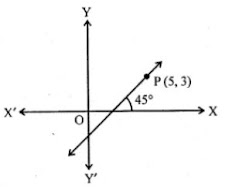
Answer
(i) Here θ = 45°
So, slope of the line = tan θ
= tan 45°
= 1
(ii) Equation of the line through P and Q is y -3 = 1(x - 5)
⇒ y - x + 2 = 0
(iii) Let the coordinates of Q be (0, y)
Then m = (y2 - y1)/(x2 - x1)
⇒ 1 = (3 - y)/(5 - 0)
⇒ 5 = 3 - y
⇒ y = -2
So, coordinates of Q are (0, -2)
30. In the adjoining diagram, write down
(i) the co-ordinates of the points A, B and C.
(ii) The equation of the line through A parallel to BC. 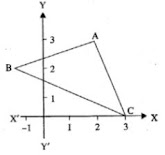
Answer
From the given figure, it is clear that co-ordinates of A are (2, 3) of B are (- 1, 2) and of C are (3, 0).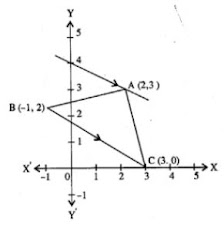
Now slope of BC (m) = (y2 - y1)/(x2 - x1)
= (0 - 2)/{3 - (-1)}
= -2/(3+1)
= -2/4
= -1/2
∴ Slope of line parallel to BC = -1/2
∵ It passes through A (2, 3)
∴ Its equations will be, y - y1 = m(x - x1)
⇒ y - 3 = -1/2 ×(x - 2)
⇒ 2y - 6 = -x + 2
⇒ x + 2y = 2 + 6
⇒ x + 2y = 8
31. Find the equation of the through (0, -3) and perpendicular to the line joining the points (- 3, 2) and (9, 1).
Answer
The slope (m1) of the line joining the points (- 3, 2) and (9, 1)
= (y2 - y1)/(x2 - x1)
= (1 - 2)/(9 + 3)
= -1/12
Let slope of the line perpendicular to the line = m2
∴ m1m2 = -1
⇒ -1/12 × m2 = -1
⇒ m2 = -1 × (-12/1)
= 12
∴ Equation of the line passing through (0, -3) and of slope m2 = 12
y - y1 = m(x - x1)
⇒ y + 3 = 12(x - 0)
⇒ y + 3 = 12x
⇒ 12x - y - 3 = 0
32. The vertices of a triangle are A (10, 4), B (4, - 9) and C (- 2, - 1). Find the equation of the altitude through A. The perpendicular drawn from a vertex of a triangle to the opposite side is called altitude.
Answer
Vertices of ∆ABC are A (10, 4), B (4, - 9) and C (-2, -1)
Slope of the line BC (m1) = (y2 - y1)/(x2 - x1)
= (-1 + 9)/(-2 - 4)
= 8/(-6)
= -4/3
Let the slope of the altitude from A (10, 4) to BC = m2
∴ m1m2 = -1
⇒ -4/3 × m2 = -1
⇒ m2 = -1 ×(-3/4) = 3/4
∴ Equation of the line will be,
y - y1 = m(x - x1)
⇒ y - 4 = 3/4 ×(x - 10)
⇒ 4y - 16 = 3x - 30
⇒ 3x - 4y + 16 - 30 = 0
⇒ 3x - 4y - 14 = 0
33. A (2, - 4), B (3, 3) and C (-1, 5) are the vertices of triangle ABC. Find the equation of :
(i) the median of the triangle through A
(ii) the altitude of the triangle through B
Answer
(i) D is the mid-point of BC
Co-ordinates of D will {(3 - 1)/2, (3 + 5)/2} or {(2/2, 8/2)} or (1, 4)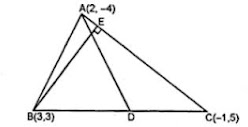
∴ Slope of median AD
(m) = (y2 - y1)/(x2 - x1)
= (4 + 4)/(1 - 2)
= 8/-1
= -8
Then equation of AD will be,
y - y1 = m(x - x1)
⇒ y - 4 = -8 (x - 1)
⇒ y - 4 = -8x + 8
⇒ 8x + y - 4 - 8 = 0
⇒ 8x + y - 12 = 0
(ii) BE is the altitude from B to AC
∴ Slope of AC (m1) = (y2 - y1)/(x2 - x1)
= (5 + 4)/(- 1 - 2)
= 9/-3
= -3
Let slope of BE = m2
But m1m2 = -1
⇒ - 3×m2 = -1
m2 = -1/-3 = 1/3
∴ Equation of BE will be,
y - y1 = m(x - x1)
⇒ y - 3 = 1/3 ×(x - 3)
⇒ 3y - 9 = x - 3
⇒ x - 3y - 3 + 9 = 0
⇒ x - 3y + 6 = 0
34. Find the equation of the right bisector of the line segment joining the points (1, 2) and (5, - 6).
Answer
Slope of the line joining the points (1, 2) and (5, 6)
m1 = (y2 - y1)/(x2 - x1)
= (-6 - 2)/(5 - 1)
= -8/4
= -2
Let m2 be the right bisector of the line
∴ m1m2 = -1
⇒ -2 × m2 = -1
m2 = (-1/-2) = 1/2
mid-point of the line segment joining (1, 2) and (5, -6) will be {(1 + 5)/2, (2 - 6)/2} or (6/2, -4/2) or (3, -2)
∴ Equation of line, the right bisector will be y - y1 = m(x - x1)
⇒ y + 2 = 1/2 ×(x - 3)
⇒ 2y + 4 = x - 3
⇒ x - 2y - 3 - 4 = 0
⇒ x - 2y - 7 = 0
35. Points A and B have coordinates (7, -3) and (1, 9) respectively. Find
(i) the slope of AB.
(ii) the equation of the perpendicular bisector of the line segment AB.
(iii) the value of ‘p’ if (-2, p) lies on it.
Answer
Coordinates of A are (7, -3), of B = (1, 9)
(i) ∴ Slope (m) = (y2 - y1)/(x2 - x1)
= {9 - (-3)}/(1 - 7)
= (9+3)/(1 - 7)
= 12/-6
= -2
(ii) Let PQ is the perpendicular bisector of AB intersecting it at M.
∴ Co-ordinates of M will be = (x1 + x2)/2, (y1 + y2)/2
= (7 + 1)/2, (-3 + 9)/2
= 8/2, 6/2 or (4, 3)
∴ Slope of PQ = 1/2 (m1, m2 = -1)
∴ Equation of PQ = y - y1 = m(x - x1)
⇒ y - 3 = 1/2 ×(x - 4)
⇒ 2y - 6 = x - 4
⇒ x - 2y + 6 - 4 = 0
⇒ x - 2y + 2 = 0
(iii) ∵ Point (-2, p) lies on it
∴ - 2 - 2p + 2 = 0
⇒ -2p + 0 = 0
⇒ -2p = 0
∴ p = 0
36. The points B (1, 3) and D (6, 8) are two opposite vertices of a square ABCD. Find the equation of the diagonal AC.
Answer
Slope of BD (m1) = (y2 - y1)/(x2 - x1)
= (8 - 3)/(6 - 1)
= 5/5
= 1
Diagonal AC is perpendicular bisector of diagonal BD
∴ Slope of AC = -1 (∵ m1m2 = -1)
And co-ordinates of midpoint of BD will be {(1 + 6)/2, (3 + 8)/2} or (7/2, 11/2)
∴ Equation of AC,
y - y1 = m(x - x1)
⇒ y - 11/2 = -1 ×(x - 7/2)
⇒ y - 11/2 = -x + 7/2
⇒ 2y - 11 = -2x + 7
⇒ 2x + 2y - 11 - 7 = 0
⇒ 2x + 2y - 18 = 0
Or x + y - 9 = 0
37. ABCD is a rhombus. The co-ordinates of A and C are (3, 6) and (- 1, 2) respectively. Write down the equation of BD.
Answer
Co-ordinates of A (3, 6), C (-1, 2)
Slope of AC (m1) = (y2 - y1)/(x2 - x1)
= (2 - 6)/(-1 - 3)
= -4/-4
= 1
∴ Slope of BD = - 1 (∵ m1m2 = -1)
And co-ordinates of mid point of AC will be {(3 - 1)/2, (6 + 2)/2} or (2/2, 8/2) or (1, 4)
∴ Equation of BD will be,
y - y1 = m(x - x1)
⇒ y - 4 = -1(x - 1)
⇒ y - 4 = -x + 1
⇒ x + y - 4 - 1 = 0
⇒ x + y - 5 = 0
38. Find the equation of the line passing through the intersection of the lines 4x + 3y = 1 and 5x + 4y = 2 and
(i) parallel to the line x + 2y - 5 = 0
(ii) perpendicular to the x-axis.
Answer
4x + 3y = 1 ...(i)
5x + 4y = 2 ...(ii)
Multiplying (i) by 4 and (ii) by 3
16x + 12y = 4
15x + 12y = 6
Subtracting (i) from (ii),
x = -2
Substituting the value of x in (i)
4(-2) + 3y = 1
⇒ -8 + 3y = 1
⇒ 3y = 1+8 = 9
⇒ y = 9/3 = 3
∴ Point of intersection = (-2, 3)
(i) In the line x + 2y - 5 = 0
⇒ 2y = - x + 5
⇒ y = -1/2 x + 5/2
∵ Slope (m1) = -1/2
∴ Slope of its parallel line = -1/2
And equation of the parallel line y - y1 = m(x - x1)
⇒ y - 3 = -1/2 ×(x + 2)
⇒ 2y - 6 = -x - 2
⇒ x + 2y - 6 + 2 = 0
⇒ x + 2y - 4 = 0
(ii) ∵ Any line perpendicular to x-axis will be parallel to y - axis.
∴ Equation of the line will be
x = a
i.e., x = -2
⇒ x + 2 = 0
39. (i) Write down the co-ordinates of the point P that divides the line joining A (- 4, 1) and B (17, 10) in the ratio 1 : 2.
(ii) Calculate the distance OP where 0 is the origin
(iii) In what ratio does the y-axis divide the line AB?
Answer
(i) Co-ordinate A (-4, 1) and B (17, 10) P divides it in the ratio of 1 : 2
Let the co-ordinates of P will be (x, y)
∴ x = (m1x2 + m2x1)/(m1 + m2)
= {1×17 + 2×(-4)}/(1+2)
= (17 - 8)/3
= 9/3
= 3
y = (m1y2 + m2y1)/(m1 + m2)
= (1×10 + 2×1)/(1 + 2)
= (10+2)/3
= 12/3
= 4
∴ Co-ordinates of P will be (3, 4)
(ii) O is the origin
∴ Distance between O and P
(iii) Let y-axis divides AB in the ratio of m1 : m2
∴ x = (m1x2 + m2x1)/(m1+m2)
⇒ 0 = {m1×17 + m2×(-4)}/(m1+m2)
⇒ 17m1 - 4m2 = 0
⇒ 17m1 = 4m2
⇒ m1/m2 = 4/17
⇒ m1 : m2 = 4 : 17
40. Find the image of the point (1, 2) in the line x - 2y - 7 = 0
Answer
Draw a perpendicular from the point P (1, 2) on the line, x - 2y - 7 = 0
Let P’ is the image of P and let its coordinates are (𝝰, 𝝱) slope of line x - 2y - 7 = 0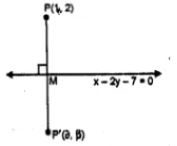
⇒ 2y = x - 7
⇒ y = 1/2 ×x - 7/2 is 1/2
∴ Slope of PP’ = -2 (∵ m1m2 = -1)
∴ Equation of PP’
y - y1 = m(x - x1) = y - 2 = -2×(x - 1)
⇒ y - 2 = -2x + 2
⇒ 2x + y = 2 + 2
⇒ 2x + y = 4
∵ P’ (𝝰, 𝝱) lies on it
∴ 2𝝰 + 𝝱 = 4 ...(i)
∵ P’ is the image of P in the line x - 2y - 7 = 0
∴ the lines bisects PP’ at M.
Or M is the mid-point of PP’
∴ Co-ordinates of M will be {(1+𝝰)/2, (2+𝝱)/2}
∵ M lies on the given line x - 2y - 7 = 0
∴ Substituting the value of x, y
(1+𝝰)/2 - {2(2 + 𝝱)/2} - 7 = 0
⇒ (1+𝝰)/2 - (2 + 𝝱) - 7 = 0
⇒ 1 + 𝝰 - 4 - 2𝝱 - 14 = 0
⇒ 𝝰 - 2𝝱 = 4 + 14 - 1 = 17 ...(ii)
⇒ 𝝰 = 17 + 2𝝱
Substituting the value of 𝝰 in (i)
2×(17 + 2𝝱) + 𝝱 = 4
34 + 4𝝱 + 𝝱 = 4
⇒ 5𝝱 = 4 - 34 = - 30
𝝱 = -30/5
= -6
Substituting the value of 𝝱 in (i)
2𝝰 - 6 = 4
⇒ 2𝝰 = 4 + 6 = 10
𝝰 = 10/2 = 5
∴ Co-ordinates of P’ will be (5, -6)
41. If the line x - 4y - 6 = 0 is the perpendicular bisector of the line segment PQ and the co-ordinates of P are (1, 3), find the co-ordinates of Q.
Answer
Let the co-ordinates of Q be (𝝰, 𝝱) and let the line x - 4y - 6 = 0 is the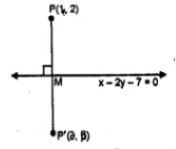
Perpendicular bisector of PQ and it intersects the line at M.
M is the mid point of PQ
Now slope of line x - 4y - 6 = 0
⇒ 4y = x - 6
⇒ y = 1/4 ×x - 6/4 is 1/4
∴ Slope of PQ = -4 (∵m1m2 = -1)
And equation of line PQ
y - y1 = m(x - x1)
⇒ y - 3 = -4 (x - 1)
⇒ y - 3 = -4x + 4
⇒ 4x + y - 3 - 4 = 0
⇒ 4x + y - 7 = 0
⇒ 4x + y = 7
∵ Q (𝝰, 𝝱) lies on it.
∴ 4𝝰 + 𝝱 = 7 ...(i)
Now co-ordinates of M will be {(1 + 𝝰)/2, (3 + 𝝱)/2}
∵ M lies on the line x - 4y - 6 = 0
∴ {(1 + 𝝰)/2 - 4(3+𝝱)/2} - 6 = 0
⇒ 1 + 𝝰 - 4(3 + 𝝱) - 12 = 0
⇒ 1 + 𝝰 - 12 - 4𝝱 - 12 = 0
⇒ 𝝰 - 4𝝱 = 24 - 1 = 23 ...(ii)
Multiply (i) by 4 and (ii) by 1
16𝝰 + 4𝝱 = 28
𝝰 - 4𝝱 = 23
Adding we get,
17𝝰 = 51
⇒ 𝝰 = 51/17 = 3
Substituting the value of 𝝰 in (i)
4×3 + 𝝱 = 7
⇒ 𝝱 = 7 - 12 = -5
∴ Co-ordinates of Q will be (3, -5).
Question 42: QABC is a square, O is the origin and the points A and B are (3, 0) and (p, q). If OABC lies in the first quadrant, find the values of p and q. Also write down the equations of AB and BC.
Answer

∵ OA = AB (sides of a square)
But OB2 = OA2 + AB2
⇒ p2 + q2 = 9 + (3 - p)2 + q2
⇒ p2 + q2 = 9 + 9 + p2 - 6p + q2
6p = 18
⇒ p = 18/6 = 3
Substituting the value of p in (i)
(3)2 + q2 - 6(3) = 0
⇒ 9 + q2 - 18 = 0
⇒ q2 - 9 = 0
⇒ q2 = 9
⇒ q = 3
∴ p = 3, q = 3
∵ Equation AB will be x = 3
⇒ x - 3 = 0
Multiple Choice Questions
Choose the correct answer from the given four options :
1. The slope of a line parallel to y-axis is
(a) 0
(b) 1
(c) -1
(d) not defined
Answer
(d) not defined
Slope of a line parallel to y-axis is not defined.
2. The slope of a line which makes an angle of 30° with the positive direction of x-axis is
(a) 1
(b) 1/√3
(c) √3
(d) -1/√3
Answer
(b) 1/√3
Slope of a line which makes an angle of 30° with positive direction of x-axis = tan 30° =
3. The slope of the line passing through the points (0, -4) and (-6, 2) is
(a) 0
(b) 1
(c) -1
(d) 6
Answer
(c) -1
Slope of the line passing through the points (0, -4) and (-6, 2)
(y2 - y1)/(x2 - x1) = (2 + 4)/(- 6 - 0)
= 6/-6
= -1
4. The slope of the line passing through the points (3, - 2) and (- 7, - 2) is
(a) 0
(b) 1
(c) -1/10
(d) not defined.
Answer
(a) 0
Slope of the line passing through the points (3, -2) and (-7, 2)
(y2 - y1)/(x2 - x1) = (-2+2)/(-7-3)
= (0/-10)
= 0
5. The slope of the line passing through the points (3, -2) and (3, -4) is
(a) -2
(b) 0
(c) 1
(d) not defined
Answer
(d) not defined
Slope of the line passing through the points (3, -2) and (3, -4)
(y2 - y2)/(x2 - x1) = (-4+2)/(3 - 3)
= -2/0
6. The inclination of the line y = √3x - 5 is
(a) 30°
(b) 60°
(c) 45°
(d) 0°
Answer
(b) 60°
The inclination of the line y = √3x - 5 is √3 = tan 60°
= 60°
7. If the slope of the line passing through the points (2, 5) and (k, 3) is 2, then the value of k is
(a) -2
(b) -1
(c) 1
(d) 2
Answer
(c) 1
Slope of the line passing through (2, 5) and (k, 3) is 2, then
m = (y2 - y1)/(x2 - x1)
⇒ 2 = (3 - 5)/(k - 2)
⇒ 2 = (-2)/(k - 2)
⇒ 2k - 4 = -2
⇒ 2k = 4 - 2
= 2
⇒ k = 2/2 = 1
8. The slope of a line parallel to the line passing through the points (0, 6) and (7, 3) is
(a) -7/3
(b) -3/7
(c) -3
(d) 3
Answer
(b) -3/7
Slope of the line parallel to the line passing through (0, 6) and (7, 3)
Slope of the line = (y2 - y1)/(x2 - x1)
= (3 - 6)/(7 - 0)
= -3/7
9. The slope of a line perpendicular to the line passing through the points (2, 5) and (- 3, 6) is
(a) -1/5
(b) 1/5
(c) -5
(d) 5
Answer
(d) 5
Slope of the line joining the points (2, 5), (-3, 6)
= (y2 - y1)/(x2 - x1)
= (6 - 5)/(-3 - 2)
= 1/-5 = -1/5
∴ Slope of the line perpendicular to this line = 5
10. The slope of a line parallel to the line 2x + 3y - 7 = 0 is
(a) -2/3
(b) 2/3
(c) -3/2
(d) 3/2
Answer
(a) -2/3
The slope of a line parallel to the line 2x + 3y - 7 = 0
Slope of the line
3y = - 2x + 7
⇒ y = -2/3 + 7/3
= -2/3
11. The slope of a line perpendicular to the line 3x = 4y + 11 is
(a) 3/4
(b) -3/4
(c) 4/3
(d) -4/3
Answer
(d) -4/3
Slope of a line perpendicular to the line 3x = 4y + 11 is
⇒ 4y = 3x - 11
⇒ y = 3/4 x - 11/4
Slope = 3/4
∴ Slope of the line perpendicular to this line = -4/3 (∵ m × n = -1)
12. If the line 2x + 3y = 5 and kx - 6y = 7 are parallel, then the value of k is
(a) 4
(b) -4
(c) 1/4
(d) - 1/4
Answer
(b) -4
Lines 2x + 3y = 5 and kx - 6y = 7 are parallel
Slope of 2x + 3y = 5
Slope of kx - 6y = 7
⇒ 3y - 2x + 5
⇒ y = -2/3 ×x + 5/3
Slope of 2x + 3y = 5 is -2/3
And slope of kx - 6y = 7
6y = kx - 7
⇒ y = (k/6)×x - 7/6
∴ Slope = k/6
Since both lines are parallel
∴ -2/3 = k/6
⇒ k = (-2 × 6)/3
= -4
13. If the line 3x - 4y + 7 = 0 and 2x + ky + 5 = 0 are perpendicular to each other, then the value of k is
(a) 3/2
(b) -3/2
(c) 2/3
(d) -2/3
Answer
(a) 3/2
Line 3x - 4y + 7 = 0 and 2x + ky + 5 = 0 are perpendicular to each other
∴ Product of their slopes = (m1×m2) = -1
Slope of 3x - 4y + 7 = 0
⇒ 4y = 3x + 7
⇒ y = 3/4 x + 7/4
Slope (m1) = 3/4
And slope of 2x + ky + 5 = 0
ky = -2x - 5
y = (-2/k) ×x - 5/k
∴ Slope (m2) = -2/k
Since the given lines are perpendicular to each other
∴ 3/4 × -2/k = -1
⇒ -6/4k = -1
⇒ -k = -6/4
⇒ k = 3/2
Chapter Test
1. Find the equation of a line whose inclination is 60° and y-intercept is - 4.
Answer
Angle of inclination = 60°
Slope = tan θ
= tan 60°
= √3
Equation of the line will be,
y = mx + c
= √3x + (-4)
⇒ y - √3x - 4
2. Write down the gradient and the intercept on the y-axis of the line 3y + 2x = 12.
Answer
Slope of the line 3y + 2x = 12
⇒ 3y = 12 - 2x
⇒ 3y = - 2x + 12
⇒ y = (-2/3)×x + 4
∴ Slope = -2/3 and y-intercept = 4
3. If the equation of a line is y - √3x + 1, find its inclination.
Answer
In the line
y = √3x + 1
Slope = √3
⇒ tan θ = √3
⇒ θ = 60° (∵ tan 60° = √3)
4. If the line y = mx + c passes through the points (2, -4) and (-3, 1), determine the values of m and c.
Answer
The equation of line mx + c
∵ it passes through (2, -4) and (-3, 1)
Now substituting the value of these points -4 = 2m + c ...(i)
And 1 = -3m + c ...(ii)
Substracting we get,
-5 = 5m
⇒ m = -5/5 = -1
Substituting the value of m in (i)
-4 = 2(-1) + c
⇒ -4 = -2 + c
c = -4 + 2 = -2
∴ m = -1, c = -2
5. If the point (1, 4), (3, -2) and (p, - 5) lie on a straight line, find the value of p.
Answer
Let the points to be A (1, 4), B (3, -2) and C (p, -5) are collinear and let B (3, -2)
Divides AC in the ratio of m1 : m2
∴ x = (m1x2 + m2x1)/(m1 + m2)
⇒ 3 = (m1p + m2×1)/(m1 + m2)
3m1 + 3m2 = m1p + m2
⇒ 3m1 - m1p = m2 - 3m2
⇒ m1(3 - p) = -2 m2
⇒ m1/m2 = - 2/(3 - p) ...(i)
and -2 = {m1(-5) + m2×4}/(m1 + m2)
⇒ -2m1 - 2m2 = - 5m1 + 4m2
⇒ -2m1 + 5m1 = 4 m2 + 2m2
⇒ 3m1 = 6 m2
⇒ m1/m2 = 6/3 = 2 ...(ii)
From (i) and (ii)
-2/(3-p) = 2
⇒ -2 = 6 - 2p
⇒ 2p = 6 + 2 = 8
⇒ p = 8/2 = 4
6. Find the inclination of the line joining the points P (4, 0) and Q (7, 3).
Answer
Slope of the line joining the points P (4, 0) and Q (7, 3)
= (y2 - y1)/(x2 - x1) = (3-0)/(7-4) = 3/3 = 1
∴ tan θ = 1
⇒ θ = 45° (∵ tan 45° = 1)
Hence inclination of line = 45°
7. Find the equation of the line passing through the point of intersection of the lines 2x + y = 5 and x - 2y = 5 and having y-intercept equal to -3/7.
Answer
Equation of lines are
2x + y = 5 ...(i)
x - 2y = 5 ...(ii)
Multiply (i) by 2 and (ii) by 1, we get
4x + 2y = 10
x - 2y = 5
Adding we get,
5x = 15
⇒ x = 15/5 = 3
Substituting the values of x in (i)
2×3 + y = 5
⇒ 6 + y = 5
⇒ y = 5 - 6
= -1
∴ Co-ordinates of point of intersection are (3, -1)
∵ the line passes through (3, -1)
∴ -1 = m×3 - 3/7 (y = mx + c)
3m = -1 + 3/7 = -4/7
m = -4/(7×3)
= -4/21
∴ Equation of line y = -4/21 ×x - 3/7
⇒ 21y = -4x - 9
⇒ 4x + 21y + 9 = 0
8. If point A is reflected in the y-axis, the co-ordinates of its image A1, are (4, - 3).
(i) Find the co-ordinates of A.
(ii) Find the co-ordinates of A2, A3 the images of the points A, A1, Respectively under reflection in the line x = - 2
Answer
(i) ∵ A is reflected in the y-axis and its image is A1 (4, -3)
Co-ordinates of A will be (-4, 3)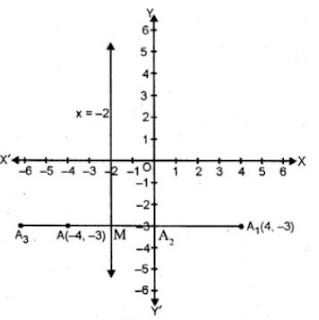
(ii) ∵ A2 is the image of A (-4, -3) in the line
x = -2 which is parallel to y-axis
∴ AA2 is perpendicular to the line x = -2 and this line bisects AA2 at M.
Let co-ordinates of A2 be (𝝰, 𝝱)
∴ 𝝰 = 0 and 𝝱 = -3
∴ Co-ordinates of A2 will be (0, -3)
Again x = -2 is perpendicular bisector of A1, A3 intersecting it at M.
∴ M is mid point of A1A3.
∴ A3M = MA1
∴ Coordinates of A3 will be (-8, -3)
9. If the lines x/3 + y/4 = 7 and 3x + ky = 11 are perpendicular to each other, find the value of k.
Answer
Given equation of lines are x/3 + y/4 = 7
⇒ 4x + 3y = 84
⇒ 3y = -4x + 84
⇒ y = -4/3 ×x + 28 ...(i)
And 3x + ky = 11
⇒ ky = -3x + 11
⇒ y = (-3/k)×x + 11/k ...(ii)
Let slope of line (i) be m1 and of (ii) be m2
∴ m1 = -4/3 and m2 = -(3/k)
∵ These lines are perpendicular to each other
∴ m1m2 = - 1
⇒ -4/3 × (-3/k) = -1
⇒ 4/k = -1
⇒ - k = 4
⇒ k = - 4
10. Write down the equation of a line parallel to x - 2y + 8 = 0 and passing through the point (1, 2).
Answer :
The equation of the line is x - 2y + 8 = 0
⇒ 2y = x + 8
⇒ y = (1/2)×x + 4
∴ Slope of the line = 1/2
∴ Slope of the line parallel to the given line passing through (1, 2) = 1/2
∴ Equation of the lines will be,
y - y1 = m(x - x1)
⇒ y - 2 = 1/2 (x - 1)
⇒ 2y - 4 = x - 1
⇒ x - 2y - 1 + 4 = 0
⇒ x - 2y + 3 = 0
11. Write down the equation of the line passing through (-3, 2) and perpendicular to the line 3y = 5 - x.
Answer
Equation of the line is
3y = 5 - x
⇒ 3y = -x + 5
⇒ y = -(1/3)×x + 5/3
∴ Slope of the line = -1/3
And slope of the line perpendicular to it and passing through (-3, 2) will be = 3
(∵ m1m2 = -1)
∴ Equation of the line will be
y - y1 = m(x - x1)
⇒ y - 2 = 3(x + 3)
⇒ y - 2 = 3x + 9
⇒ 3x - y + 9 + 2 = 0
⇒ 3x - y + 11 = 0
12. Find the equation of the line perpendicular to the line joining the points A (1, 2) and B (6, 7) and passing through the point which divides the line segment AB in the ratio 3 : 2.
Answer
Let slope of the line joining the points A (1, 2) and B (6, 7) be m1
∴ m1 = (y2 - y1)/(x2 - x1)
= (7-2)/(6-1)
= 5/5
= 1
Let m2 be the slope of the line perpendicular to it then m1×m2 = -1
⇒ 1×m2 = -1
∴ m2 = -1
Let the point P (x, y) divides the line AB in the ratio of 3 : 2
∴ x = (m1x2 + m2x1)/(m1 + m2)
= {3×6 + 2×1)/(3 + 2)
= (18+2)/5
= 20/5
= 4
And y = (m1y2 + m2y1)/(m1 + m2)
= (3×7 + 2×2)/(3+2)
= (21+4)/5
= 25/5
= 5
∴ Co-ordinates of P will be (4, 5)
Now equation of the line passing through P and having slope -1
y - y1 = m(x - x1)
⇒ y - 5 = -1(x - 4)
⇒ y - 5 = -x + 4
⇒ x + y - 5 - 4 = 0
⇒ x + y - 9 = 0
13. The points A (7, 3) and C (0, -4) are two opposite vertices of a rhombus ABCD. Find the equation of the diagonal BD.
Answer
Slope of line AC (m1)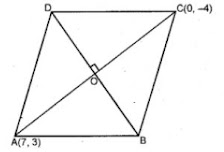
= (y2 - y1)/(x2 - x1)
= (-4 - 3)/(0 - 7)
= -7/-7
= 1
∵ Diagonals of a rhombus bisect each other at right angles
∴ BD is perpendicular to AC
∴ Slope of BD = -1 (∵ m1m2 = -1)
And co-ordinates of O, the mid-point of AC will be {(7 + 0)/2, (3 - 4)/2} or (7/2, -1/2)
∴ Equation of BD will be
y - y1 = m(x - x1)
⇒ y + 1/2 = -1 (x - 7/2)
⇒ y + 1/2 = -x + 7/2
⇒ 2y + 1 = -2x + 7
⇒ 2x + 2y + 1 - 7 = 0
⇒ 2x + 2y - 6 = 0
⇒ x + y - 3 = 0 (Dividing by 2)
14. A straight line passes through P (2, 1) and cuts the axes in points A, B. If BP : PA = 3 : 1, find : 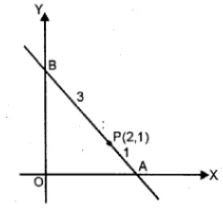
(i) the co-ordinates of A and B.
(ii) the equation of the line AB
Answer
(i) A lies on x-axis and B lies on y-axis
Let co-ordinates of A be (x, 0) and B be (0, y) and P (2, 1) divides BA in the ratio 3:1.
∴ x = (m1x2 + m2x1)/(m1 + m2)
⇒ 2 = (3×x + 1×0)/(3+1)
⇒ 3x/4 = 2
⇒ 3x = 8
⇒ x = 8/3
And y = (m1y2 + m2y1)/(m1 + m2)
⇒ 1 = (3×0 + 1×y)/(3+1)
⇒ y/4 = 1
⇒ y = 4
∴ Co-ordinates of A will be (8/3, 0) and of B will be (0, 4)
(ii) Slope of the line AB = (y2 - y1)/(x2 - x1)
= (4 - 0)/(0 - 8/3)
= {4/(-8/3)}
= - 4 × 3/8
= -3/2
∴ Equation of AB will be
y - y1 = m(x - x1)
⇒ y - 1 = -3/2 (x - 2)
⇒ 2y - 2 = -3x + 6
⇒ 3x + 2y - 2 - 6 = 0
⇒ 3x + 2y - 8 = 0
15. A straight line makes on the co-ordinates axes positive intercepts whose sum is 7. If the lines passes through the point (-3, 8), find its equation.
Answer
Let the line make intercept a and b with the x-axis and y-axis respectively then the line passes through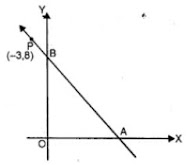
A (a, 0) and B (0, b)
But a + b = 7
b = 7 - a
Now slope of the line = (y2 - y1)/(x2 - x1)
= (b - 0)/(0 - a)
= -b/a
∴ Equation of the line y - y1 = m(x - x1)
⇒ y - 0 = (-b/a).(x - a) ...(i)
∵ the line passes through the point (-3, 8)
∴ 8 - 0 = -b/a(- 3 - a)
= - {(7 - a)/a}×(-3 - a)
⇒ 8a = (7 - a)(3 + a)
⇒ 8a = 21 + 7a - 3a + a2
⇒ a2 + 8a - 7a + 3a - 21 = 0
⇒ a2 + 4a - 21 = 0
⇒ a2 + 7a - 3a - 21 = 0
⇒ a(a + 7) - 3(a + 7) = 0
⇒ (a + 7)(a - 3) = 0
Either a + 7 = 0, then a = -7, which is not possible as it is not positive
Or a - 3 = 0, then a = 3
and b = 7 - 3 = 4
∴ Equation of the line y - 0 = -(b/a)×(x - a)
⇒ y = -4/3(x - 3)
⇒ 3y = -4x + 12
⇒ 4x + 3y - 12 = 0
⇒ 4x + 3y = 12
16. If the coordinates of the vertex A of a square ABCD are (3, - 2) and the equation of diagonal BD is 3x - 7y + 6 = 0, find the equation of the diagonal AC. Also find the co-ordinates of the center of the square.
Answer :
Co-ordinates of A are (3, - 2)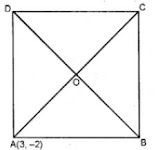
Diagonals AC and BD of the square ABCD bisect each other at right angle at O.
∴ O is the mid-point of AC and BD equation
Diagonals AC and BD of the square ABCD bisect each other at right angle at O.
∴ O is mid-point of AC and BD
Equation of BD is 3x - 7y + 6 = 0
⇒ 7y = 3x + 6
⇒ y = (3/7)×x + 6/7
∴ Slope of BD = 3/7
And slope of AC = -7/3 (∵ m1m2 = -1)
∴ Equation of AC will be
y - y1 = m(x - x1)
⇒ y + 2 = -7/3 (x - 3)
⇒ 3y + 6 = -7x + 21
⇒ 7x + 3y + 6 - 21 = 0
⇒ 7x + 3y - 15 = 0
Now we will find the co-ordinates of O, the points of intersection of AC and BD
We will solve the equations,
3x - 7y = - 6 ...(i)
7x + 3y = 15 ...(ii)
Multiplying (i) by 3 and (ii) by 7, we get,
9x - 21y = - 18 ...(iii)
49x + 21y = 105 ...(iv)
Adding we get,
58x = 87
⇒ x = 87/58 = 3/2
Substituting the value of x in (iii)
9(3/2) - 21y = - 18
⇒ 27/2 - 21y = - 18
21y = 27/2 + 18
= (27 + 36)/2
= 63/2
y = 63/(2×21)
= 3/2
∴ Co-ordinates of O will be (3/2, 3/2)