ICSE-X-Mathematics
Previous Year Paper year:2016
Note: Please signup/signin free to get personalized experience.
Note: Please signup/signin free to get personalized experience.
10 minutes can boost your percentage by 10%
Note: Please signup/signin free to get personalized experience.
- #ICSE Board
Class X Mathematics
Board Question Paper 2016
(Two and a half hours)
Answers to this Paper must be written on the paper provided separately.
You will not be allowed to write during the first 15 minutes.
This time is to be spent in reading the Question Paper.
The time given at the head of this Paper is the time allowed for writing the answers.
Attempt all questions from Section A and any four questions from Section B.
All working, including rough work, must be clearly shown and must be done
on the same sheet as the rest of the answer.
Omission of essential working will result in loss of marks.
The intended marks for questions or parts of questions are given in brackets [ ].
Mathematical tables are provided.
- # [40]Section : AAttempt all questions from this Section.
- #1
- #1-a [3]Using remainder theorem, find the value of k if on dividing ``2x^3 + 3x^2 - kx + 5`` by ``x - 2``,
leaves a remainder 7.Ans : Let ``f(x)=2x^3+3x^2-kx+5 ``
By remainder theorem, when f(x) is divided by (x-2) means x-2=0 , ``\Rightarrow`` x=2 , then the remainder is 7 .
Therefore ``2(2)^3+3(2)^2-k(2)+5 = 7 ``
``\Rightarrow 16+12-2k+5=7 ``
``\Rightarrow 2k = 26 ``
``\Rightarrow k = 13 ``
- #1-b [4]Given A= \begin{bmatrix}2&0\\-1&7 \end{bmatrix} and I= \begin{bmatrix}1 & 0\\ 0 & 1\end{bmatrix} and ``A^2 = 9A + ml``. Find m.Ans : Given ``A = \begin{bmatrix} 2 & 0 \\ -1 & 7 \end{bmatrix} and I = \begin{bmatrix} 1 & 0 \\ 0 & 1 \end{bmatrix}`` and ``A^2=9A+mI ``.
LHS ``= A^2 = \begin{bmatrix} 2 & 0 \\ -1 & 7 \end{bmatrix} \times \begin{bmatrix} 2 & 0 \\ -1 & 7 \end{bmatrix}``
``= \begin{bmatrix} 4 & 0 \\ -2-7 & 0+49 \end{bmatrix} ``
``= \begin{bmatrix} 4 & 0 \\ -9 & 49 \end{bmatrix} ``
``RHS = 9A+mI= 9 \begin{bmatrix} 2 & 0 \\ -1 & 7 \end{bmatrix} + m \begin{bmatrix} 1 & 0 \\ 0 & 1 \end{bmatrix} ``
``= \begin{bmatrix} 18 & 0 \\ -9 & 63 \end{bmatrix}+ \begin{bmatrix} m & 0 \\ 0 & m \end{bmatrix}``
``= \begin{bmatrix} 18+m & 0 \\ -9 & 63+m \end{bmatrix} ``
Since LHS = RHS
``\begin{bmatrix} 4 & 0 \\ -9 & 49 \end{bmatrix}= \begin{bmatrix} 18+m & 0 \\ -9 & 63+m \end{bmatrix}``
``\Rightarrow 4= 18+m \Rightarrow m = -14 ``
Also ``\Rightarrow 49 = 63+m \Rightarrow m = -14 ``
Hence the value of m = -14
- #1-c [3]The mean of following numbers is 68. Find the value of .x..
45, 52, 60, x, 69, 70, 26, 81 and 94
Hence estimate the median.Ans : Mean ``= \frac{Sum \ of \ Variates}{Number \ of \ Variates} ``
``\Rightarrow 68 = \frac{45+52+60+x+69+70+26+81+94}{9} ``
``\Rightarrow 612=497+x ``
``\Rightarrow x = 115 ``
Now arrange the numbers in ascending order we get
26, 45, 52, 60, 69, 70, 81, 94, 115
Number of terms (n) = 9 (odd number of terms)
Median `` = Value \ of \ the \ (\frac{n+1}{2})^th`` terms
= Value ``\ of \ the (\frac{9+1}{2})^{th}`` term
= Value ``\ of \ the \ (5)^{th} = 69`` (median)
- #2Ans : (a) i) Let ``P(6, k)=(x_1, y_1) \ and \ Q(1-3k, 3)= (x_2, y_2) ``
Given: Slope of PQ ``= \frac{1}{2} ``
Formula for slope of PQ = ``\frac{y_2-y_1}{x_2-x_1} ``
``\Rightarrow \frac{3-k}{1-3k-6}= \frac{1}{2} ``
``\Rightarrow \frac{3-k}{-3k-5}= \frac{1}{2} ``
``\Rightarrow 6-2k=-3k-5 ``
``\Rightarrow k = -11 ``
ii) Let ``P(6, k)=(x_1, y_1) \ and \ Q(1-3k, 3)= (x_2, y_2) ``
Given: Slope of ``PQ = \frac{1}{2} ``
Formula for slope of ``PQ = \frac{y_2-y_1}{x_2-x_1} ``
``\Rightarrow \frac{3-k}{1-3k-6}= \frac{1}{2}``
``\Rightarrow \frac{3-k}{-3k-5}= \frac{1}{2} ``
``\Rightarrow 6-2k=-3k-5 ``
``\Rightarrow k = -11 ``
- #2-a [3]The slope of a line joining P(6, k) and Q (1- 3k, 3) is ``\frac12``.
Find
i) k
ii) Midpoint of PQ, using the value of .k. found in (i).
- #2-b [4]Without using trigonometrical tables, evaluate:
$${cosec}^2 57° - tan^2 33° + cos 44°\cdot cosec 46° - \sqrt2 cos45°- tan^2 60°$$Ans : Given:
``Cosec^2 \ 57°-tan^2 \ 33°+cos 44° \ cosec \ 46°-\sqrt{2} cos \ 45°-tan^2 \ 60° ``
``= Cosec^2 \ (90-33)°-tan^2 \ 33°+cos (90-46)° \ cosec \ 46°-\sqrt{2} cos \ 45°-tan^2 \ 60° ``
``= Sec^2 \ 33°-tan^2 \ 33°+sin \ 46° . \frac{1}{ sin \ 46° } -\sqrt{2} . \frac{1}{\sqrt{2}}-(\sqrt{3})^2``
``= 1+1 -1-3 = -2 ``
- #2-c [3]A certain number of metallic cones, each of radius 2 cm and height 3 cm are
melted and recast into a solid sphere of radius 6 cm. Find the number of cones.Ans : Let number of cones = n
Volume of cones = Volume of sphere [Provide Formulas]
``\frac{1}{3} \pi r^2 h \times n = \frac{4}{3} \pi r^3``
``\frac{1}{3} \pi 2^2 \times 3 \times n = \frac{4}{3} \pi 6^3 ``
``\Rightarrow n = \frac{\frac{4}{3} \pi 6^3}{\frac{1}{3} \pi 2^2 \times 3} ``
``\Rightarrow n = \frac{216}{3} = 72 ``
Therefore the number of cones needed is 72
- #3
- #3-a [3]Solve the following inequation, write the solution set and represent it on the
number line.
$$-3(x -7) \ge 15 -7x \gt \frac{x + 1}{3}, x \epsilon R $$Ans : ``-3x(x-7) \geq 15-7x \ge \frac{x+1}{3} ``
``-3x+21 \geq 15-7x \ge \frac{x+1}{3} ``
Therefore we have:
``-3x+21 \geq 15-7x``
``\Rightarrow 4x \geq -6``
``\Rightarrow x \geq -\frac{3}{2} `` . . . . . i)
Also we have
15-7x \ge \frac{x+1}{3}
``\Rightarrow` 45-21x \ge x+1 ``
``\Rightarrow 44 \ge 22x ``
``\Rightarrow 2 \ge x ``. . . . . i)
Combining i) and ii) we get
Solution Set ``=\{x: -\frac{3}{2} \geq x \ge 2 \ and \ x \in R \} ``
- #3-b [4]In the figure given below, AD is a diameter. O is the centre of the circle.
AD is parallel to BC and ∠CBD = 32°. Find:
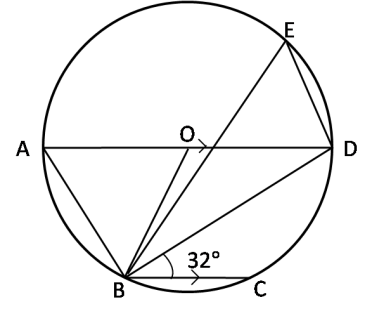 Ans : Given ``AD \parallel BC``
Therefore ``\angle ADB = \angle DBC = 32° `` (alternate angles)
Since OB=OD (radius of the same circle)
Therefore `` \angle OBD = 32° `` (angles opposite to equal side of the triangle are equal)
``\angle AOB =2 \angle ODB = 2 \times 32° `` (angle at the center is twice that subtended at the circumference)
In ``\triangle`` ABC
``\angle ABD = 90°, \angle ADB = 32°``
``\angle BAD = 180-90-32 = 58°`` (sum of the angles of a triangle is 180° )
``\angle BAD = \angle BED`` (angle in the same segment)
Therefore ``\angle BED = 58° ``
- #3-b-i∠OBD
- #3-b-ii∠AOB