ICSE-X-Physics
05: Refraction through a Lens
Note: Please signup/signin free to get personalized experience.
Note: Please signup/signin free to get personalized experience.
10 minutes can boost your percentage by 10%
Note: Please signup/signin free to get personalized experience.
- Qstn #23State the condition for each of the following: (i) a lens has both its focal lengths equal (ii) a ray passes undeviated through the lensAns : 23 (i) If a lens has both its focal length equal medium is same on either side of lens.
(ii) If a ray passes undeviated through the lens it is incident at the optical centre of the lens.
- Qstn #24A parallel oblique beam of light falls on a (i) convex lens, (ii) concave lens. Draw a diagram in each case to show the refraction of light through the lens.Ans : 24
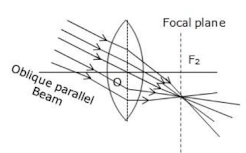
Refraction of an oblique parallel beam by a convex lens.
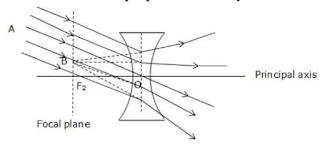
Refraction of an oblique parallel beam by a concave lens
- Qstn #25The diagram alongside shows a lens as a combination of a glass block and two prisms. (i) Name the lens formed by the combination. (ii) what is the rays the line XX' called? (iii) Complete the ray diagram and show the path of the incident ray AB after passing through the lens. (iv) The final emergent ray will either meet XX' at a point or appear to come from a point on XX'. Label the point as F. What is this point called?
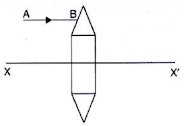 Ans : 25 (i) The combination forms convex lens.
(ii) XX' is known as principal axis.
(iii) The complete diagram is
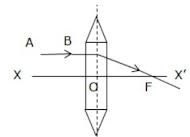
(iv) The point F is called as Focal point or focus.
- Qstn #26The diagram alongside shows a lens as a combination of a glass block and two prisms. (i) Name the lens formed by the combination. (ii) what is the line XX' called? (iii) Complete the path of the incident ray AB after passing through the lens. (iv) The final emergent ray either meets XX' at a point or appears to come from a point on XX'
Label it as F. what is this point called?
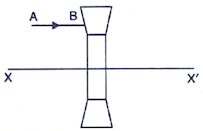 Ans : 26 (i) The combination forms concave lens.
(ii) XX' is known as principal axis.
(iii) Complete diagram is drawn as
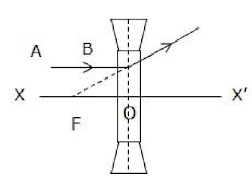
(iv) The point F is called as Focal point or focus.
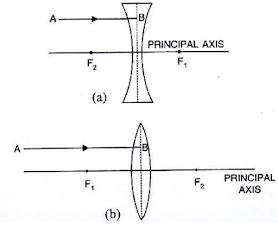
- Qstn #27In Fig., F1 and F2 are the positions of the two foci of the thin lenses shown in diagramAns : 27
- #27-aand (b) draw accurately the path taken by the light ray AB after it emerges from the lens in each diagram
(a) and
(b).
 Ans :
Ans :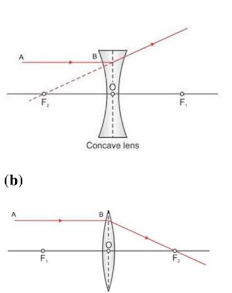
- #28-aand (b) and AB is the incident ray. Compete the diagram to show the path of the ray AB after refraction through the lens in each diagram
(a) and
(b).
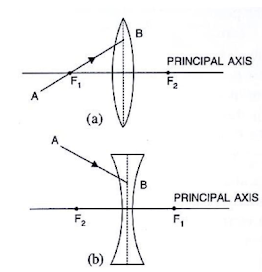 Ans :
Ans :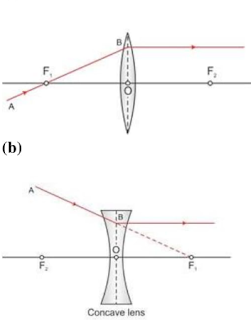
- #29-aIf half part of a convex lens is covered, the focal length ........ . . . . . . . . ... change, but the intensity of image ...................Ans : If half part of a convex lens is covered, the focal length does not change, but the intensity of image decreases.
- #29-bA convex lens is placed in water. Its focal length will ..............Ans : A convex lens is placed in water. Its focal length will increase.
- #29-cThe focal length of a then convex lens is .................. than that of a thick convex lens.Ans : The focal length of a thin convex lens is more than that of a thick convex lens.
Multiple Choice Type
- #Section : B
- Qstn #1A ray of light after refraction through a lens emerges parallel to the principal axis of the lens. The incident ray either passes through or appears to meet at: (a) optical centre (b) first focus (c) Second focus (d) centre of curvature of the first surface.Ans : 1
(b) First focus
- Qstn #2A ray of light incident on a lens parallel to its principal axis, after refraction passes through or appears to come from: (a) its first focus (b) its optical centre (c) its second focus (d) the centre of curvation of its second surfaceAns : 2
(d) its second focus
Exercise 5 B