ICSE-X-Biology
06: The Circulatory System
Note: Please signup/signin free to get personalized experience.
Note: Please signup/signin free to get personalized experience.
10 minutes can boost your percentage by 10%
Note: Please signup/signin free to get personalized experience.
- #5-cThe blood groups of both the donor and recipient must be known before transfusing blood.Ans : During blood transfusion it is important that the blood groups of the donor and the recipient are compatible. In case of an incompatible blood transfusion, the recipient develops antibodies that attack the antigens present on the RBCs of the donor causing the blood cells to clump together which may result in death. The examination of Rh factor is also necessary for the blood transfusion. Therefore, the blood groups of both the donor and recipient must be known before transfusing blood.
- #5-dOnly the veins and not the arteries are provided with valves.Ans : Veins carry the blood from the body part towards the heart while the arteries carry the blood from the heart. Veins carry the blood against the force of gravity. Therefore, only the veins and not the arteries are provided with valves.
- #5-eAtrial wall is less muscular than the ventricular wall.Ans : Atrial wall is less muscular than the ventricular wall because the major function of atria is to receive blood from the body and pump in into very next ventricles. While the ventricles pump the blood out of the heart. Right ventricle to the lungs and the left ventricle to all the body parts.
- #5-fThe arteries are deep seated in the bodyAns : Arteries are responsible to carry oxygenated blood from the heart to the tissues. The blood flows in the artery under high pressure and in spurts. If arteries are located superficially then there is a high possibility of their damage which could lead to a lot of blood loss. To prevent this damage and blood loss, the arteries are deep seated in the body.E. Structure/Application/Skill Type
- #Section : ii
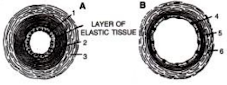
- #1-aIdentify the two kinds of blood vessels A and B.Ans : A is artery, B is vein.
- #1-bname the parts numbers 1 to 6Ans : 1- Endothelium of the artery,
2 - Middle layer of smooth muscles and elastic fibres of the artery, 3 - External layer of connective tissue of the artery, 4 - Endothelium of the vein, 5 - Middle layer of smooth muscles and elastic fibres of the vein,
6 - External layer of connective tissue of the vein.
- #1-cMention any two main differences between A and B.Ans : An artery has thick muscular walls and a narrow lumen. It carries blood away from the heart towards any organ. A vein on the other hand has thin muscular walls and a wider lumen. It carries blood away from an organ towards the heart.
- #2-awhich part (state the number) represents the heart? Give reason in support of your answer.Ans : The structure 3 represents the heart. It forms the centre of double circulation and is located between the liver and the head (as per the diagram). Also, the blood circulation (indicated by 1) begins from heart to lungs.
- #2-bWhich numbers represent the following respectively?
Aorta
Renal Vein
Hepatic portal vein
Pulmonary artery
Stomach
Dorsal aorta
Superior vene cava
 Ans :
Ans :Aorta 5 Hepatic portal vein 7 Pulmonary artery 1 Superior vena cava 9 Renal vein 8 Stomach 10 Dorsal aorta 11
- Qstn #3Given diagram shows a simple diagram of the circulation of blood in a mamma showing the main blood vessels, the heart, lungs and body tissues. The blood vessel, labelled 6, contains deoxygenated blood and the valve leading to it has three semi-lunar pockets.
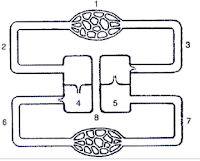
- #3-aName the blood vessels and organs marked by numbers 1 to 8.Ans :
1 Systemic Circulation 2 Vena Cava 3 Aorta 4 Right Ventricle 5 Left Atrium 6 Pulmonary Artery 7 Pulmonary Vein 8 Pulmonary Circulation
- #3-bWhat is meant by the term “double circulation' of blood in mammals? (c) what is diastole? [There is an “error” in the diagram. According to the usual practice the pulmonary (lung) circulation is shown upward and the systemic downward, but here it is reversed].Ans : Blood flows twice in the heart before it completes one full round. The full round thus includes pulmonary and systemic circulation. For this reason, the blood circulation in the human body is called double circulation.
The relaxation of muscles of ventricles or auricles is known as diastole.